
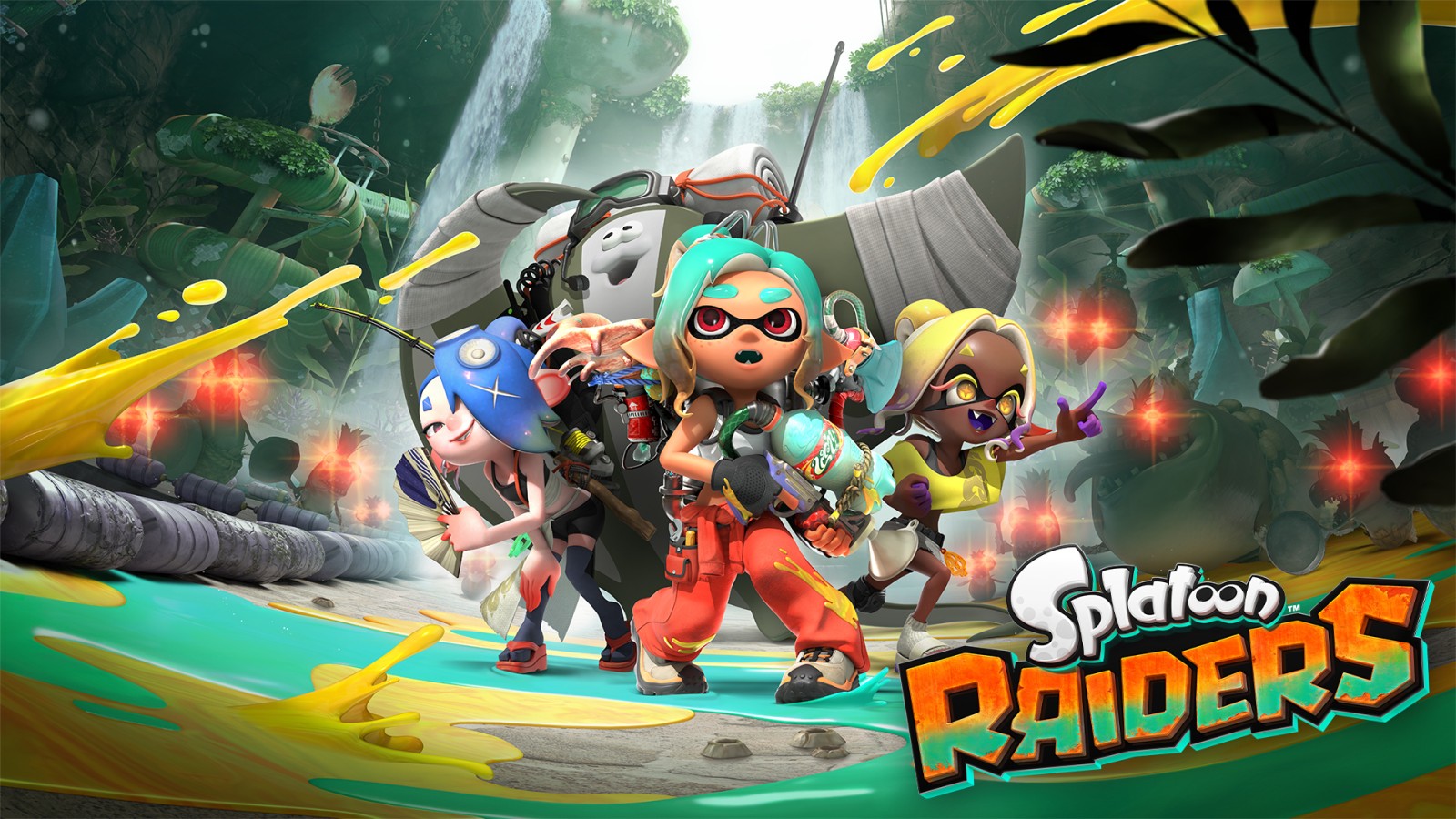
As I’ve said previously, I am a huge fan of that Splatoon franchise… though only in terms of the multiplayer. While I have played a bit of the single player mode in each game, I’ve never been a massive fan of them, much preferring to duke it out with fellow Squidlings than play around in obstacle courses. And I know I’m not the only one, so see my surprise when I heard that they were making a brand new single player Splatoon game. While first hearing about it I was skeptical, I was also mildly curious about it. And being the big Splatoon fan that I am, I felt morally obligated to at least give it a try. Splatoon Raiders was developed and published by Nintendo as a Nintendo Switch 2 exclusive and was released on the 23rd July 2026.
Story
This game follows the idol group Deep Cut, consisting of Shiver, Frye and Big Man, who apparently have a side gig as treasure hunters. They are flying in a helicopter towards the recently resurfaced Spirhalite Islands, in hopes of pillaging the place of whatever loot they can find. However, a mishap during flight, forcing the pilot to make a crash landing. A month goes by and we find the group stranded on a ship made out of junk constructed by the pilot, who they now call the Mechanic (who you play as). During an expedition where the Mechanic goes to look for more building materials, they come upon a strange looking robot. After returning and fixing it up, it displays the location of various treasures spread throughout the island. Deep Cut sees a golden opportunity in this, deciding to use the robot to resume their plans of looting and plunder. It is now up to the mechanic, with the aid of Deep Cut to traverse the island, battle its inhabitants and seek out that sweet loot.
The story is fine. This really isn’t a story focused game, it being told through the occasional conversation between the members of Deep Cut. There is some mystery to the island, mostly with particular relics, which can be interesting. Though ultimately, the game really doesn’t have that heavy of a focus on its narrative.
Presentation
Despite being on a more powerful console, graphically this game doesn’t look that much different than Splatoon 3. There is a slight improvement to characters and environments, though you wouldn’t notice unless you were really looking. It’s not like there’s much to improve upon as Splatoon 3 already looked very good and I’m not sure what could be changed or added to make it look better, so there isn’t really anything to complain about there.
Environments, if I’m being honest, are kind of boring. Now I’m not expecting anything as expressive or full of personality as the multiplayer stages in previous games, but I was expecting a little more than plain environments that feel more like level set pieces rather than actually livable areas. None of the levels really stand out compared to one another, and because of that, none of them end up being particularly memorable.
This game runs really well both docked and handheld. It can get very chaotic at times, with what feels like dozens of enemies on screen at once, each throwing different kinds of attacks at you, and yet I never once noticed a drop in framerate at all. If that doesn’t convey the power of the Switch 2 then I don’t know what will.
If there was anything that disappointed me with this game, it was the soundtrack. Splatoon is known to have very upbeat and loud soundtracks that perfectly match the mayhem going on in the game. And yes I would be lying if I said that there weren’t songs that matched those games, the music playing during the final boss comes to mind. But most of the songs really don’t work for me, having a jungle sound that fits more in a Donkey Kong game than Splatoon. And even then, some of the songs sound bloated, like there are too many sounds happening at once, making me feel overwhelmed when listening to it. Personally, I’d take any of the previous game’s soundtracks over this one in a heartbeat.
Level Design
If you’re expecting this game to play like the single player mode of the normal Splatoon games, you’d be mostly mistaken. I see those levels more as obstacle courses than anything else, almost treating them like training for the multiplayer portion. This game’s levels revolve way more on fighting Salmonids than platforming.
There are three main types of dungeons that you’ll be playing through,Treasure Hunts, Shard Mining, and Multilevel dungeons. The Treasure Hunts will feel most like the single player modes in other Splatoon games. With these you go down linear pathways and defeat enemies that get in your way in an attempt to obtain the treasure at the end. At certain points you will be forced to defeat a band of Salmonids to be able to move on, with you being rewarded with a crystal that you can mine for shards – two small ones mid level and one large one at the end. It’s also here that you’ll do most of the platforming, nothing complex, mostly cliffs or rail obstacles, but still something there for those who did enjoy the previous games’ obstacle courses. These levels are the simplest, but they are also my favourite type. It was honestly fun to run through them as fast as possible, it was also here that you got to discover new enemy types and learn to defeat them before the game goes relentless with them.
The Shard Mining Dungeons are way more open than the last, giving you a giant island to wander around. Spread across this island are a series of crystals guarded by bands of Salmonids, defeat them and you’ll be able to mine the crystals for shards. Now, despite mining crystals being the main gimmick of these dungeons, collecting them isn’t what your main goal in the game is, in fact it’s actually the gathering of Power Eggs dropped by enemies. You see, to beat the level you have to mine a giant crystal at its starting point, and to do so requires a large amount of Power Eggs to make the robot’s drill strong enough to break it – arguably the other crystals are optional. These were probably my least favourite levels in the game, though that doesn’t mean I disliked them, I just found the act of exploring the island looking for the crystals to be a bit of a slog at times. Crystal shards are an important currency in this game, therefore you’ll no doubt be coming back to these to do a bit of grinding. Especially as the crystals and enemies will respawn after a while, so you could arguably stay here for hours if you’re patient enough.
The final level is what I call the Multilevel Dungeons. These ones are where the game goes from a little crazy but manageable, to down right psychotic. Your task in these is very simple, kill Salmonids until you collect enough Power Eggs to move on. Sometimes these will only have one floor, though oftentimes you’ll have to descend and repeat this two more times. These dungeons can get ludicrously difficult if you’re not careful, it is very easy for you to get bombarded with enemies, spraying their own puke coloured ink and giving you little to no room to get away. Some of these dungeons will only have you battling one type of enemy, which can make gathering Power Eggs really easy or rage-inducing depending on who you’re up against. These dungeons and I have a very love-hate relationship, on one hand they can be very fun and satisfying to play, but on the other hand they can feel borderline unfair at times, to the point where beating them feels like pure luck.
When you’re not battling your way through armies of Salmonids, you’ll most often be resting on the hideout ship. It’s here that you’ll be preparing for upcoming hunts by doing things like upgrading weapons and your tank – giving you more health or letting you deal more damage amongst other things. You’ll also be able to see what relics and treasures you’ve gathered up and do research on enemies and lore found on the scrolls you can collect.
Combat and Enemy Design
Combat is, well, pretty much the exact same as any other Splatoon game. Using an assortment of weapons, like guns, bows and arrows and giant paint rollers, you’ll have to spray multicoloured ink onto your enemies while ensuring the terrain around you is covered in ink of your colour instead of the Salmonids. Of course, this time around covering the stages with your ink isn’t as important, as Turf Wars aren’t a thing this time around. It’s still important as it makes traversal easier and refills your ink tank once you’ve run out, but you won’t find yourself doing it as relentlessly this time around.
Your weapon pool consists of the exact same types as you had in Splatoon 3 with no new additions. The main difference is that these weapons aren’t bought but found within dungeons, and they have rarities and levels. The levels will of course determine how much damage these weapons deal and can be increased a maximum of five times (unless it’s a five star in which case it can be upgraded indefinitely). The rarity of the weapon however dictates what additional powers these weapons have, powers that include reducing the amount of ink the weapon uses up, being able to freeze or set enemies on fire, being able to recover health faster, amongst others. The higher the rarity the more powers the weapon has installed.
In this game you have three unique tanks, Speed, Power and Tactical. These tanks will not only determine the gadgets you’ll be using, but pretty much your entire playstyle. Gadgets are similar to the Special Weapons from previous games, weapons that can deal explosive damage when played. These weapons can be used whenever but will have to cool down before they can be used again. The Speed Tank focuses mostly on mobility and swiftness. The Power Tank does heavy damage with attacks that are more widespread. And the Tactical Tank uses more traps and tools to aid in battle rather than deal heavy damage. For me personally, the Speed Tank fits my fast paced playstyle much more than the others, and lets me avoid being surrounded much easier than the others did. Though they all work equally well, it just depends on how you like to play the game.
As the previous section implies, the robot you found at the start of the game joins you on your journey, though it’s used for far more than just drilling through crystals. One of the members of Deep Cut will pilot it (meaning I probably should have been calling it a mech rather than a robot… sorry Reece), and they will be of great help in dungeons. They can do things like shoot at enemies you’re too preoccupied to deal with, let you jump on it to give you a massive air boost, which is required for some dungeons and greatly helps fight off some enemies, and you “bot buddy” will even have a powerful special attack that can be activated once you’ve collected enough Power Eggs – the attack that is pulled off depends entirely on which Deep Cut member you bring along.
Finally, let’s talk about the island’s natives. There are a large variety of Salmonids that you’ll have to face, with each one requiring a different method to combat. The normal “Lesser Salmonids” will just swing at you with spoons of various sizes, though the “Boss Salmonids” not only look different but use very different attacks to each other. Like the Flyfish flying using jetpacks and firing missiles at you (those can be a pain), Steel Eels piloting long machines with one little guy at the back that you have to shoot (those ones really are a pain), or the Stingers being on top of a stack of pots shooting one continuous spray at you which can somehow shoot through walls (and these ones genuinely make my blood boil). There are even stronger variants of the Boss Salmonids, which will drop a ton of Power Eggs once defeated, which is good because, holy hell, they are tough to deal with. What I like though is that it’s not just the stronger Salmonids that you have to worry about, as you see, when you run out of health you enter the danger zone, if you get hit once while in this state you instantly die and lose one of your lives, meaning that even the tiny Smallfry are a massive threat – in fact it’s them who have probably killed me more times than any other.
Post Game Content
Now it’s not often that I talk about post game stuff, but I feel like it’s worth talking about this time around. To start off, once you’ve beaten the game you’re able to replay previous missions on a higher difficulty. If I’m being honest, I’m generally not a massive fan of this. It just feels kind of lazy, especially as there’s no change to the enemies you fight in these levels, they have more health and deal more damage, but ultimately feel the exact same.
So is there anything actually new to play through in the post game? Actually there is, there’s the Bottomless Buffet. This is a series of infinitely descending Multilevel Dungeons that get progressively more difficult the further down you go. Now, I’ll be honest, I didn’t struggle that much in this game, yes there were some levels that took me longer to beat than others, but I didn’t have too hard of a time with it… until the Bottomless Buffet. These floors are ludicrously difficult, to the point that they don’t even feel fair. The dungeons will just bombard you with enemies and will give you barely enough time to be able to collect enough Power Eggs to move on. You can’t even go off and grind for a higher level or better weapons, as eventually your level cap will max and you’ll receive minimal upgrades after that. I wouldn’t mind it too much if this was just an endurance test, but seeing as this is a must do to be able to fight a secret boss and unlock the secret ending, it feels like too much of a difficulty spike. I reached floor 79 before deciding I couldn’t stomach it anymore.
Conclusion
Now the question is, is this as good as the other Splatoon games? Honestly, no. I found those games to be way more fun and replayable. Though that doesn’t mean that this isn’t still a damn good game. I had a ton of fun with Splatoon Raiders, the combat was as fun as always, the challenge was balanced and engag
ing, and whenever I failed a run it just made me more eager to go back in and give it another go (except for Bottomless Buffet… obviously). If you’re a fan of Splatoon then I seriously recommend this to you, and even if you’ve never played a game in the series, I think this will be a great game to dip your toes into to see if it’s the series for you.
FINAL SCORE: 8.7/10
Anime Amigo and Nerd Consultant




Leave a Reply