
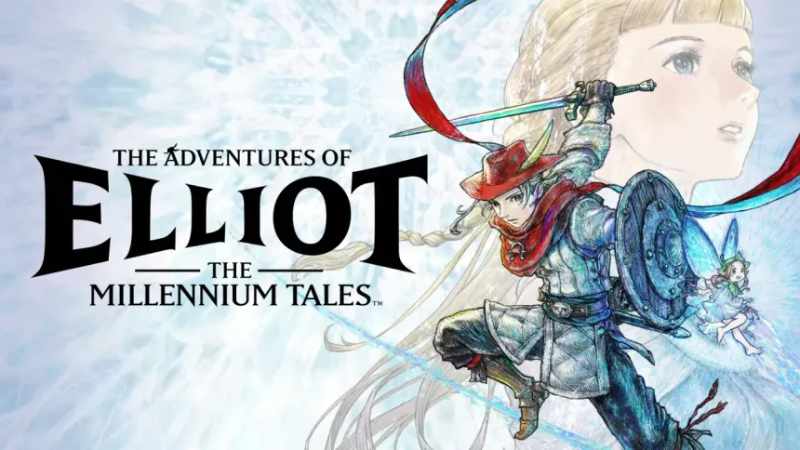
The Adventures of Elliot – The Millennium Tales
Let’s talk about the name Elliot to start off. The name Elliot (or Elliott if you like to spell things wrong), is a variant of the name Elijah and in Old English means “the Lord is my God”. It can also mean “With Strength and Right”, “Boldly and Rightly” or “Bravely and Truly”. Elliot is not a common name you find in fiction, although there are examples of the name showing up, like Elliot Alderson from Mr Robot, Elliot Carver, the antagonist of Tomorrow Never Dies, and of course Elliott Taylor from E.T… It also just so happens to be my name, so imagine my shock when a game called The Adventures of Elliot: The Millennium Tales was announced in a Nintendo Direct on 31st July 2025… Yes, the entire reason I’m reviewing this is because the main character and I share the same name… just roll with it. The Adventures of Elliot: The Millennium Tales was developed by Claytechworks and Square Enix, published by Square Enix and released on 18th June 2026 for Playstation 5, Xbox Series X/S, Nintendo Switch 2 and PC.
Story
The content of Philabieldia is one infested with beast tribes, animal humanoids that kill any human on sight (a likely fantasy for the furries of the world), therefore humanity lives behind the walls of the Kingdom of Huther, protected by the spell of safekeeping. You play as Elliot (you have no idea how weird it is to play as a character who has the same name as you), an adventurer and one of the only people brave enough to venture outside of the kingdom. One day he is called upon by King Hichard and his daughter Heuria to explore some ruins that have been recently discovered, despite the objection from the king’s aide Kaifried. Elliot discovers that the ruins lead to a Doorway of Time, a gateway to the past. After relaying this to the king, Kaifried defies orders and heads to the doorway himself with plans to change the past and make himself king. Elliot confronts the king’s aide, though the battle ends with his defeat. Elliot is miraculously brought back to life by the powers of a small Fairy named Faie, that only he can see for some reason, and discovers that he has awakened in the past. It is now up to our titular hero to go on a journey through time, exploring new ages, and meeting new friends in an attempt to put an end to Kaifried’s plot.
I actually really like this story. It starts off simple and ramps up as the story progresses, having deeper levels as the events of the past begin to add to further context in the present. The characters are quite fun as well, again, pretty simple without a lot of depth – aside from one or two – but you quickly grow to love them and almost become sad to see them go when the adventure ends.
Presentation
This game is another one of those 2D-HD games that Square Enix enjoys doing. And, while I can admit that it’s certainly been done too much, it really does look pretty. Having 3D environments juxtaposed with the 2D sprites really makes the details pop and stand out – especially with details like light coming from fire or the shine of crystals. The particle effects from attacks or cutscenes when characters start overflowing with power are especially great, making the fights feel grandiose and strengthening the impact of each blow.
Character designs are great as well. During cutscenes, characters will be portrayed with illustrations of themselves and are all brilliantly drawn and perfectly capture their expressions in the moment. The pixel sprites also look great, perfectly capturing the characters details despite the restrictions, they look like they come straight out of a JRPG on the SNES like Chrono Trigger or Final Fantasy VI.
I played the game on the Switch 2 and while docked it runs really well, if there were any dips in framerate I certainly didn’t notice them. That being said, I definitely noticed a drop in performance when playing in handheld mode, especially when exploring the overworld or just after you’ve teleported somewhere. It’s not enough to ruin your experience, but certainly enough to notice.
The soundtrack is mostly just fine. It perfectly fits the somewhat easy-going fantasy setting, with a combination of calm and epic songs. Sadly though, there’s nothing that really makes it stand out from other games of the same style. It’s not a bad soundtrack, just mostly unmemorable.
Combat and Enemy Design
If I had to compare The Adventures of Elliot to any other game, it would have to be The Legend of Zelda: A Link to the Past. You have a number of weapons, you get a couple through story progression though you have to explore for most of them, and two slots that you can equip them to. The weapons in this game aren’t that different from what you’d find in your traditional fantasy adventure game, a sword, bow and arrows, bombs, a spear, honestly the most extravagant one you have is the chain and sickle. While some of these weapons are necessary for particular obstacles – most notably the bombs needed to blow up cracks in walls – you don’t really need most of them for certain situations or enemies. I don’t mind this, but it would have been nice to have had particular enemies that were weak to one weapon or require one to be able to hit, mostly just so I wasn’t using the sword and bow for 90% of my playthrough.
Each weapon in this game has a quick attack and a charged attack. The quick attacks are just single swipes or stabs or shots, while the charged attacks will have extra abilities outside of heavier damage, like the sword shooting a projectile after a slash, or the bow firing multiple arrows at once, or the chain and sickle being swung through the air while you’re charging it up. It makes each weapon feel more unique and gives you more ideas on how they can be utilized. As you explore the world you may encounter stronger weapons to replace your older ones, the main benefit of these is a much stronger charged attack. You also have access to a shield that can not only block enemy attacks, but also stun them if you time the block perfectly (yes even this game has a parry mechanic, I would say I’m sick of it if I didn’t use it all the time). The shield does have a durability metre and will not allow you to use it for a short period if it depletes.
When you kill an enemy, it starts a chain. The chain will keep going up as you kill enemies which will end when you next get hit. The more your chain rises the better enemy drops you’ll receive. It adds a unique way to encourage you to improve and to learn enemy patterns and avoid taking damage.
One thing that will greatly help you in battle is Magicite. These small gems can be equipped to weapons and will add additional effects to your attacks, such as increasing your critical rate or damage, adding status effects to your attacks, or further effects that would only work with the equipped weapon. Each magicite is weapon exclusive, and the stronger the magicite, the more it will cost to equip. You can gain more magicite and level up the magicite box – which will let you raise the max cost limit of what you can equip – at specific vendors.
Enemy design is honestly kind of disappointing. The enemies themselves are fine, there are three kinds of enemy per beast tribe, they each only have a couple of attacks that you can figure out quickly, the main challenge is trying to juggle fighting multiple kinds at once. The main issue I have is the lack of variety. The enemies that you encounter at the beginning of the game are the same as the ones that you’ll fight close to the end, and it never feels like they get any tougher. It’s especially disappointing when you consider the fact that you’re literally travelling through time, it would have been really cool to have fought different enemies in different time periods, instead of the same humanoid chicken wielding the same bow from two ages ago. It’s not a deal breaker, but it would have been nice and possibly even immersed me in the world a little more.
The bosses on the other hand are a definite highlight of the game. These fights are very challenging with each boss having a variety of attacks for you to learn, and even once you do, they can prove to be a worthy adversary. You will have to fight some of these bosses more than once, though they do often have new gimmicks so it’s not the same challenge you fought before.
Of course, you’re not going on this adventure alone, as you have your fairy companion Faie journeying with you. She can be controlled with the right thumbstick or by a second player (a fate given to all the little brothers who want to play), and she has her own variety of powers to help you. These include Ignite, where she sets herself on fire to light torches to deal damage to enemies, Sprint which lets you zoom forward at a rapid speed, or Copy letting her become a clone of Elliot temporarily, to name a few. What I like about these abilities is that they aid in both combat and exploration, meaning you’ll find new ways to use them and will be using them constantly throughout your playthrough.
The one power of Faie’s that I don’t like is her ability to revive you. Simply put, if you die in the game, Faie will be able to bring you back from where you fell, at the cost of some of your currency, with the cost doubling every time you fall. This makes death feel way less impactful and almost doesn’t incentivise you to avoid getting greedy – especially if you don’t care about building up a chain – or perfect boss fights as there’s little consequence for doing so. Some people won’t mind this, possibly like this even, but I really wasn’t a fan and would have preferred the game without.
Exploration and World Design
The continent of Philabieldia is evenly split into six different types of environment. These aren’t anything you wouldn’t find in any other fantasy game, you have your usual snow-covered land, a desert, a volcano, amongst others. You do encounter different types of enemies in each of these areas, like frog-people in the swamp area or rat-people in the desert, which I do like as it makes sense for particular animal races to prefer one environment to another, making the world feel a little deeper.
The map in each age is pretty much the exact same, building and caves are in the exact same place, temples and dungeons are essentially unchanged, the only real difference is the state and layout of the human’s city and the environment being coloured differently. I don’t mind this too much, as it makes navigating each age easier, meaning I won’t be wasting time trying to get somewhere that I’ve already visited previously (though I did still get lost quite often trying to get to a previously visited temple). That being said though, navigating through this world is a bit more difficult than it may seem at first. This world is rife with blocked pathways, secret tunnels and, lord forbid, small twigs that you can’t step over or cut down – the greatest foe of any adventurer. This game does really encourage going out of your way to find more unorthodox methods of reaching your destination, like going to an entirely different environment just to circle back to the previous, or traversing caves filled with enemies. One thing I do really like with the caves is that once you’ve explored one it will tell you in the map where the exits will leave you, once again helping out those deep explorers. Some pathways will also require a new ability, meaning that you’ll have to backtrack there at a later date. While I do like this, it did lead to embarrassingly long periods where I was going back and forth trying to figure out what the right way forward was.
Regularly, you’ll find wrap points spread throughout the world, meaning that you’re not forced to run everywhere. These also act as save points, though the game does autosave very often so it acts more as a bit of extra security. Just like everything else, these warp points are in the exact same spots in each age, though you will have to find them again in a new era to be able to use them.
There is at least one temple in each area. While you can explore them in each age, there’s only one where you can go through the entirety of it. I don’t mind this too much, as you will go to the “main” temple as you play through the story anyway and the rest just act as a place to find some extra goodies. Just like with the overworld, the main challenge with these temples is navigating them, especially if you want to find all the items in them. While there are puzzles, they aren’t too challenging, mostly just flicking switches or using Faie’s abilities every now and again.
Collectables and Powerups
As I said, this game really encourages you to go out of your way and explore every inch of this continent. Part of the reason for this is just how much it rewards you for doing so. All throughout the world you’ll find chests or buildings that will grant you boons and powerups that will greatly aid you. One thing that I really like is that most of the treasures you can find will be presented to you on the map once you’ve opened up that area, meaning that you won’t go crazy searching every nook and cranny for them – or more likely you won’t be opening that walkthrough as often.
One of the main ones you’ll find are the Shards of Life. They are basically like Heart Containers from The Legend of Zelda, collect four of them and you’ll receive more health. Some of these can be found in chests hidden throughout the world, however you can also find them in these mysterious shrines. When you enter the shrines, you’ll have to undergo a trial to be able to receive the shard. These trials will either be a small puzzle or a horde of enemies.
It’s not just Shards of Life hidden in these shrines, as there are a few that will test your skills with one of Faie’s powers. Making you complete a puzzle revolving around a specific ability, these are easily the most challenging puzzles in the game. Completing these will improve the used ability and grant it additional effects.
One collectable that will please the animal lovers reading this are cats. Yes, throughout the world you’ll encounter a lot of cats, often found in the overworld, although others will be hidden in temples. By finding them and bringing them to an NPC with cat ears, he’ll reward you with a series of goodies depending on how many you’ve brought him, such as a larger quiver or bomb pouch and will also guide you towards the best ending (yes, there are multiple endings to this game, but this is one of the better games to implement them in my opinion).
Conclusion
I always enjoy games that encourage exploration, not just through having a large world but also rewarding you for going out of your way to travel as much of it as you can, and this game definitely succeeded in doing that. I had a very good time with this game, the combat was simple but fun, the story is honestly one of my favourites of the year so far, and travelling this world was simply a joy. If you’re a fan of classic SNES games or are just wanting a fun adventure with likeable characters, then I recommend this game. I spent nearly 50 hours in this world trying to get everything, and, honestly, I could easily have gone for longer.
8.4/10
Anime Amigo and Nerd Consultant
Share This Post:




Leave a Reply