


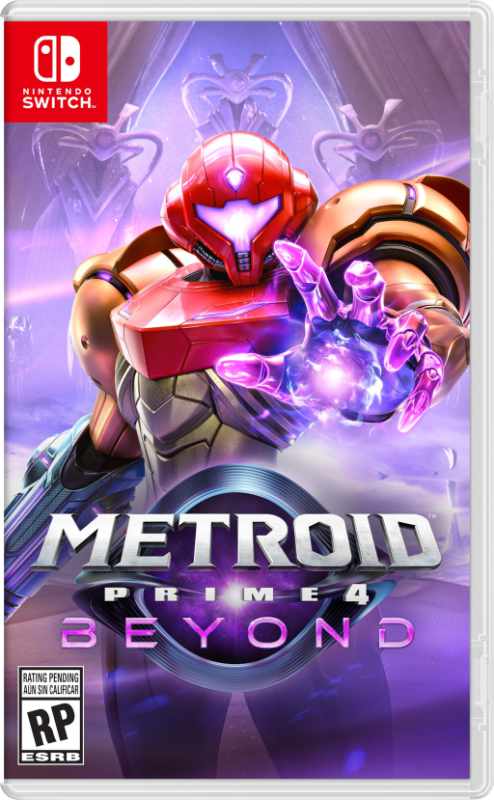
Metroid Prime 4
Switch 2 – Game Review
Metroid Prime 4 is an action-adventure FPS (First Person Shooter) game where players suit back up as bounty hunter Samus Aran, as she finds herself stranded on an alien planet being pursued by an old rival, stopping her from returning home.
It is also the long return of the numbered Prime games, ever since Metroid Prime 3 Corruption back in 2007 on the Nintendo Wii, and this game was in active development for 6 years after a failed development start for 2 years prior to that.
It has finally been released and is available on both Nintendo Switch 1 and Switch 2, with this review being made using the Switch 2 version.
This review does also contain spoilers for the whole game, so I would recommend playing the game first before fully reading the review.
Pro:
Graphics.
Metroid Prime 1 was the best-looking game on the GameCube when it released, with its remaster on Switch being the best-looking game on that console too.
Now on release, Metroid Prime 4 has to be the best-looking game on Switch 2 so far, with its gorgeous environments and boss designs looking great with very high fidelity.
The game offers two different modes to play the game, with either Quality Mode or Performance Move. Quality Mode offers a full 4K resolution when docked that cuts the frame rate in half to 60 fps, but I found the frame rate still very good and easy to play while making the most out of the environments and new game assets.
Performance mode instead cuts the pixel resolution in half to 1080p to maintain a full 120 fps frame rate. Whilst the game still looks great at 1080p, I would recommend players experience Quality Mode first, especially when first entering the dungeons for the first time.
Boss fights.
The hallmark of the Metroid series is a boss fight to top off a particular zone or dungeon in the games, and Metroid Prime 4 is no exception.
At the end of every dungeon is a boss fight with a giant monster for one of the teleporter keys that the player needs to defeat to access the final boss.
The bosses this time around felt simpler and less of a threat compared to prior Prime games, but still plenty of fun, with the boss of Flare Pool being the highlight for the game aside from the final boss.
While I found the 1st phase of the final boss annoying due to the NPCs accompanying Samus needing constant babysitting, when the boss shifts to phase 2 it is a lot more enjoyable and the combat is the best in the entire game along with the soundtrack.
The bosses also get melted by the new elemental damage very quickly, so if players want the boss fights to last longer, I recommend only using the normal cannon shot when hitting the Metroid weak points, otherwise the bosses die very quickly.
Frame rate.
Depending on whether the player is playing the game in Quality or Performance mode, means the player has access to either 60 fps or 120 fps when the Switch 2 is docked.
It didn’t feel like 120 fps was that necessary for combat and I instead preferred to mainly play in Quality mode to have 4K resolution and 60 fps for the graphical fidelity.
The Performance mode with 120 fps, whilst feeling smoother gameplay wise, only really came into effect with the various boss battles where players had to use more precise aiming whilst also dodging enemy attacks.
Mouse control.
Since the Metroid Prime series is no longer on the Nintendo Wii, players do not have access to the point controls of the Wii mote for accurate free aim shots. Instead on Switch 2, players can detach a Joy-Con and use that as a mouse to get a similar type of aim.
Unfortunately, I found it a lot more cumbersome and unresponsive compared to standard thumbstick aiming or gyroscopic control, and that was even after testing with the sensitivity in the option menu.
Therefore, this is a good idea in theory, but unfortunately in actual practice didn’t work out that well for me personally. However, this could have been influenced by my Dyspraxia, making it more difficult to aim with the mouse control.
Dungeons.
Once on Viewros, the player is asked to travel to five dungeons across the map and defeat the guardian hidden within to get the teleporter key to get home.
Of the five dungeons, my personal favourite was Volt Forge (2nd dungeon) which is the best for gameplay and minor puzzle aspects. It is also the only dungeon in the game that the player is not subjected to the other NPCs constantly talking and interfering with the atmosphere of the dungeon.
My favourite dungeon for the lord of the game was Ice Belt (3rd dungeon) which has the best added lore for the game, feels like it has come straight out of a sci-fi horror film, and is reminiscent of the Research Lab from Metroid Prime 1 in Phendrana Drifts.
Scout Bots.
These are handy little robots that the player finds in every dungeon, deactivated doing nothing.
However, near the end of the game when the player unlocks the Thunder Shot and returns, they can now reactivate them by shooting the scout bots in the face and scanning them.
This then upgrades all the maps the player currently possesses to point out the hidden upgrades they haven’t collected yet. This was invaluable to getting 100% of the items as Metroid Prime 4 did a great job of hiding some of the missable power ups out of sight of the player.
I would recommend players use the marker function on their maps whenever they find a Scout bot so they can return to it at the end of the game for the final clean-up.
Music.
Metroid has always had incredible music for its soundtrack and that shines through with Metroid Prime 4.
All the dungeons have a great signature track that kicks in when the player activates the main gimmick of the dungeon, aside from the final dungeon in the game that is mostly ambiance.
My favourite song in the game was easily Ice Belt after the player activates the generator, restoring power to the research station and bringing all the laboratories back online.
Each boss fight also has a great theme song to them, and they do not disappoint either, especially the boss battle music against Sylux being the highlight of the soundtrack.
Con:
Pacing.
The game starts off with Samus trying to protect an ancient artefact from Sylux that teleports Samus to Viewros and removes all her suit’s abilities and upgrades again, in a very fast paced and hectic battle at a research base.
For the first half of the game up to the Ice Belt, the game has great pacing through the first three dungeons but then the fetch quests and backtracking begin.
The broader lore is decent with the backstory of the alien Lamorn race and Viewros, but the actual narrative is basic and Sylux is a massive let-down as the main antagonist the further the player gets into the story.
This great pacing however grinds to a halt at the end of the game, as it is all padding before the final boss fight after finishing the final dungeon. This is due to players needing to collect half of all green crystals in the game, along with collecting the several missing mech parts to rebuild the Golem mech before getting access to the final boss battle.
Instead, the resources should have been redistributed throughout the rest of the game by having them as rewards for beating the various bosses in the game, along with the teleporter keys. Another option would have been to remove the need for keys entirely, and have the teleporter open for anyone who reaches it behind the shield that needs destroying by the mech.
Sol Valley.
The most controversial part of the game to me is Sol Valley, which acts as a hub for the game and has paths to each of the game’s several dungeons.
The desert however is extremely barren, and lacking any interesting architecture that isn’t just the entrances to the dungeons of one of the few Zelda inspired shrines that gives the player an upgrade to their elemental shot types.
Nintendo has made other inhospitable open world zones, like Sol Valley, but made them more interesting such as the Great Ocean in Wind Waker or Oblivia in Xenoblade Chronicles X. These worlds also had vehicles that allowed faster travel, but the vehicles had a lot more utility as Vi-O-La is only used to cross the desert faster and for one boss battle in Sol Valley.
Even combat in the desert feels redundant as the player is only actively attacked by two main enemies in the desert, a wheel robot and a flying enemy. However, it is pointless to fight them as the player does not get anything for doing so, making it easier just to keep driving and ignore them altogether to focus on driving through the green crystals.
The desert and Vi-O-La could have just been a fast travel menu option and nothing of value would have been lost. Retro Studios could have had the green crystals littered around the dungeons like some were in Fury Green and the mech parts too, like the player has to find in Flare Pool.
Sol Valley is also almost completely silent unless the player spends an additional cost to buy the new Samus Amiibo to unlock a radio for Vi-O-La, as the ability to hear music is now being paywalled from the player.
Level design.
The dungeons in this game were disappointing compared to prior games as they all felt very linear from Volt Forge onwards, with only the occasional room or two to the sides, that otherwise funnel the player in one direction towards the end of each dungeon.
The final dungeon was the worst for this, as it drives the player in a singular direction and down the entire time until they reach the boss room.
This is in stark contrast to Metroid Dread that was very labyrinthine, and even the Metroid Prime 1 remaster that released on Nintendo Switch, as those games had plenty of alternative paths through each dungeon that spread out to other paths or dead ends.
Game length.
This really surprised me given all the extra padding the game makes the player do, with the grinding and unskippable loading times between dungeons and zones.
As my total playtime for my first run on normal difficulty, 100% scans, and items came out to under 13 hours.
This is after spending two hours trying to find the final item I was missing. That item was to increase my total from 98% to 100% and had me revisiting all five dungeons in the game in person. This involved checking the maps for all the floors and rooms, only to find that the final item was tied to mandatory game progression that it does not tell you about.
Without looking at a guide and even with all the padding, it is still the shortest Prime game in the series, even after 6 years of active development at Retro studios for its linear dungeons.
NPCs.
The Galactic Federation members are one of the biggest drags in the entire game and with no shame to the voice actors but two of them are extremely annoying and ruin the atmosphere of the game.
The only character I did enjoy was the team’s sniper as the player encounters him several times and actually learns his history and backstory, so he isn’t just a walking cliché like the other characters in the game.
Myles MacKenzie is the engineer of the group and Samus has to travel back to him several times over the course of the story to apply the different elemental shots to her cannon after finding them in the dungeons and kills the pacing.
The player also hears from him every time they exit a dungeon with what to do next, or to gather green crystals at the end to unlock the end of the game. When back tracking to all the other dungeons in the game to gather item pickups and energy tanks, he constantly repeats that the player should be collecting green crystals in Sol Valley insistently.
Players cannot turn off the hints they receive from Myles either, as they are mandatory compared to prior games where the player could turn off the hint system.
The character dialogue just is a shallow imitation of Marvel film dialogue, with constant quips and over the top reactions that feels so out of place in this game. This is really highlighted with Samus in comparison, as she is with the characters a lot in cut scenes interacting but never responds or says a word, only nods along, making the dialogue feel very awkward when the NPCs ask her questions or statements directly to no response.
As bad as Other M was as a game, it still gave Samus more of a personality, since she directly interacted and responded to the NPCs in that game and it felt like a similar approach should have been taken in Prime 4.
The last member of the squad is also the most underutilised, being the giant robot the player rescues on their revisit to Ice Belt, and straight afterwards the player goes to the final main dungeon.
The final main dungeon is all one giant fake out where every member of the squad has a final last stand along the way protecting Samus. This allows her to carry on, only for the rug to be pulled at the very last minute and reveal they are all alive, which kills any tension that may have been built.
This was made more ridiculous where the first one to “sacrifice” themselves was the robot the player just rescued in Ice Belt 5 minutes ago, so there are no emotional ties between the player and this robot. As there isn’t enough time to build a bond with these characters, particularly as the robot even returns a second time to do the same sacrifice near the end of the mines again, this comes off more as a parody. It has happened twice to the same character in the same dungeon that the player only just rescued before going into said dungeon.
The NPCs also drag down combat due to them being able to be defeated in combat and if the player doesn’t heal them in time, then it’s an automatic game over and the player needs to restart from a checkpoint or prior save. This is a really bad game design when players get to the final boss fight, as the NPCs join in for the first phase and they are just constantly dying and not doing any damage, being more of a chore than a triumphant moment as the player has to babysit them all constantly.
Sylux.
The biggest disappointment story wise was the inclusion of Sylux as the main villain.
He is a character who was hyped up before release by his inclusion in Metroid Prime Hunters, Prime 3 Corruption and Metroid Prime Federation Force in its ending.
So now nearly two decades after his introduction, players thought they were finally going to get his backstory and why he is always described as having such a personal Vendetta against Samus.
However, he is absent for the majority of the story after the introduction and doesn’t factor into the story until the final boss battle where it was revealed he was in a healing pod the entire time.
Players instead fight several robots that copy and mimic Sylux’s appearance in the story. Two of these copies are fought on foot, while the other boss fight is against a copy in a ship. However, this ship battle doesn’t use any of Sylux’s signature attacks, just the ship’s weapons, making it redundant to be a Sylux copy.
Sylux, in his major focused role as the main villain, is only in the opening tutorial cutscene and the final boss fight, making him a complete afterthought in the story. This is shown when the game only gives him one short cutscene of backstory to explain his history with Samus after the nearly two decades worth of teasing.
No spoilers on what that backstory is, but it is incredibly poorly written compared to the other most recent villain in the franchise, with Raven Beak in his debut game of Metroid Dread.
Psychic abilities.
These are supposed to be the brand-new mechanic for Prime 4, but they all feel very derivative of prior abilities and not that unique as the majority are telekinesis based.
They are not used for any interesting puzzle elements just general hitting a button with the Control Beam and feel like an afterthought in combat. For example, the Psychic boots allow the player to double jump again and stand on floating platforms, which is only used for getting optional items and getting into the Ice Belt Zone.
The boss fights are prime examples of the lack of interesting applications of the psychic powers. As the bosses only need the use of psychic powers for one element per fight when they could have been used a lot more. For example, the main bosses of Volt Forge and Ice Belt could have used the Psychic Lasso ability to remove their armour to expose the cores for attacks, but this isn’t the case.
This means the majority of Psychic abilities are used only for bonus item collecting or minor platforming segments that are glossed over, instead of more involved in combat.
Scanning.
The scanning mechanic makes its return in Metroid Prime 4 but feels more tacked on compared to prior games.
This is due to it taking longer to scan objects and enemies, in addition to so much more of the environment being able to be scanned with redundant flavour text that adds nothing to the situation or the story, as it is incredibly boring compared to prior games with the Chozo and Luminoths.
Retro studios could have removed over half the scans in the game, and it would have been an improvement, since in Prime 4 there are two types of coloured scans, with one being Yellow for plot important scans and green for everything else.
This issue comes with the green scans, as all the scans needed for 100% show up as green in the environment, with no differences between those needed for the scan log and the unnecessary ones.
Map Markers.
Players get the option to add map markers when in dungeons to mark points of interest or item pickups that the player cannot access yet.
However, when placing the marker, it instead puts it over the entire room instead of pinpointing on the area of the map where you want to mark.
When revisiting later in the game, the marker is not that helpful as players need to examine the entire room to remember what they tried to mark in the first place.
Menu button.
While most of the other buttons can be rebound, the main exception is the pause menu button that is bound to the minus button, and Vi-O-La is bound to the plus button.
Due to muscle memory from playing other Nintendo games or games on Switch 2, every time I want to pause the game, I always end up summoning the bike in an open zone or nothing happens as the bike cannot be summoned.
A simple solution would be the ability to swap the plus and minus buttons as it’s an odd choice to not allow players to rebind the main menu button.
Conclusion:
After waiting 18 years after Prime 3 and 8 years of game development on and off after it restarted part way through with a new console generation, I can’t help but be somewhat disappointed with how Prime 4 turned out and how it feels held back from what it could have been.
The game does not feel like it was innovated after the nearly decade-long development with how similar and safe it feels compared to prior entries and other Nintendo games.
Whilst still a good game and I would recommend it to others, especially newcomers to the franchise as a jumping on point, it just does not feel like the breath of fresh air the franchise needed, like Dread was to the mainline 2D games.
Score: 7.5
Anime Amigo and Nerd Consultant
Share This Post:

















Leave a Reply