


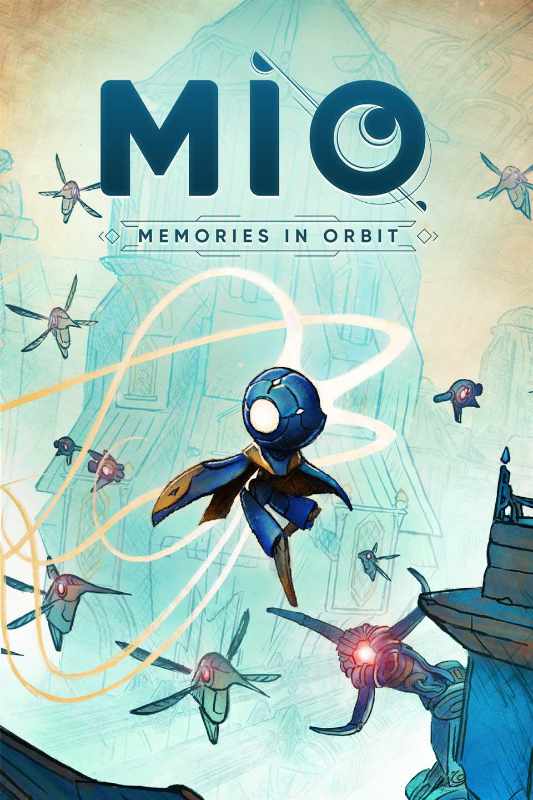
Mio: Memories in Orbit
Despite being founded in 2017, the company Douze Dixiemes only has two games released (a testament on how long game development takes nowadays). Their first release was Shady Part of Me, a game that whilst not being that popular, did receive some pretty good scores. And now we have the release of their second game, Mio: Memories in Orbit, a Metroidvania that was announced in a Nintendo Direct in 2024 with an initial release window for late 2025, that unfortunately had to be delayed. The general reception of this game has been very good, receiving a number of positive scores and finally giving the company some notoriety. Mio: Memories in Orbit was published by Focus Entertainment, developed by Douze Dixiemes and released on 20th January 2026 for Nintendo Switch 1 & 2, Playstation 5, Xbox Series X/S and Steam.
Story
Now, I am a fan of cryptic stories. I like games that let the environment do the narrating and leave you to figure out the pieces. I’m also used to games mostly having the stories take place in the background and be more of an excuse for the events that unfold. However, I feel like this game takes it a little too far.
In this game you play as MIO, a small robot who wakes up on a spaceship named ‘The Vessel’. The caretakers of the ship have stopped working, leading to the threat of the ship shutting down, and it’s up to our little friend to put a stop to this.
Even in the most cryptic games, the story would still pop up on occasion to help guide us forward or to at the very least imply that we’re progressing or going in the right direction. This game doesn’t really do that, and I found it a little annoying at times. I understand what it’s trying to do but I’m very much someone who gets attached to the stories of games, I like to dive into the world and the characters, or at the very least learn what’s happening. It’s disappointing because I feel that a premise like this could lead to a fantastic narrative. It also made MIO feel less like a character, throughout the game we never learn anything about her or if she has a motivation outside of stopping ‘The Vessel’ from shutting down, and honestly, she doesn’t really have much of a personality (which you cannot say for the rest of the robots). Maybe I’m missing something because this game has gotten a lot of praise for its environmental storytelling, but sadly this time around, it failed to really enthral me.
Presentation
The main praise given to this game is its environments and visuals. And rightfully so, this game is gorgeous. The robots are all very creatively designed, enemies, NPC’s and even background characters all look distinct, and at times very cute. Mio is obviously the star of the show when it comes to design – her size, her cape, and the fact that she doesn’t have arms so she uses her hair for everything. You get very quickly attached to her because of this and almost feel bad when she gets hurt because of it.
The environments are absolutely stunning. The game regularly has moments where it draws back to show off more of the background, not only giving you a breathtaking view, but also showing off the scope of the size of this ship. Many of the locations you explore are distinct from other Metroidvanias as well. There are still some ol’ reliables like a swamp area or a frozen area or a forest, but the way they are coloured and the general visuals make them feel unique. Platforms also blend in with the environments, taking on the form of pipes or branches, to the point where at the beginning I didn’t even recognise them as platforms, further immersing you into the world.
I played the game on Switch 2 (meaning yes this is my first written Switch 2 review, only took me like… 8 months to get one done), and I am very happy to say that the game ran perfectly. It played at a consistent 60 fps, both docked and handheld, and I found no drops at all. It did, however, crash on me a few times, most notably if I took damage from particular hazards too often. I don’t know how common this is on other platforms, and it wasn’t a common occurrence but it was still annoying when it did happen.
I found the soundtrack quite surprising, not because it was better or worse than I expected, but because it was way more… relaxing that I was expecting. The best way I can describe it is sci-fi ambient, with slow and harmonious melodies and calm synthy backings. Even when fighting bosses, the tempo is built up and it does become more energetic, but it never feels intense or stressful, more like something you’d hear in the background of a nightclub scene. Overall, I do like it, it perfectly fits the setting and even in the most intense sections of the game doesn’t feel out of place.
Combat
I’m starting off with combat instead of exploration this time around because… there isn’t really much to say with combat. MIO has a three-strike attack combo that requires you to press a single button and that’s really it for attacks. Seriously, you don’t learn or obtain any new forms of attack – no new weapons, combos, not even a special attack. On one hand it does make combat very easy to learn, but on the other hand it can make combat feel pretty shallow and possibly tedious if you’re having to run through areas you’ve already explored to reach another.
You do have a dodge button which works quite differently from what you’d expect. Instead of rolling to the side or darting into a different direction, MIO instead vanishes for a second and reappears in the same place, relying on your timing when avoiding attacks rather than moving out of the way of them – though you do get abilities that can help with that as well. I feel like this may end up isolating some people from fully enjoying this game, especially those who aren’t great at timing, though personally, I like this. If you’ve read some of my previous reviews, you’d know that I’m a big fan of learning enemy attack patterns and learning to time dodges and blocks, so this really appeals to my combat style.
The main selling point with combat are the enemies you’ll be fighting. There is a surprisingly large variety of enemies that you can encounter, from ones that fly, use ranged and melee weapons, and plenty that you can only find in certain areas while others are fought, generally they’re all the basic types you’d find in any Metroidvania. Like with MIO, all regular enemies only really have one or two types of attack, and the main key to the game is learning their timings and how to deal with each one. A number of them are not easy to deal with – there were some I was still struggling against close to the end of the game that I first fought against hours ago.
The bosses in this game are all quite tough but really fun. All of them are incredibly distinct from one another, not only with different designs but vastly different functions as well. Their fights are all complex and will take a lot of practice and patience if you want to master them. Normally, there are a couple of bosses in a game that I really don’t like, or at the very least is a bit of a letdown, but this is one of those rare games where I liked every boss I fought. Of course, there are some that are better than others, but there wasn’t a single one that I disliked, they are all pretty great.
Exploration
Exploration is where this game thrives. To start off, everything that I’ve mentioned in combat can be attributed to platforming, as there are multiple sections where you have to attack an enemy or dodge a projectile to be able to move forward. Doing either will allow you to jump an additional time and will regain you a portion or will fully refill your energy meter (more on that later). This does somewhat make up for the simple combat in my opinion, giving your attacks more uses outside of just defeating opponents.
While I said that you don’t get any new combat abilities, the same cannot be said for additional platforming skills. For starters, the strands of long flowing hair (wires?) that MIO has isn’t just for show, they are the key to you using a number of your abilities, like using it to launch yourself forward either from a hook in the environment or an enemy, or to climb walls or cling to the ceiling. You also get the ability to glide, letting you avoid obstacles that damage you on impact. All these abilities use an energy meter that is seen at the bottom of the screen, the energy is drained rapidly, and won’t refill unless you attack and hit an enemy, dodge an attack or find solid ground to land on. One massive criticism that I have with this game and this energy meter is that if you use one of these abilities and stop using it with some energy left, the meter will continue to drain. I’m someone who will instinctively use one of these abilities in a panic or will just hit a button on accident, so when I do it feels like the game is punishing me for no reason, and makes platforming unnecessarily more challenging. I’m fine with not being able to regain it unless you’re standing on solid ground, but the fact that it will continue to drain when I’m not using an ability is frustrating.
If I had to describe the platforming sections with any phrase, it would be “puzzle-like”. There are multiple sections that require you to use particular skills in specific orders, otherwise you’ll be hit by an obstacle that will damage you and teleport you back to when you were last on solid ground. It really feels like a test of skill at these points, like it’s relying on me to understand how to interact with the environment and what abilities are best used to move forward, and there is nothing more satisfying in this game than getting through one of these sections perfectly. That being said though, there are some sections, especially later in the game, that feels like luck at times, where the timing and positioning required are so specific that my successes were through sheer chance rather than my skill. In other words, it’s very gratifying when you manage to get through these, but very aggravating when you consistently fail.
Spread throughout these areas are checkpoints that act a bit like bonfires from Dark Souls. This is mostly in the sense that you can rest there to regain your health, swap around any mods you’re carrying (small items that you can equip to gain extra benefits from being able to see enemy’s health, all the way up to regular enemies not attacking you unless you strike first), as well as teleport to other checkpoints… at least, eventually you might. Basically, you can’t just teleport from one checkpoint to another just by resting there, if you want to be able to fast travel to that specific checkpoint you have to find its corresponding overseer, which can be found in the same location that the checkpoint is in. I’ll be honest, I’m really not a fan of this. I don’t mind not getting a certain benefit from not finding the checkpoint’s corresponding overseer, but for the game to gatekeep teleporting makes exploration way more tedious, as you’ll be going all over the place trying to figure out the path forwards (or at least I did), and you not being able to teleport makes traversal way more of a slog, and can be especially annoying if you go in the wrong direction.
Flaws
Before we end, there are a couple more flaws that I would like to bring up. First of all, I mentioned before that the game will zoom out and let you witness more of the environment, and this happens when you go down specific elevators into new areas, and yes, it is very pretty and mesmerising… at first. Unfortunately, you have to go through the same thing every time you use that elevator. You heard me right. EVERY TIME. And these are not short elevators, meaning that every time I use it, I have to endure about half a minute of doing absolutely nothing while waiting to get to the playable section. I would have loved at the very least an option to skip this, because it just gets annoying after a while.
The other flaw I have is in regard to the health. This game’s health is very similar to Hollow Knight’s, as in a few symbols signify how often you can get hit until you die. This isn’t something that I have a problem with, it worked very well in Hollow Knight so there’s no reason why it shouldn’t here. My problem is with how you restore health. Because enemies don’t drop restoratives, you can’t collect potions or anything like that, and there aren’t any abilities that will let you regain health – again, like in Hollow Knight. The only ways for you to regain health is either by resting at a checkpoint, finding and using a health station for a small amount of currency per health point, or finding a specific mod (which I didn’t find in my playthrough, might I add). Especially with how difficult the game can get in later sections, giving you few and infrequent methods of healing makes the game feel way more unfair than it should, and can make you go into some encounters and boss fights ill-prepared for the challenge ahead.
Conclusion
I will admit, I’ve definitely been more negative about MIO: Memories in Orbit than most other reviewers have, but that doesn’t mean that I dislike it at all. Despite my gripes with the game, I had a really fun time with it. The combat is simple to learn but makes you use it in different ways, it has some of the most fun yet complex platforming I’ve experienced in a Metroidvania, and this game is incredibly pretty. If you’re a fan of the genre, I highly recommend this game, it’s a lot of fun and a great challenge to all who are a fan of platformers.
8.2/10
Anime Amigo and Nerd Consultant
Share This Post:
















Leave a Reply