Author: Linda Buchan

  • A New Report on Systemic Change – Autism Alliance UK

    A New Report on Systemic Change – Autism Alliance UK


    A new report on systemic change

    Rising autism diagnosis rates have been the subject of debate across policy and public affairs. The Government in England has commissioned an Independent Review to explore the factors behind rising diagnosis, across autism, ADHD, and mental health conditions. At a time of intense pressure on public resources, and with stigmatising narratives circulating about ‘overdiagnosis’, there is a risk that once again, policy fails autistic children, young people, and adults, and their families.

    At these times, it is vital to have clear sight of the big picture.

    For decades, autistic people have faced systemic barriers across society and services. These barriers have not gone away, and autistic children, young people and adults continue to experience some of the greatest harms of any group.

    In the policy world there is interest in ‘strengths and needs assessment’ as a way of improving outcomes and avoiding diagnosis being used to restrict access to services, as is currently the case. But without addressing systemic barriers, any move towards ‘needs-led’ services is likely to fail.


    Share This Post:
    Facebooktwitterlinkedinmail
  • NAS – What are your views on PIP?

    NAS – What are your views on PIP?


    Do you have experience of claiming or caring for someone who receives Personal Independence Payments (PIP)? If so, there is an important opportunity for you to share your experiences with the Government.

    PIP is a benefit meant to cover the extra costs that disabled people and those with long-term conditions face. Last year, the Government proposed to restrict who could get this benefit, but the plans were scrapped after powerful and relentless campaigning from disabled people, disabled people’s organisations and MPs.

    Instead, the Government promised a review, which is being co-produced with disabled people, the organisations that represent them, carers, clinicians, experts, MPs and other stakeholders.

    ‘The Timms Review’ is now open to hearing from members of the public. Can you help by sharing your opinions and experiences of the PIP process?

    The consultation is four questions long and you don’t have to respond to them all, just those that feel relevant to you. You can also share your answers in a different way, like with a video or a voice recording by emailing timmsreview.callforevidence@dwp.gov.uk.

    Last time we campaigned against harmful changes to PIP, you made it clear how important benefits like PIP can be for autistic adults – and the Government learned that they must properly consult on changes like this. Now is your chance to let the Government know what about the PIP process works, and what needs to change.

    All the best

    Ella
    Campaigns Manager


    Share This Post:
    Facebooktwitterlinkedinmail
  • Research Participants Wanted – LinkedIn

    Research Participants Wanted – LinkedIn


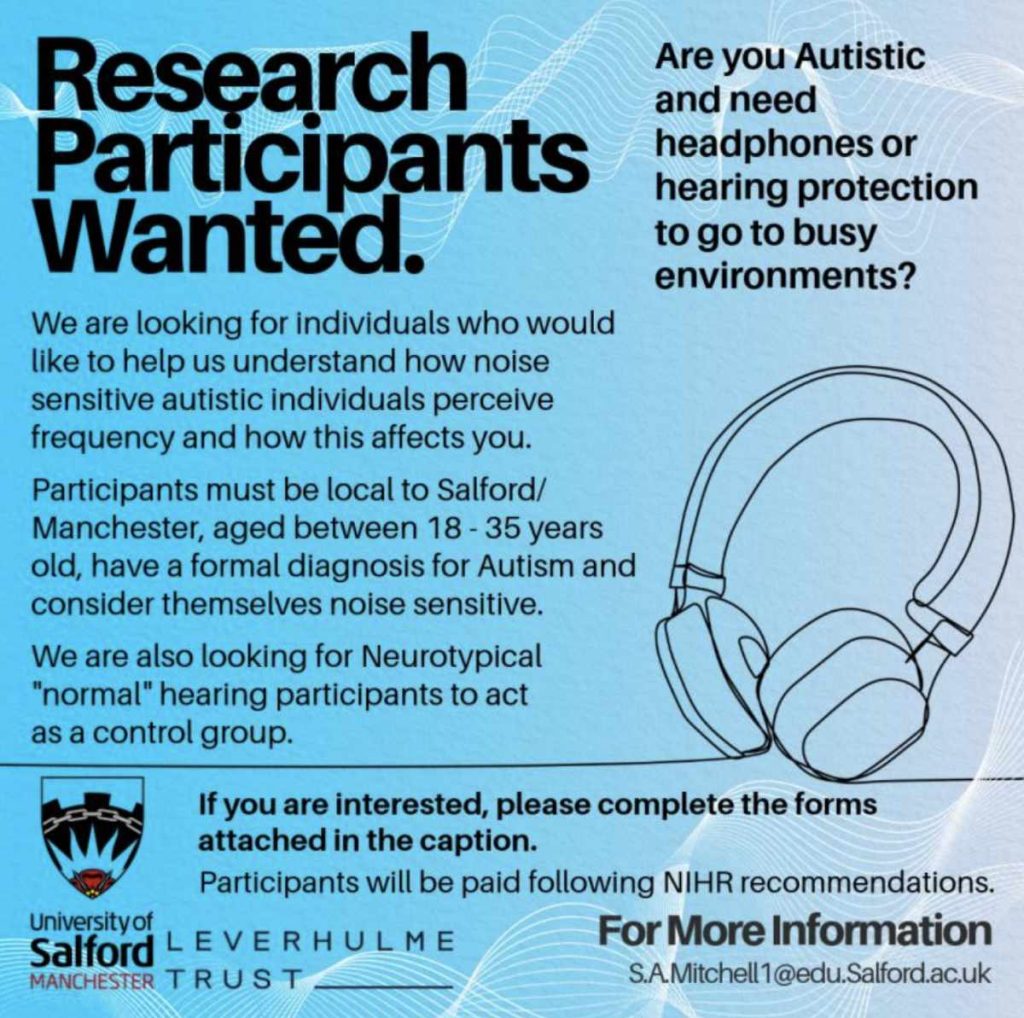
    I am recruiting participants to take part in listening assessments at the University of Salford. We are looking for clinically diagnosed autistic people who consider themselves noise sensitive and neurotypical “normal hearing” people. The assessments are in person and will help us understand how autistic people perceive and react to sound.

    This will be paid participation.

    If you are interested in taking part, please complete the form through this link: https://lnkd.in/emaQiTpQ


    Share This Post:
    Facebooktwitterlinkedinmail
  • SMC – Expert Reaction to Interim Report on Rise in Conditions Such as ADHD and Autism as Commissioned by Wes Streeting

    SMC – Expert Reaction to Interim Report on Rise in Conditions Such as ADHD and Autism as Commissioned by Wes Streeting


    Experts comment on an interim report commissioned by Health Secretary Wes Streeting into the rise in ADHD and Autism, as reported by the Times.

    Dr Amanda Roestorf, Director of Research at Autistica, said:

    “The interim review of the prevalence of autism, ADHD and mental health shows that rising diagnoses are largely about better awareness and identification e.g., of autism, ADHD, not a sudden increase in the number of autistic or ADHD people.

    “The Times coverage promotes misinformation and risks oversimplifying what is a complex and carefully balanced interim review.

    “The review does not conclude that children are being ‘incentivised’ to seek diagnoses. It highlights that demand is increasing in a system where diagnosis is the main path to support.


    Share This Post:

    Facebooktwitterlinkedinmail
  • NAS – Response to the Interim Report of the Independent Review Into the Prevalence of Autism, Mental Health And ADHD

    NAS – Response to the Interim Report of the Independent Review Into the Prevalence of Autism, Mental Health And ADHD


    The Government has published its interim report of the independent review into the prevalence of autism, mental health and ADHD.

    We are concerned that not only are autistic people’s needs clearly not being met, but that this review is fuelling the increasingly polarised debate about autism.

    Our response to the interim report: Mel Merritt, Interim Assistant Director of Policy, Research and Strategy at the National Autistic Society, said:

    “This report makes one thing unmistakably clear: autistic people’s needs are not being met in education, employment or healthcare.


    Share This Post:

    Facebooktwitterlinkedinmail
  • HealthWatch – Join us for Share for Better Care Week 2026

    HealthWatch – Join us for Share for Better Care Week 2026


    Get involved in a national week of action to help more people have a stronger voice in their care.

    Public feedback about NHS and social care support helps services spot problems, identify what’s working well, and areas for improvement.

    But six in ten people don’t remember ever having done this.

    You can help change this by supporting Share for Better Care Week, which begins on 23 March 2026.

    Whether you’re part of the Healthwatch network, work in the NHS or social care or receive support from them, you can play your part by asking others to donate three minutes to share feedback on care.


    Share This Post:
    Facebooktwitterlinkedinmail
  • SEND Reform Teachers and Professionals Toolkit – NAS

    SEND Reform Teachers and Professionals Toolkit – NAS


    We know that your time can be stretched, especially if you work in schools where the workload is high. We’ve put this toolkit together to help break down the Government’s proposals and what they might mean for you, and to help you get involved and have your say. We’ve estimated the time needed for each activity, so that you can take action in a way that works for you.


    Share This Post:
    Facebooktwitterlinkedinmail
  • NAS – Share Your Views on SEND

    NAS – Share Your Views on SEND


    It’s been just over a week since the Government published its Schools White Paper, detailing plans to reform the Special Educational Needs and Disabilities (SEND) system in England.

    Alongside these plans, the Government launched a consultation, which is open until 18 May 2026. They want to hear from people about their opinions of the plans. Anyone can take part and this is one of the main ways for people with experience of the SEND system can share their views.

    We encourage you to respond and make sure autistic people and their families are heard. To help, we’ve put together a guide for responding to the consultation. It’s a long document, but you only need to respond to the questions you want to. The guide includes our interpretation of the questions, plus suggestions and ideas for what to include in your answers.

    Since the White Paper was published, we’ve been working hard to understand exactly what the plans will mean for autistic people and their families, the proposals we feel encouraged by and those we have concerns about.

    We know that lots of people may have big questions about what to expect now and what the plans might mean for them and their family. As well as our consultation guide, we’ve put together an FAQ page to provide more information about what the reforms could mean for you.

    You can find the consultation guide, the FAQ and more over on our webpages.

    Let’s work together to make sure these reforms are the best they can be.

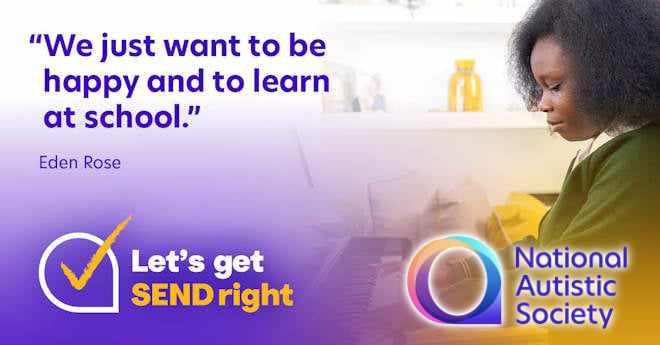
    Let’s Get SEND Right.

    All the best,

    Ella
    Campaigns Manager


    Share This Post:
    Facebooktwitterlinkedinmail
  • NAS – Government Published Its Plans for SEND System

    NAS – Government Published Its Plans for SEND System


    Today, the Government published its plans for how it will reform the Special Educational Needs and Disabilities (SEND) system.

    Reforms are much needed and have been long promised. But rumours and leaks have caused a lot of anxiety for families about what reforms will mean for the support their child receives.

    The first thing to say is that none of the changes will happen immediately and there’s still a lot that needs to be worked out.

    The paper has lots of proposals that could really help autistic young people
    We are encouraged to see a commitment for much-needed investment, ambitions for every child with SEND to have support in place through Individual Support Plans and plans to expand inclusion bases in mainstream schools.

    But we need much more detail and clarity to feel confident
    More reassurance will be needed to really address the fight and the exhaustion that autistic children and their families have been facing for years. To get SEND right, overworked SENCOs, teachers and staff will need proper training, capacity and support, and autistic children’s access to a school place that is right for them must be protected.

    Over the coming days, we will be carefully analysing the Schools White Paper to understand exactly what it means for autistic people and their families. We will be back in touch very soon with more information, plus advice and guidance for getting involved and getting your voice heard through the Government’s consultation.

    This is a once in a generation opportunity. We will work together to make these reforms the best they can be for autistic people. Thousands of us are ready to act, stand up for the autistic community and make sure reforming the SEND system means giving autistic children the support they need to thrive.

    I’ll be in touch soon,
    Ella
    Campaigns Manager


    Share This Post:
    Facebooktwitterlinkedinmail
  • Ambitious About Autism – Absence Note to the Government

    Ambitious About Autism – Absence Note to the Government


    Following further leaks in the media in recent days, we expect the Government to finally publish its plans for SEND reform this week.

    We know the government wants an emphasis on early support in mainstream schools, but reform must not come at the expense of existing legal rights or access to support, which many autistic pupils rely on.

    In the meantime, we shouldn’t forget the significant challenges autistic pupils are facing in school right now.

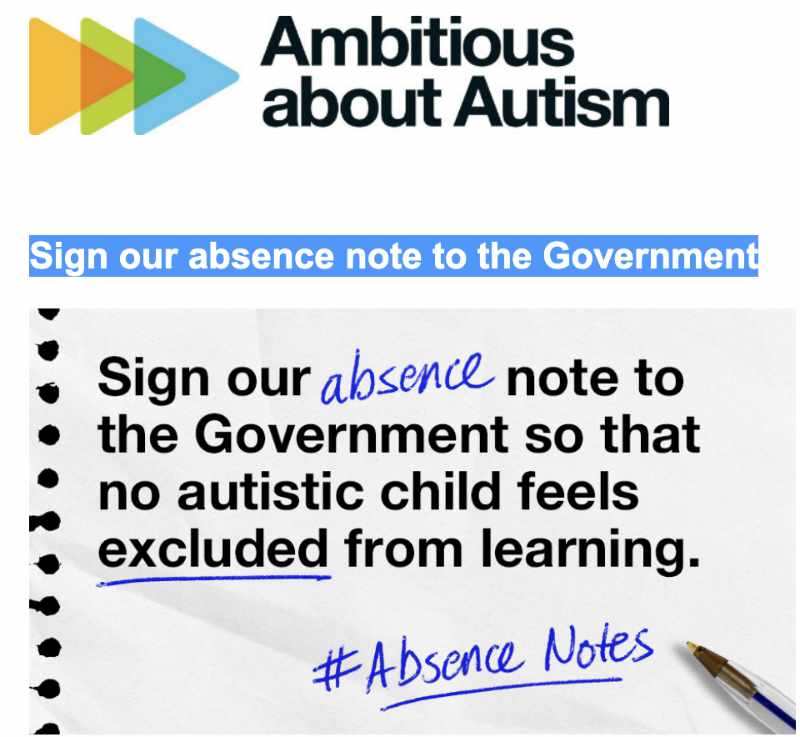
    Join our #AbsenceNotes campaign to ensure every autistic young person has the chance to learn, thrive and achieve.


    Share This Post:
    Facebooktwitterlinkedinmail
  • Autism Action – Help us understand the needs of people on autism and ADHD waiting lists

    Autism Action – Help us understand the needs of people on autism and ADHD waiting lists


    The assessment crisis needs action – right now
    We know there are hundreds of thousands of people waiting for an autism and/or ADHD assessment. Many desperately need help. Yet they are waiting years. That’s years of not getting the right help in education or employment; years of struggling to access health or social care; years of mental health crisis, relationship breakdown, and feelings of isolation.

    This can’t go on. We need the Government to step in and address this ongoing crisis.


    Share This Post:
    Facebooktwitterlinkedinmail
  • The 5 Principles That Must Shape the Government’s SEND Reforms – Ambitious About Autism

    The 5 Principles That Must Shape the Government’s SEND Reforms – Ambitious About Autism


    We expect the Government to announce its long-awaited plans to reform the special educational needs and disabilities (SEND) system very soon.

    In a new blog, our Chief Executive sets out our five principles for effective reform. If the white paper is built around these principles, then we can be confident for the future but if not, it will be hard to see how it can be anything but a failure.

    We will judge the Government’s SEND reforms on these principles and we will continue to campaign relentlessly to ensure they are included. The futures of autistic young people depend upon it.

    Read the full blog and join our campaigning work: https://bit.ly/3ZPv7mj


    Share This Post:
    Facebooktwitterlinkedinmail
  • DCP & Kids Young Person’s Survey 2026

    DCP & Kids Young Person’s Survey 2026


    The Disabled Children’s Partnership and the charity Kids, campaign for better support for disabled children, young people and their families. This survey is for young disabled people aged 11-25 years, living in England.

    The government plan to reform the system of support for children with special educational needs and / or disabilities. Their plan will be announced early 2026.

    The results of the survey will help our campaign, to make sure this opportunity for reform is not wasted. Your responses help us to make sure your voice is heard during the process.


    Share This Post:

    Facebooktwitterlinkedinmail
  • LeDeR report republished today after retraction just three months after its long-delayed appearance

    LeDeR report republished today after retraction just three months after its long-delayed appearance


    Background

    For many years, evidence has shown that autistic people and people with a learning disability have reduced life expectancy. In September 2025, minister Stephen Kinnock said, “The latest report shows that on average, people with a learning disability die 19.5 years younger than the general population and are almost twice as likely to die from an avoidable cause of death. This is unacceptable.”

    However, these have proven to be empty words, as no action has been taken to address the underlying issues. The Government points to a programme called ‘LeDeR’ as evidence that it is taking action. We have reported extensively* on the limitations and failings of that programme, which was created to learn from deaths of autistic people and people with learning disabilities.

    Insufficient reporting of deaths of autistic people

    As it stands, anybody can refer a death to LeDeR, and every death referred will be reviewed. That sounds more impressive than it is, because a lack of awareness of LeDeR means that deaths of autistic people without a learning disability have proven highly unlikely to be referred. The number of those deaths reported has been appallingly low in the first two years of their inclusion. As a result, both Kings College London, the authors of the national report, and NHS England, in their discussions with us, caution that the data cannot be considered representative of all autistic people. In other words, we cannot draw meaningful conclusions from the national data.


    Share This Post:
    Facebooktwitterlinkedinmail
  • Charity sector calls out Government on ‘unacceptable’ autism policy

    Charity sector calls out Government on ‘unacceptable’ autism policy


    23 January 2026

    Joint statement:

    Today the Government has responded to the House of Lords’ report, ‘Time to deliver: the Autism Act and the new autism strategy’. As the autism charity sector, we stand together to say the Government’s response is unacceptable.

    We see no evidence that the Government intends to develop a new national autism strategy, or do anything meaningful in compliance with the Autism Act or in response to the House of Lords inquiry. Despite the legal requirement and the expiry of the existing strategy in June, no timeline is provided.

    Share This Post:
    Facebooktwitterlinkedinmail
  • LinkedIn – Global Child and Maternal Health

    LinkedIn – Global Child and Maternal Health


    In 2024, we Global Child and Maternal Health published the Black Child SEND Report and convened our first Black Child SEND Conference – bringing families, practitioners, and policymakers together to expose and evidence racial inequity within the SEND system.

    In 2026, we are back.

    As the UK awaits the forthcoming SEND White Paper, we return – this time to Parliament – at a critical moment for SEND reform. Decisions being taken now will shape children’s educational experiences, rights, and access to support for years to come.


    Share This Post:
    Facebooktwitterlinkedinmail
  • NAS Rsponse to Adult Psychiatric Morbidity Study

    NAS Rsponse to Adult Psychiatric Morbidity Study


    The NHS has published the Adult Psychiatric Morbidity Study, which shows that the prevalence of autistic adults in the UK remains at around one in 100 people. Our charity’s response is included below.

    NAS comment:

    Mel Merritt, Head of Policy and Campaigns at the National Autistic Society, said: “These figures show the prevalence of autistic adults in the UK remains at around one in 100 people. We hear increasingly loud, misleading and harmful narratives about autism, like false claims about ‘overdiagnosis’. But there is no evidence to suggest this is happening. Misinformation can be hugely damaging and lead to discrimination and autistic people being dismissed or denied the support they need.


    Share This Post:
    Facebooktwitterlinkedinmail
  • AutismAction – Making the House of Lords Report Count

    AutismAction – Making the House of Lords Report Count


    The Autism Act 2009 is a law that says the Government must make an autism strategy, keep it up to date, and provide guidance for the NHS and local authorities about what they need to do. A House of Lords committee was formed in 2025 to review the Autism Act and to make recommendations about how the Government should support autistic people. That makes both the Autism Act and the autism strategy what we call ‘root causes’ – because they have the potential to have an impact on all autistic people, and if the Autism Act and autism strategy aren’t working, they will create a huge number of problems across all areas of life.


    Share This Post:
    Facebooktwitterlinkedinmail