
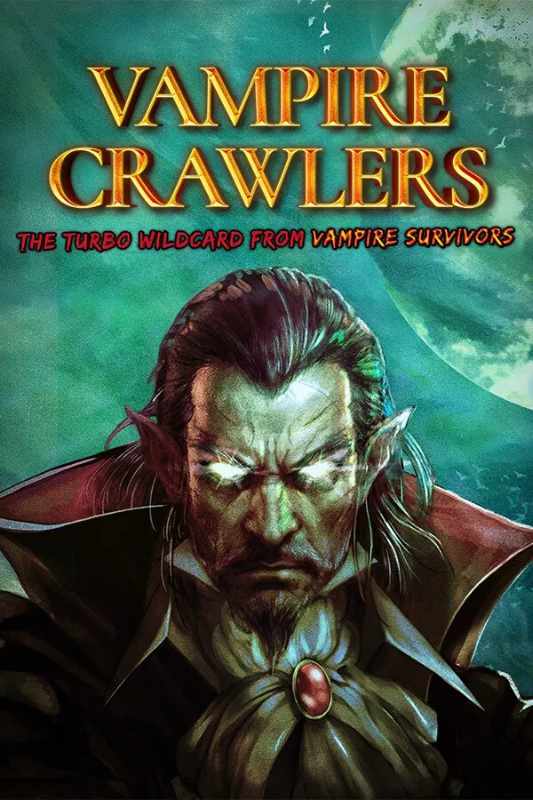
Vampire Crawlers
As other reviews would imply, I can get very addicted to certain video games, with indie games being the main thing to fuel my dopamine. There are two Roguelikes (well technically three but I don’t think Cult of the Lamb really has any relevance today) that even today I’ve spent hundreds of hours playing, those being Vampire Survivors and Slay the Spire. One of these involves being a bullet-hell where you have to survive waves of enemies for thirty minutes, and the other being a deck-builder where you fight random encounters through three floors of trials. As much as I love both of them, I never found myself considering what would happen if the two games were combined, yet Poncle did and decided to develop the first ever spin-off to Vampire Survivors, Vampire Crawlers, a roguelike dungeon Crawler whose main mechanic is based around collecting cards and crafting decks. Vampire Crawlers was developed by Poncle and Nosebleed Interactive, published by Poncle, and released on 21st April 2026 for Playstation 5, Xbox Series X/S, Nintendo Switch 1 & 2 and PC, with a mobile port planned for future release.
Level Design
Just like with my Tomodachi Life: Living the Dream review, there isn’t really much to discuss with story, as all you’re told is that you have to kill the vampire. Nor is there much to say with presentation as it’s mostly the same as in Vampire Survivors, aside from the 3D environments (which look great I will admit), so we’re just going to go straight into gameplay.
The game is a procedurally generated dungeon Crawler, where you have to descend a series of floors, the stairway to each one being guarded by a boss, collecting cards and improving your decks as you do so. Each level consists of a few rooms and corridors, and while you will find similar layouts, each floor, as well as item and enemy placement, will be randomised. You’ll be able to see where everything is on the mini map at the bottom of the screen, as it reveals where every encounter, treasure chest and destroyable object – which will give you random goodies for destroying, like random cards, permanent upgrades or coins – is placed, though you still won’t be aware of what you’ll encounter until you’ve reached it. My one small nitpick with the mini map is that it doesn’t tell you some of the more intricate details of each room, primarily the fences or shelves that will block you from going certain directions, especially when you’re heading towards something you can break, only to realise it’s on the other side of the bookshelf. It only takes a few seconds to correct your mistake, hence why it’s only a nitpick, but it would have been nice to have it on the map so I didn’t make said mistake to begin with.
When you’re not traversing these dungeons, you’ll find yourself preparing for your next run at the Village. Whilst here, you’ll be able to purchase upgrades. These can be for yourself, whether it’s recruiting new Crawlers to play as or buying power-ups to increase stats or cards draws, or you can upgrade your cards by increasing the number of slots in each of them (more on that later). These upgrades may seem inconsequential at first, but once you’ve obtained enough of them, you’ll find yourself decimating more waves of enemies with ease (or at the very least not dying as embarrassingly).
Combat
I have compared this game to Slay the Spire a lot, though that is exclusively due to its card slinging gameplay as when it comes to combat itself, this game is way simpler. There are four standard card types all indicated by their colour: red is attack, blue is defence and healing, purple are mana based and yellow are stat increases, with there being two additional colours, white and black, that are destroyed upon use. The abilities on these cards are actually rather simple, there aren’t any complex strategies or hidden combinations you have to learn, and the cards effects are quick and easy to understand and memorise. One thing I really have to give the game praise for is managing to convert the equipment from Vampire Survivors into cards in ways that feel natural to their original effects. Some of the more basic ones still retain similar abilities, the Spinach increasing damage dealt or the Duplicator increasing the number of projectiles as examples, though it’s the more game specific ones that I’m proud of. For example, the Orb originally pulled EXP crystals from further away towards you, and in this game it draws you more cards, basically giving you resources faster, or the Empty Tome originally shortening the cooldown between weapon attacks, this time gives you more mana, letting you use more attacks on your turn. These cards really play like their bullet-hell counterparts, meaning that anyone familiar with the previous game will have an easier time understanding what the cards do.
You start each crawl with a very limited number of cards and the ones you start with will depend on which Crawler you play as, though you will receive more as you descend through the dungeon. The main way you get them is from levelling up, when you’ll be able to choose from a selection of three random ones. The cards you receive are not limited by your Crawler, meaning that you can customize your deck however you want, so long as you get the right cards for it. When it’s your turn you’ll have a limited supply of mana with each of your cards requiring a certain amount of mana to be used, and once you run out of usable cards, your turn will automatically end and it’ll be the enemy’s turn next (luckily you can increase your mana with cards or permanently increase your starting mana with orbs found on select floors). This will go back and forth until either you fall or all your enemies are destroyed.
There is one card type that is unique to each character though, those being the Crawler cards. These cards will have specific effects depending on which Crawler you are using. These will have effects similar to other cards you’re already using, like healing you a few hit points, or an increase in projectiles. However, what makes them unique are their trigger abilities. These abilities will remain after these cards are played and will trigger every time a card of a particular colour is played, Antonio for example will increase damage by 10% every time you play a red card, or Clerici will restore one hit point at the end of a battle whenever a blue card is played. Every time one of these is triggered, a counter will tick down and once depleted, the Crawler card will return to your deck. These cards are another part that makes you consider which Crawler to take into battle, on top of what cards you want in the early game.
While I say that the combat is more simple than other card games, there is still a level of strategy and deck optimisation that you have to adhere to. Thus, leading to easily my favourite part of this game, and the part that can make this game insanely chaotic, the combo system. Performing combos is actually really easy and something you’ll naturally learn to do as you play the game. In order to pull one off all you have to do is play a card whose mana cost is one more than the previous one played. Doing so will multiply the numbers on the cards that would continue the combo – be that their damage output, shield or mana generation for example – by however big that combo is (in other words, if a combo consists of three cards, the effects of cards that would continue the combo would be three times as powerful). Now you’re probably hearing this and thinking: “Well then, the combos can only go so high then”, but that’s where the Wildcards come in. The Wildcards are very special tools, most of them are the aforementioned white cards that you can only receive from breakable objects around the floors or from effects of specific cards, though there are some that can be permanent additions to your decks via level up. These cards are not only played for free, but they add on to your current combo, and will even allow the next card you play to increase said combo as well. Just through this I’ve managed to pull off some absolutely insane stunts in this game, from killing boss enemies with a single attack, to having my entire deck in my hand, to having so much mana that my turn will essentially never end. It’s absolutely insane how powerful this system can make you and, holy hell, there is nothing more satisfying than having a combo go into the thirties or possibly even the fifties.
One mechanic that’s been converted over from Vampire Survivors is weapon evolution. In that game if you had two corresponding items – a weapon and passive item – then once they were fully levelled up you were able to evolve the weapon, making it more powerful and even adding new effects to it. It works somewhat the same this time around, to the point where the combinations are the exact same. It’s not without its risks however, as receiving an evolved card not only requires two specific cards, but those cards are also removed from your deck. This makes evolving more risky than it did in Vampire Survivors – where there really wasn’t any downside to evolving – as you could be losing some really good resources, not to mention the fact that evolved cards cost more than the ones used to make them, meaning that if you’re not prepared or your deck isn’t optimised enough, you’re not going to be able to pull off combos as often, which could potentially be a run killer if you’re not careful. I actually really like this idea, it stops you from being overpowered too early and does emphasise the fact that you can’t just throw powerful cards into a deck and hope for the win.
You remember before I mentioned that you can upgrade your cards to contain more slots, well those are specifically for you to store gems. Gems are power ups that you can equip to cards and will add a new effect when activated. There are some that share the same effects as other cards, such as letting you draw from your deck, giving an increase to stats or some that will launch additional attacks based on certain cards. There are plenty that add unique effects, such as making the card free to play or even turning it into a wildcard, adding a colour to the equipped card so you can activate Crawler triggers more often, or ones that will double or triple the damage the card deals as a few examples. Unlike regular card effects, gems aren’t affected by combos, though they are still very useful and can even save you from defeat in a time of crisis. They also manage to make each deck more unique and will give people more customisability with their cards.
Now, so far it probably feels like this is a game that’s very easy for you to become overpowered in, and therefore will not be much of a challenge, especially in the late game. And while that may be true at times, this is still a game where you can lose incredibly easily. When you fight a wave of opponents, you’ll be put face to face with a line of at maximum five enemies, with more behind them waiting patiently for the monster in front of them to fall so they can take their place. When it’s your turn you are told exactly how much damage their next attack is going to deal, and it can be devastating. There have been plenty of times where I wasn’t able to take out a single monster and ended up losing about 80% of my health in a single turn. This is why deck optimisation and making sure you aren’t passing over certain card types is very important. This isn’t a slower burner kind of game, either destroy or be destroyed. And there’s one more factor that can make or break your run, luck. You can have the perfect deck, with the best cards in the game, but if luck is not on your side, then all your progress will come tumbling down. Some people may see this as a downside, though this is a natural part of card games, so it’s something that’s to be expected in a game of this nature.
Finally, let’s talk about boss monsters. Now for the most part these guys act and fight like normal monsters in that you’re told how much damage they’re going to deal you, and they will attack at the end of your turn, they just have a much larger health pool. Or at least it’s like that at the beginning of the fight, as after you deal enough damage they enter what I’ll just call their “second phase”. When they enter their second phase, you’ll notice a number of eye shaped holes above them and will be filled every time you play a card. Once these holes have been filled in they’ll automatically make their move, it doesn’t matter if you still have cards in your hand or mana still floating, they’re going to attack you either way. I love this mechanic, not only does it make boss fights feel different from regular enemies, it also makes you completely change your playstyle, making you put much more consideration into what the best card to play is, and forcing you to prioritise certain card types over others.
Conclusion
Despite loving both Vampire Survivors and Slay the Spire, I wasn’t sure what to expect when getting this game, and I certainly wasn’t expecting to put six hours into it on the night I bought it. This game is very addicting and I have not gotten the slightest bit bored of it in the fifty plus hours I’ve put into it. The simplicity of the game makes it very accessible for newcomers to card games, and the fast-paced combos will bring hours of enjoyment to the veterans of the medium. Needless to say, I highly recommend this game to anyone interested, or to anyone wanting something new to get addicted to, because trust me, you’ll want to keep playing until the sun comes up.
9.3/10
Anime Amigo and Nerd Consultant
Share This Post:




Leave a Reply