


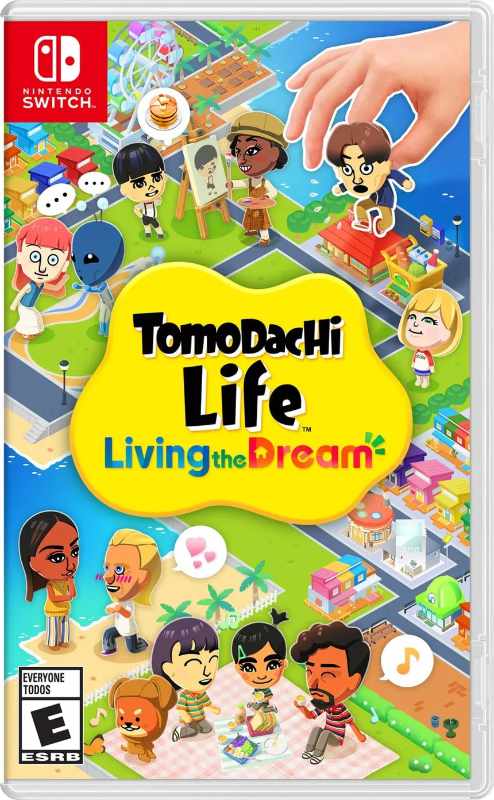
Tomodachi Life Living the Dream
Despite my trying over the years, I’ve never really been able to get into lifesim games. I’ve played multiple games in the genre but I always find myself getting bored or burnt out after long enough, even the really popular and high rated ones like Animal Crossing or Stardew Valley. Yet for some reason I absolutely adored Tomodachi Life. It’s one of the first games I got seriously addicted to, despite it just being you looking after a bunch of Mii’s, and still remains to this day as one of my favourite games on the console. I had been praying for years for a version of the game to come on to Nintendo Switch, especially after the incredible remake of Miitopia. Well, you can only imagine my excitement during the Nintendo Direct in March 2025, when we got the announcement for Tomodachi Life: Living the Dream (I’m honestly surprised I didn’t get a noise complaint from all the squealing I did). This is a game that I and the small yet passionate Tomodachi Life fanbase have been waiting for for more than a decade, so was that wait worth it? Tomodachi Life: Living the Dream was developed by Nintendo EPD, published by Nintendo and released on 16th April 2026 exclusively on Nintendo Switch (and Nintendo Switch 2 via backwards compatibility).
Building Your Community
So there really isn’t a story in this game, and there isn’t that much to describe when it comes to presentation (the graphics are more stylized and a step up from Miitopia, all the voices being text to speech is humorous and the music is very pleasant) so we’re just going to go straight into gameplay. Gameplay is basically the same as it was in the first game, you have a community of Mii’s that you have to take care of, all the while they meet, become friends and potentially become lovers.
Your first step to doing that is, of course, creating your Mii’s. Now we’ve come a long way from the Mii creator of 2013, back then it was essentially the same Mii Maker that you had on the Wii, with enough character options but not a lot. Tomodachi Life: Living the Dream essentially takes the Mii Maker from the Miitopia remake and somehow expands it even further. This game gives you more hairstyles and colour options, even letting you pick out the Mii’s fringe and separately from the back. Apply makeup or eyelashes to them for added flair. You can finally give them ears (the fact that that’s a new feature is quite baffling). And the facepaint from Miitopia is back, allowing you, if you have the artistic skills, to add any character from any media to the game. One thing that some people see as a flaw is the fact that you’re not able to use Mii’s that other people created like you were able to in Miitopia. I do believe it’s to encourage people to make their communities as custom as they can, especially as it’s more likely that people will create Mii’s of friends and family, which I do get, but I can also understand why those who aren’t as good as art or struggle drawing with the Switch controls will be a bit upset about not being able to put their favourite anime characters into the game.
Other customisation options include the usual, like height and width of the character, as well as the voice they can get, with the ability to make them go insanely weird or creepy if you want them to. One massive addition is the ability to select not only your Mii’s gender identity, but also their sexual orientation, this is probably the most wanted feature that fans of the previous game wanted, so the fact that it’s been added is super appreciated, especially for those in the LGBTQ+ community.
One definite downgrade from the 3DS game is the fact that your island now only has room for 70 Mii’s, in comparison to that game’s 100. 70 Mii’s is still a lot and you probably won’t be able to fill up that much space, but the reduced capacity is still a bit disappointing.
Customizing Your Island
One of the big selling points in this game is the fact that you can now see your Mii wandering the island and interact with each other outside instead of just in their own apartments. Thus the game gives you the complete freedom to customize the island however you want. Straight from the beginning, you have access to the Island Builder, which lets you make many additions and changes to your island, from adding aesthetic items like flowers or vending machines that your residents will interact with, to even letting you completely change the layout of your island.
Mii’s no longer live in one giant apartment building, but instead in individual lodgings and you can decide where they are placed. As well as the location of certain facilities that you and your island residents can interact with. Personally, I had all the houses put into their own corner, forming a small neighbourhood that everyone lives in, and have all the shops and whatnot spread throughout the rest of the island. Sadly there isn’t really much point in having more than one of each shop or facility outside of aesthetics, which for some would be fine enough, but personally I like to get some use out of everything I add, so it does take away a bit of my fun if I’m honest.
It’s not just you who decides how the island looks however, your Mii’s will also make suggestions on how to improve the island. Sometimes they will make big requests for changes, like new roads, or plants and benches to make the island more pleasing and easier for them to travel around, and sometimes they will just ask for one small thing to be added, like a spotlight or picnic table. The former suggestion I normally say yes to, as they are very good improvements, though the latter I’ve been denying more often than not, mostly because they just want to fill in empty space and it makes the island look more ugly in my opinion (they’ve already ruined one beach and are trying to ruin the second).
Interacting With Your Mii’s
Part of the reason why this game is so difficult to explain is because the majority of it is just helping your Mii’s with whatever problem they are currently going through. If they are having any mild inconvenience or decision to make, whether it be hunger, wanting new clothes, who to talk to, who to fall in love with, they will call for your assistance.
What they require depends entirely on the colour of the thought bubble above their head. Yellow normally means they need you to give them something, such as food, some new clothes, their room to look different, amongst other things.
Orange always relates to another Mii on the island. Sometimes they’ll just ask you how well they get along with a particular resident, though often it relates to the Mii having an interest in the other Mii and wanting to be their friend. These thought bubbles can also be one Mii wanting to become housemates with another, and having them move into a much bigger place if everything goes well. I do also like that when they do move in together they just stack their old lodgings on top of the new house and have them act as their rooms, it’s a nice touch.
One of the more common requests from the Mii’s will be to play games with you, sometimes they will ask you to play one on one and sometimes you will have multiple Mii’s participating. The type of game they’ll ask you to play will often be hinted at by where they are when they request it. One of the more common ones I’ve played involves you identifying items that have been hidden, either by pixelation, being silhouetted by a shadow, or by being zoomed in. Some of these games are really fun and I find myself playing them every time they’re requested, like Bowling, Red Light Green Light, or No Repeats (though my main problem with that game is the fact that the only subject on it seems to be food, I would have liked if there were other subjects to change things up a bit). Though there are some that I’m really not a fan of like What’s Missing or Poke the Ferris Wheel. When winning one of these, you’ll win a treasure that you can either pawn off or give to a Mii at a later point, though if you lose, they will give you either tissues or a roll of toilet paper, assumingly to help wipe away your tears after failing to identify a pixelated roast chicken.
All this is done in order to increase your Mii’s happiness. Each Mii has a happiness level that will increase the more tasks you do for them, with the amount that is increased depending on what task you complete for them, or how happy they are with a gift or food you’ve given them. Whenever they level up you’re able to give them a special reward, such as a unique gift that you’ll see them playing with in their spare time, like a football or camera. You can also give them a fun quirk that will change the way they greet people, the way they walk or even how they eat, you can also give them an expression to say whenever they’re in a certain mood.
However, don’t think that it’s just your Mii’s benefitting from their own happiness, as when you collect enough happiness points, you’re able to use them at the Wishing Fountain to increase your island’s rank and obtain items that can make island life a little better, like new decorations, interior designs for a Mii’s home, or just travel tickets to send your residents on a quick holiday. My one issue with this is the fact that your island ranks up incredibly easily – I only have to speak to a few Mii’s and already I’m able to unlock a new thing – meaning that I found myself unlocking everything insanely quickly – in fact, at time of writing, I have 122 unused wishes because there’s nothing to spend them on except travel tickets, so hopefully in the future they add more things for you to unlock, though I feel like this wouldn’t be as much of an issue if ranking up took a bit more work.
Getting Your Mii’s To Be Friends
For me at least, the most rewarding part of the game is seeing all your Mii’s become friends and interact with one another. Sometimes this will happen on its own, though most of the time they will come to you for assistance. Unlike the last game, if you want Mii’s to become friends you’re able to drag them to one another and force them into a conversation, most of the time this will lead to the two becoming acquaintances, though it is possible for the interaction to go badly. After a while, the Mii may ask you to help them become friends with the other Mii, after which you will have to give them a topic of conversation – one that you’ll have to write out for them, meaning that you can either add your own interests into the game, or you can be like everyone online and add in subjects that will require you to play this game on mute in polite company (you are all filthy people). Sometimes, someone will think that two Mii’s will get along swimmingly and will ask you to help them introduce the two Mii’s. If the conversation goes well, congrats, the two are now besties and you can even decide nicknames for each of them, otherwise, they’ll have to try again another day.
Friendships aren’t the extent of how close Mii’s can get, it is of course possible for Mii’s to develop romances for one another. This is something that you can try to set up, and who knows it might even work, but most of the time this will occur purely through random chance. This can be quite funny as it can lead to some unlikely and hilarious pairings – my islands weird couples consist of Ichiban from Like a Dragon and Inkling from Splatoon, Maomao from The Apothecary Diaries and Johnny Silverhand from Cyberpunk 2077, and most recently Grace Ashcroft from Resident Evil Requiem and Monkey D. Luffy from One Piece. It could be that one Mii helped out the other when they couldn’t move or had fallen over, possibly it could happen when the two Mii’s and just hanging out together and one of them does something cute, or it they might just get a crush on someone that they spot on the other side of the street. When this happens, you will see the Mii start blushing when interacting with their crush, they’ll start asking you more about that Mii and try to help get the two closer, and you’ll see them fantasizing about being “sweethearts” with their crush… on numerous occasions… per day (looking at you Calvin and Priya). It will eventually get to the point where the Mii cannot hide their feelings anymore and just HAS to confess, after which, with a little bit of guidance from you, there will be a cutscene showing how the confession goes. These cutscenes can get bloody wild, it’s not always a straight yes or no, if the Mii has multiple suitors, they can and will try to interject and ask the crush out themselves, which may even lead to the crush choosing one of the interjectors. There’s even a chance, if the Mii is a little too persistent, that one of the crush’s friends will go in their place to tell them that he/she/they aren’t interested… Those ones are especially devastating. If the crush says no, then the Mii will enter a pit of despair that you’ll have to get them out of, either by bombarding them with a horde of food and presents, or simply by sending them on a trip to Kyoto or something.
When Mii’s become sweethearts, as the game calls them, you’ll get unique interactions with the two, some of them sweet, like when they’re chasing each other on the beach, or some that are just really cringey, like their conversations in the restaurant (I never thought I’d hear someone describe their partner as “yummy”, and this game has made me realise that I hate that adjective). Eventually, if the relationship goes on for long enough (somewhere between three weeks to about thirty minutes), they decide that they want to marry the other Mii, which will have you play a bullet hell minigame to keep the proposers mind on their partner.
Soon enough, married Mii’s will even want to have a baby with one another, and will have one a couple of days after the idea is brought up. The baby will have some of the features of their parents, including facepaint if possible, and will even obtain the personality of the parents. The babies are a returning feature from the previous game, and this is my biggest disappointment this time around. You see, last time, the babies stayed as children for five days before fully growing up and becoming island residents, during that time you see them slowly grow up, their parents play and interact with them, and will have to help them on occasion. This time around, you get none of that, you get a single, admittedly adorable, cutscene of the baby growing up and then, BOOM, they’re fully grown. I was really looking forward to seeing how the babies would interact with the island, seeing them in strollers, being walked around the island, eventually running with their parents, and having them grow up that quickly makes the Mii’s having children feel more pointless, less rewarding and you don’t grow as attached to them as you did in the last game – especially as, once they are fully grown, they don’t get any unique interactions between them and the parents or anything like that, basically acting more as if they were friends rather than family. Mii’s having kids was one of my favourite features in Tomodachi Life and here it feels like a wasted opportunity.
Things aren’t always gonna be upbeat and happy, as relationship turmoil can and will happen after long enough. Mii’s can fall out with one another, making each other so angry that they may not want to be friends anymore, and while you can get them to calm down and try and make up, that doesn’t mean that the other will forgive them. Even relationships or marriages aren’t guaranteed to work out, with the chance of the sweethearts breaking up or divorcing if one isn’t happy in the relationship. This one isn’t a common occurrence, and in my over 100 hours in the game has only happened once, but it’s still very sad when it does happen.
Studio Workshop
The final thing that this game introduces is the creation studio, this gives you the ability to really customise your island with your own creations. You can make your own food (from looking online, people have been feeding their Mii’s cigarettes and cakes containing various hallucinogens). You can also customise clothes for them to wear, allowing you to add in real life clothing or have your Mii’s from popular media look more like themselves. You can create gifts and treasures that you can give your residents, like music records, jewels, or even pets – or in my case a lot of Pokemon. You can even design your own interiors and exteriors for your Mii’s houses. You can start just from scratch, or use an in game model as a base and edit on it. This is also the one time that the game will let you use touch controls, making it easier for you to draw. I will admit, I only have limited experience with this, mostly due to my ungodly level of incompetence of drawing and not having access to a switch stylus that a lot of other people have, but I can tell that this is a very well implemented mechanic that I’m sure a lot of the artistic crowd will get hours out of.
Conclusion
To say that I am addicted to this game is a massive understatement. I’ve had this game on in the background whenever I’ve been at my desk, and I am constantly looking back to it to see if my Mii’s need any help (this game is the reason why it’s taking me so long to get my Pragmata review out). While there are some features missing from the previous entry – town hall, events like rap battles, couples sleeping in the same bed and, of course, the babies slowly growing up – I’d say the new features definitely make up for it. I will admit that this isn’t a game for everyone, but those who this will appeal to will find it taking over their lives for a good while. It’s a game that I’ve been waiting over a decade for, and I’d say that the wait was worth it.
9.2/10
Anime Amigo and Nerd Consultant
Share This Post:


















Leave a Reply