
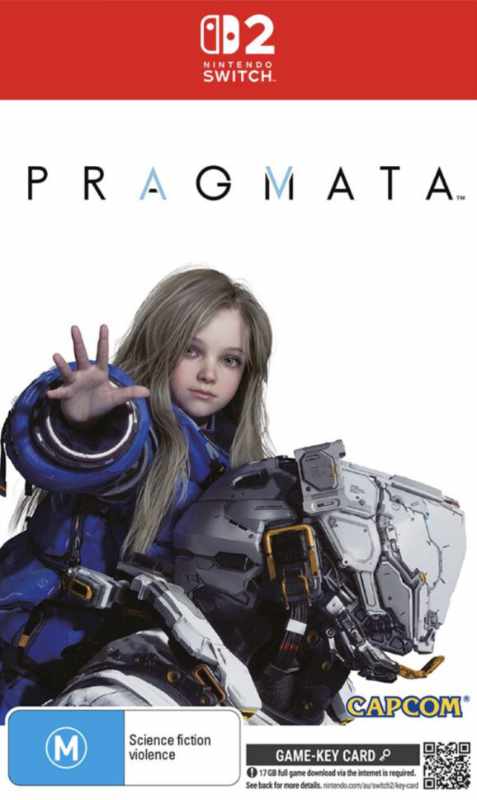
Pragmata
I’ve said this numerous times now, but Capcom has really been on a roll the last few years. It seems like every game they’ve released has gotten critical acclaim and is praised by fans. Resident Evil has arguably entered its best era, Street Fighter 6 has become one of the most popular fighting games today, and they’re even revitalising classic franchises with games like Mega Man: Dual Overdrive or Onimusha: Way of the Sword. Thus leading us into their newest IP, Pragmata. the game was announced all the way back in June 2020 – nearly six years ago – and ended up getting delayed over and over, eventually being delayed indefinitely in 2023. Finally in 2025 we finally got a new trailer for it, with a release window that they actually stuck with. Pragmata was developed and published by Capcom and released on 17th April 2026 for Playstation 5, Xbox Series X/S, Nintendo Switch 2 and PC.
Story
You take on the role of Hugh Williams, a systems engineer who’s been sent to a mining outpost called The Cradle, along with a small team, after communications with them and Earth have stopped. Shortly after arriving, the base is struck by a moonquake, which kills everyone on the support team except Hugh who is knocked unconscious. He is awoken by a Pragmata, an android designed to look like a little girl, who Hugh names Diana (which thank god because I do not want to be writing Pragmata D-I-0336-7 this entire review). He soon enough learns that the stations’ AI, IDUS, has turned hostile and begins using various robots to try and take out our heroes, a skirmish that Hugh only survives due to Diana’s ability to hack into said robots. Now with his new trusty and adorable companion, Hugh must traverse through the outpost, to try and figure out exactly what’s going on and to try and find a way back home.
The story as a whole is fine. It’s fairly generic and can be pretty predictable at times, though as a whole inoffensive and still well told. The main draw of the story is the relationship between Hugh and Diana, the two quickly take on a father and daughter role and it’s written in a way that feels very natural and well developed. I especially love Diana, who, despite being an android, acts just like a little kid, having the same playfulness and excited curiosity that someone of her age would have, it’s simply delightful.
Presentation
Graphically, the game looks great, once again using the RE Engine it has the same detailed presentation options that you had in Resident Evil Requiem, giving you general options like texture and shadow quality, but also details like hair strands. Once again telling you how much of your PC’s GPU the graphics settings use up, ensuring the most stable and best-looking experience you can have.
Despite the entire game taking place in a mining outpost, there is a decent amount of variety in the environments. I’m specifically thinking about the amazing spectacle that is the city, with bright coloured billboards whose neon lights bleed into the reflections on the pavement below, or when you go outside and traverse across the moon, showing you just how vast his outpost is all the while seeing the Earth in the distance. The environments make you want to dive deeper into the outpost, to explore every inch of it and see what’s hiding in its depths.
You really don’t meet a lot of characters in this game, for the most part it’s just Hugh and Diana – and one other character which we won’t get into because of spoilers. Both of our main characters are designed excellently. I love how Hugh’s suit looks, having a cool helmet similar to Issac Clark’s from Dead Space, with the rest of it being somewhat puffy like you would expect a space suit to be. I also love Diana’s design, her very long hair and the blue puffer jacket only add to how cute she is. The hostile robots are definitely a highlight looks-wise. A number of them look simple, white plated humanoids, but their uncanniness and how human they look can make them feel very intimidating. You get an idea on how a number of them fight based on how they look as well, with details like components, limbs or some just straight up looking like tanks. It’s a great way of hinting at how they work instead of straight up telling you. Not to mention they all look very distinct, so you won’t be mistaking one robot for another.
I seriously love the voice acting in this game. David Menkin, who’s previously voiced Barnabas from Final Fantasy XVI, and Malos from Xenoblade Chronicles 2, puts on a great performance as Hugh. That being said though, the star of the show is clearly Grace Saif, who’s only had one named role in the past (Manana from Xenoblade Chronicles 3), as Diana, she perfectly did the speech patterns and mannerisms of a giddy child. Genuinely one of the best performances of the year.
The game’s soundtrack perfectly matches the sci-fi setting. Many of the songs go for an upbeat techno sound, similar to what you’d hear in a rave. While the songs never get too intense, in my opinion anyway, they do fit well in battles – being fast paced and striking while not feeling like it’s a fierce gunfight. There are also a number of slower and calmer tracks, them being droning and ambient notes or slow piano pieces. They’re the kind of songs you would imagine listening to while staring at the night sky or a sunset. The soundtrack is a blend that perfectly accompanies the story about a collapsing outpost with a lot of heart added into it.
Combat
Pragmata is a third person shooter where you explore various sectors and defeat anything slightly robotic that would hinder your progress. The action isn’t as fast-paced as something like Devil May Cry, but at the same time it’s not as slow as Resident Evil. Really combat is a bit like a puzzle, requiring you to work to open the enemies up for just moderate damage. What do I mean by this? Well you see, the plating on enemies is near bullet-proof, therefore the damage you’ll be dealing is less than pitiful, so it’s Diana’s job to hack into them and open up the plating so you can deal some real damage.
The hacking in this game is actually fairly simple. When activated you’ll see a square grid with a bunch of blue icons spread throughout it, as well as a power symbol that will open the robot up. All you have to do is move the cursor towards that power symbol while moving it across as many of the blue icons as you can, and the more icons you cover, the longer the enemy will remain open for. Is that all there is to the hacking? Of course not, as there are some things to make it easier and more challenging. One powerup you’ll be utilising a lot I would imagine are the hacking nodes which are equipable enhancements that will add extra effects to your hacks when activated. For example, Multihack will hack all enemies within a certain range, Freeze will stun enemies for a short period, and Confuse will make enemies attack one another instead of you – unless you’re their only opponent. There are also hindrances that will prevent the perfect hack, some enemies could have walls, looking a lot like warning symbols that you’ll have to go around, as well as red warning symbols that will completely cancel your attempt, forcing you to start again. Some enemies will also have an external shield that will also block you from moving the cursor, forcing you to shoot and destroy that shield before you can pull off a successful hack. The hacking system is what makes this game as fun as it is. It’s easy enough to understand but also makes the fights much more tense and difficult, forcing you to multitask and concentrate on numerous things to get the advantage. It will definitely be a struggle for some people to get used to, but it’s still a ton of fun to do.
Now, I imagine the most common way that people will be playing this game is with a controller, though you can also use the mouse on PC, and both come with their pros and cons. When hacking with the mouse you have the advantage of speed. though you’re far more likely to make mistakes, meanwhile with a controller you’re much slower but you’re not going to have as many accuracy problems. It’s a risk reward no matter which control style you go with, and I think it’s really good that the game does that. I personally used the mouse to get the better hacking speed, though I will admit the allure of better accuracy was certainly enticing.
For weapons, you do have a bit of a variety. The main weapon you’ll be carrying is your trusty pistol; it doesn’t deal too much damage although it is the only weapon that reloads on its own. That’s right, all other weapons don’t reload, in fact once they run out of ammunition they are destroyed. This may seem like a downside, but I honestly quite like it, it’s kind of similar to the weapon degradation in The Legend of Zelda: Breath of the Wild and Tears of the Kingdom – though not as infuriating as in those games – forcing you to improvise with what you’ve got and having to keep an eye out for other weapons to use. The weapons you can use are pretty unique to this game and aren’t just designed for damaging. Yes, you do get your usual shotgun and charge gun, though there are some that have unique abilities. These can include the Stasis Net that immobilises enemies for a short period, Sticky Bombs that decrease the size of the hacking grid, and the Hacking Mines that will let you perform a hack on it and it will automatically hack every enemy within range, even affecting them with the same nodes.
If there’s any issue that I have with combat, then it’s the healing. You have access to a number of healing cartridges to use when a battle gets a bit too hectic and you take a bit of damage, and this is probably one of my least favourite healing systems that I’ve experienced in a while. For starters, you have to hold down the healing button to be able to use it, meaning that if you’re desperate for health, you still have a risk of being hit before you’re able to heal. Even then, you have to be planted firmly on the ground in order to be able to use it. If you’re dodging or hovering or doing anything other than standing or running, then you won’t be able to even hold the button down to use a cartridge when you land. Not to mention, when you do manage to use a cartridge, it heals very little, maybe a quarter of your health at the start of the game, and you only have two of them at the beginning. It feels like the healing is designed specifically against the player to the point where it feels really unfair at times. Not even Dark Souls is that restrictive with its healing.
As mentioned, enemies are very distinctive and each will fight you in different ways. How you fight them will be the same, but what will be different is the placement of their weak points and their main attacks and how to avoid them. There are some whose main attacks are by jumping, and therefore you’ll have to be off the ground when they do, some will bombard you with missiles forcing you to dodge all over the place before you can try and hack them or use one of your special guns, and there are some that are smaller that are super-fast and difficult to shoot though they don’t have a lot of health and their weak spot is their entire body. The challenge with fights is trying to juggle fighting multiple enemies that require different methods to combat, it makes the fights thrilling and can make even the weakest enemies a threat if you’re not careful.
Level Design and Exploration
Pragmata is a semi-open game, meaning it does have some open areas though the level progression is pretty linear. The game is split into various sectors, each one bringing different environments and challenges for you to combat. Like Sector 2 making you explore numerous buildings to find switches to unlock a big door blocking your way, or Sector 4 taking place outside, meaning you’ll be dealing with zero gravity as well as a boss monster constantly hunting you down. Each level brings a new gimmick or challenge for you to deal with, ensuring a different experience with each new area.
There is a decent amount of platforming and verticality in this game, either from the layout of the sector or due to the gradual decay of the outpost. Luckily, Hugh has a jetpack to help with this, letting him hover and dash from one platform to another. This jetpack does require energy to be used, though it does restore itself fairly quickly.
There are a number of puzzles for you to solve throughout the outpost, and these sections are Diana’s time to shine. That’s right, it’s not just robots that she’s able to hack, as there will be a number of door and elevator switches that will need to be accessed to move forward. These hacking minigames are simple to understand and easy to solve, taking the form of switches you’ll have to rotate by pressing certain buttons, a particular button sequence or the same but with timing the button presses involved. You do get a timer that will tick down, but it gives you way too much time in my opinion, to the point that I forgot there was a timer half the time. If you do end up failing the hack you don’t really get punished, you just have to start the puzzle again. I’m a little mixed on this, I understand that failing one of these while in combat would be stressful, but when exploring it’s just a minor annoyance, making me almost wish that it was a little more punishing, losing a little bit of health upon failure for example.
If you start getting tired or are running out of resources, then you can always return to your Safe Room. As the name implies, this is a small hub that is devoid of enemies, where you can heal up and regain all your healing nodes. There are a number of checkpoints in each sector that will take you back here and will let you return to that same spot when you’re ready to continue (though with all the enemies being respawned as well), and when you die you’ll automatically respawn back here. It’s also here that you can upgrade your weapons and hacking nodes, as well as your suit and Diana’s hacking abilities. It’s also here that you can take on the Training Simulations, small yet difficult challenges that will net you a number of rewards and upgrades, with secondary objectives that make the Simulations extra laborious, but the extra goodies make them very worth it. Or, while you’re here, you can have a quick chat with Diana, where you’ll learn more about the two characters and bring them closer than before. Once it’s time to leave, you’re able to select your loadout, deciding on what weapons, hacking nodes and mods you want to bring with you as you descend further into the outpost.
One thing I heavily praise this game for is how well it rewards you for exploration. There are not only a couple of cute collectibles for you to find, like Earth Memories which are items from back home – mostly toys – for Diana to play with back in base (with crayons being the best because she will draw numerous pictures of her and Hugh, the one instance of AI art I can approve of). Throughout the levels there are a number of goodies that will greatly strengthen you in battle, like new mods that will add passive abilities to greatly help you in combat and exploration, upgrade materials for your equipment, and even expansions to your storage letting you carry more weapons or more healing equipment. It gives you great incentive to go out of your way to find everything in each level, especially as each area will have a checklist of what’s left to find in them.
Conclusion
Even amongst all the fantastic releases that Capcom have released the last few years, this one still finds a way to stand out. Pragmata is an incredibly fun game, with one of my favourite combat systems that the company has ever made, making the game challenging and ensuring that combat encounters will never get tiresome. While the story’s nothing too special, the dynamic between Hugh and Diana will pull on the hearts of anyone playing. If you ask me, this is an absolute must buy for everyone this year. I am certain I will be replaying this in the near future and I hope that this is the start of a new franchise for Capcom.
9.4/10
Anime Amigo and Nerd Consultant
Share This Post:




Leave a Reply