Author: Calvin Atkinson

  • Shang-Chi and the Legend of the Ten Rings – Review

    Shang-Chi and the Legend of the Ten Rings – Review


    “SHANG-CHI AND THE LEGEND OF THE TEN RINGS”

    Shang-Chi and the Ten Rings is the first Asian American led film in the MCU, taking lesser-known martial arts-based hero, Shang-Chi, and hoping to propel him to a bigger role. Marvel is very committed to this—the entire cast is almost entirely made up of Asian actors and it’s very much enriched by the culture it’s based on. Destin Daniel Cretton, who directed the films, Short Term and Just Mercy, was hired to direct. The cynical part of me really saw this film as a marketing exercise. Disney has been really trying to make films to appeal to the Chinese film market, considering that they are now the second biggest film market in the world (and this has been especially the case in recent memory). Have you ever wondered why Disney kind of gave up making Star Wars spin-offs after Solo: A Star Wars story? Well, while there’s the fact that Solo was rather disappointing in the box office, it’s also the fact that Star Wars wasn’t doing very well in China. It’s also one of the big things that propelled the terrible Mulan remake that went straight to Disney Plus last year. This one certainly is part of that marketing drive, though it at least doesn’t feel like any major censorship has gone on here, and it is very respectful to the culture. The first ten minutes, for example, are done entirely in Chinese and most of the film takes place in China.

    I’m not sure at this point in time whether Shang-Chi and the Ten Rings is a filler Marvel movie or a much more eventful one; the film seems to want to go down both routes. But I will say it’s a very good origin story for the character. Shang-Chi played by Simu Liu, runs away from home and takes a job as a driver for a hotel, alongside his friend Katie, played by Awkwafina. Shang-Chi is completely rocked one day when his father’s organisation The Ten Rings, immediately goes after them and steals one of his mother’s pendants. The next target will be his sister Xialing, played by Meng’ er Zhang, unless he travels to Makow(?) to look for her and keep her safe. One of the things that surprises me about Shang-Chi is that it’s a surprisingly personal story. It probably has one of the better villains of the MCU. In this case, it’s Shang and Xialing’s father Xu Wenwu, played by Tony Chiu-Wai Leung. And the film strikes an incredible balance of keeping his motivations sympathetic but his actions unjustifiable. I won’t spoil it but the film does an excellent job with this and it’s amazing how well the character work was handled in this one. Initially, it didn’t feel very much like and MCU film but it definitely moulds more into that as the film goes on, though the introduction of Razor Fist into the MCU is probably the most Marvel thing in this one. He’s played by Florian Munteanu who played Drago’s son in Creed 2.

    Now, Shang-Chi is not one of my favourite Marvel characters but the film does a very good job introducing this incarnation of the character, establishing his back story, and really giving us an idea of what the character is capable of. There are not really many super powers in this one; it’s definitely very martial-art focused, though obviously in a very exaggerated way (if there’s one film that it reminded me of very early on it was Crouching Tiger, Hidden Dragon). But it also does a good job with establishing the side cast, and it’s a very strong side cast. That’s definitely been something I think has been weak in some of the Marvel films but this one does a very good job of it. Xialing’s character would probably be the one that’s most changed for comic fans, mainly because she’s actually an amalgam of Shang-Chi’s five sisters all rolled into one. I personally thought this was a smarter decision—they probably wouldn’t have been able to get all of them into the one film and saving some of them for sequels would probably be a bad idea, plus the smaller family unit meant it could lead to a better dynamic as the film went on. This film has brilliant special effects also and the fight choreography is phenomenal; it’s a testament to the fact that the film is dedicated to one of the choreographers who has sadly died. The cast also gives excellent performances; there’s not a single bad performance. Actually, I think this is one of the better-acted Marvel films and it amazed me how well the direction was for all the performances; you can really tell a lot of love, care and passion was brought into the project.

    Now, Shang-Chi is quite a bit longer than most Marvel films—it goes on for two hours and twelve minutes if you include the credits and both the mid- and post-credit scene (which still annoys me when people walk out before they play). It definitely felt like the film was going on a little too long by the end of it. I also think there are a few moments where the comedy doesn’t quite land; most of it does but there were a couple of times where I thought, “I’m not sure that worked out very well there”. There were also some very weird callbacks to a lot of moments in the Marvel Cinematic Universe, particularly Iron Man 3 since this film must pretty much retcon a lot of the plot elements of Iron Man 3 since the Ten Rings were invoked in that film, but obviously the way it was invoked in that one doesn’t apply to this. They have a good way of getting around it—it’s actually a retcon that I think works. Overall, there’s not really much bad I can say about Shang-Chi and the Ten Rings; it’s a very good entry in the Marvel Cinematic Universe and it delivers on taking a not-as-well-known character and propelling them excellently. I really enjoyed this film a lot more than I was expecting to, and I think it’s up there with some of the better Marvel films. The martial arts choreography is great; the story is both personal and well-done; it’s really respectful to the culture and does a brilliant job with both its cast and their performances; and it just feels all-round great. I really hope that this does well and we get more of these characters in the Marvel Cinematic Universe but time will obviously tell. Oh, and stick around, because there are two scenes to watch out for: a mid-credit scene and a post-credit scene. The mid-credit scene sets up future films—though I’m not quite sure how—and the same goes for the post-credit scene which confirms that the cast of this film is going to be used in MCU’s future.
     
    Calvin – Nerd Consultant

    Share This Post:
    Facebooktwitterlinkedinmail
  • Candyman – Review

    Candyman – Review


    “CANDYMAN”

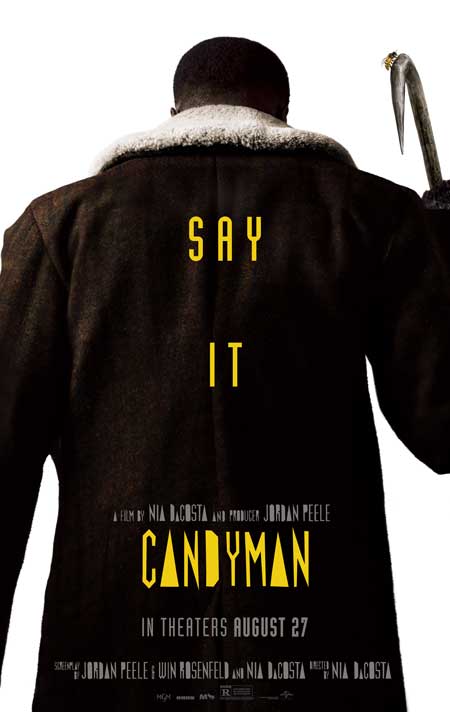
    I am someone who actually thinks quite highly of the first Candyman film, in spite of its rather problematic nature in regard to its race politics, which were heavily influenced by the studio. If you want more examples of this, I would really recommend listening to some of the interviews with the star of the film himself, Tony Todd, as he goes into great detail about it. However, unlike many things from that time period that are quite problematic, I don’t think you should completely count Candyman out. It is actually a very well-directed and written film, and it actually does what a lot of good horror films do; it is very slow and methodical, there are not actually a lot of kills in the final film. It was recently announced Candyman was going to be coming back under the director Nia DaCosta, and producer Jordan Peel, who both wrote the screenplay for the film as well. This time, the film would not only have an entirely African-American cast (bar one British actor; Nathan Stewart-Jarrett), but would also have an animated short which came out last year. I have not actually seen the short prior to going into this film, but I am aware that many of the animations were also used in the final film.

    The plotline is a fairly interesting one, I went into Candyman based on the trailers, believing that it was going to be a re-boot of the franchise, however, the Odeon website when I booked to see the film, stated it was a ‘spiritual sequel’. I can confirm now that the Odeon site is correct, and whilst I will not give away exactly how, this version of Candyman does tie in to previous films. I would recommend if you want to see this film, you probably will not get as much out of it without at least seeing the first film. The first film is what it ties back to the most, in fact rather interestingly, I actually re-watched the first film in the morning, just before I went to see the actual film. If you are going to see it, see the unrated cut, it is the one that most of the cast and the directors like, as there was less studio interference and it gets rid of plot holes that are in the R-rated version.

    Now, I will not explain exactly how Candyman 2021 is a ‘spiritual sequel’ to the other films, but it becomes apparent as the film goes on. The film is set around an artist, Anthony McCoy, who, upon investigating the neighbourhood that the first Candyman film is set in, becomes enamored by the story of the Candyman: A local named Sherman Fields gave candy to kids, only for a razorblade to be found in one of them. Following this, he was gunned down by police, only for it to be discovered later down the line that he was innocent, and would return in revenge as the Candyman. Using the same idea of when you look in the mirror and say his name five times, he will appear and kill you. Anthony, after learning this, develops a whole art exhibit about it whilst also trying to discuss middle-class gentrification, only to discover that he has accidentally re-awoken the myth and soon people will begin to die at the hands of Candyman all over again. You can probably tell from this description that this Candyman is a very politically charged film, and it wears it on its sleeve. There is no mistake that this film deals with the subject with white supremacist politics, particularly in how law enforcement structures have been allowed to continue in the way they have, it is no mistake this has come out almost a year to the date of George Floyd’s murder. I actually thought this was a genius decision. The best horror films always come from true societal fears and there is nothing more scary for individuals than this in America if you are not white.

    There is also a lot of references to Breonna Taylor in this film, particularly “Say his name” (used in the film), which is based on the slogan of “Say her name”, and in fact one of the leads is also called Brianna. As it was not largely advertised in the UK, I will get you caught up; Breonna Taylor was a black woman who was gunned down in her own home by a swat team. Therefore, from the start, this film is coming from a sincere angle and as a result, feels like a modern update to the story.

    Whilst Candyman is kind of indiscriminative in this film, most of the victims are very much in the wrong. They are failing to support gentrification and people that are taking advantage of a system that has allowed them the status they have, and can twist the facts. It is no mistake in how these victims are chosen in this film and it also does a very good job at tying back into the first film. Again, I will not spoil it exactly, but you will be thinking part way through that this does tie back to the first film in some cases, but facts have been changed along the way. However, I do not think it has done a great job all around. For one thing, it really only feels like it is there for one plot point, you could have actually probably made this a re-boot, and it would have been successful, it does actually pull off what it is attempting to do quite well, and there is at least one decent plot twist later in the film. However, there is a second one that really feels a bit strange, it kind of feels like it is confusing, especially considering this film is very much targeting racism, I thought this choice kind of undermined what they were going for. But at the same time, I don’t feel as though I am in a position to comment on it, though I would definitely be interested to hear from Nia DaCosta or Jordan Peel as to where they were going with this.

    I think my biggest problem with the film though is with Candyman himself. Filling Toby Todd’s shoes is quite difficult to do and I will say Michael Hargrove is a good casting choice, he definitely has the look down. They did a very good job with making him look like Candyman, he suits the hook for his hand very well, and the big puffy coat. He certainly can look menacing but nothing about Candyman feels hypnotic in this film. If you go back to the first film, Toby Todd’s version of the character almost feels like a dream-like figure, he almost draws you in. His fascination with Helen in the first film is one of the best parts of that film, and he has a lot more personality than your average horror movie villains. Hargrove certainly can do most of that, and they do try to do a lot with modern effects to give that dream-like effect from the first film, but for whatever reason Hargrove is not really allowed to talk in this film, which means he just becomes another movie killer. There is not much personality to this version of Candyman, and he does not really get one until the end of the film.

    I know I comment a lot about films being too long, but this film feels too short. I wouldn’t be surprised if there had been some cuts made to this film or some studio mandates because it only lasts about an hour and a half. I think they could have done with a bit more time, and by the time it had finished, I was thinking I wanted more. You could also nit-pick the hell out of this film and say that the film doesn’t exactly abide by the rules that it lays out, but honestly you’d be dissecting this film a little too much for the wrong reasons, and also the other films weren’t exactly great at being their own internal logic either. But again, they are still good films with decent writers with good characters and this means people are more likely to forgive a few shaky plot holes. I think the thing that really sold this film for me was the lead up to the arrival of Yahya Abdul-Mateen II (in the role of Anthony). He really nails this performance, and there are a lot of other good performances in the film too. I really appreciated Teyonah Parris’ performance as Brianna, and Nathan Stewart-Jarrett actually did a really good American accent (which I wasn’t aware he could do as I’m used to seeing him from his days in Misfits). I really liked acts like Colman Domingo in the film, and despite not being given enough to do in this film, Michael Hargrove could actually make a very good Candyman, if he was allowed to show off a bit more personality. My only real problem with this film is that it is a bit too much of a generic slasher in parts. There was one kill sequence in particular where I thought, you could probably take this out of the film, and it probably wouldn’t make too much of a difference, it felt like it was made for the trailer instead.

    This version of Candyman is a decent spiritual successor with an excellent and relevant point to get across, and is commendable in so many regards. It is also brilliantly shot and directed. However, it also at times feels like it falls back into being too much of a generic slasher. This version of Candyman needed a bit more work, and given a lot more lines and things to do. The film was also a little too short for my liking. Maybe there were a bunch of other scenes that could’ve dragged the scenes out too much and I’m going to see a directors cut that I think is worse than the theatrical cut, but at the end of the day I am judging what I have got at the minute.I do really recommend seeing the film, especially if you are a fan of the original. It is a very commendable film, however I just think it falls a little short in a couple of regards. But I would say, I do believe the performances and the ending sequence do make up for a lot of it.
     
    Calvin – Nerd Consultant

    Share This Post:
    Facebooktwitterlinkedinmail
  • Twelve Minutes – Game Review

    Twelve Minutes – Game Review


    Twelve Minutes

    (Available for Xbox One, Xbox Series X and S and PC)
    (PC version used for review)

    Twelve Minutes is a point and click narrative game developed by Annapurna as an Xbox console exclusive with a day 1 release on Xbox Game Pass for subscribers. The game uses the narrative device of a time loop. You play as an unnamed husband (played by James McAvoy) coming home to have dinner with his wife (played by Daisey Ridley) who has a big announcement. The evening is interrupted however by a Cop (played by Willem Dafoe) breaking in and arresting the wife for the murder of her father, and demanding the location of a pocket watch. The husband is killed before the location of the pocket watch is learned. The game then rewinds to the beginning, and the husband finds himself at the start of the evening and must repeat the same 12 minutes over and over again to find a solution. This is done by using the items, the environment and the other characters routines to learn more and attempt to end the time loops. Think of it as a less conventional puzzle game with a ticking clock.

    Pros

    • The look of the game: I actually really like the top-down perspective of the game as it gives the effect of feeling like a doll house that you are controlling. The art style also compliments this well. The graphics are not brilliant, especially in how texture and facial features are handled (as is seen in many of the few close up perspectives we see), but the developers make up for that by keeping the perspective further away to not draw attention to it. The design of the rooms is also great, providing a feeling that they are being lived in, like the place has genuinely been inhabited by a couple for years with things like washing everywhere and a faulty light switch which is a subtle but effective design choice to give a sense of realism to the characters’ lives.
    • Point and click controls: I would really recommend playing the game with a mouse rather than a controller. This game was really built with a mouse in mind like most point and click games and is also much faster in performing actions this way, which is what you need given that there are several time sensitive events happening in each loop and missing these can completely ruin what you wanted to do in a run.
    • Performances: The actors all give really good performances. Willem Dafoe is very recognisable but still convincingly moves into his character well. James McAvoy and Daisey Ridley also give excellent performances especially considering they do good American accents that make them sound unrecognisable. All 3 actors also must deliver performances that progress through the various stages of character development, and go backwards and forwards between them which is not as easy as you would think. They do a good job drawing you into the story as well, which if these performances were not as good, I think I would have given up playing.

    Mixed

    • Story: A game like this has to really rely on its story. The story has excellent set up and intrigue as you uncover new elements with each loop, and it really had me invested to begin with. However, it slowly started to lose me the more it went on. The more you play, the less intrigue there is as you solve most of the mysteries around 2 hours in, and then are just looking for a solution to end the loops and that is when it really feels like it is dragging. There was one point I thought I got the true ending, only to be thrown back to the beginning again much to my frustration. The final twist at the end is also really bad, so much so that it is getting its own section.

    Cons

    • The game is a bit too cryptic, and a guide is really required to get the true ending: I stand by the latter part of that one. I have no idea how you would figure that out unless someone told you. The game really gives minimal clues on what you are supposed to do and is really frustrating for it since unlike other puzzle-focused games, you do not have all the time in the world to figure it out. I was trying my best, but I will freely admit after so many failed loops and absolute confusion, I caved and looked up a guide. When I did this there was a ton of moments where I said out loud; “How was I supposed to figure out that?”. I know puzzle games are challenging but they normally give you clues and time to figure it out, but there was a lot of times in this game where neither happens and you will stumble upon the answer by chance. I know the developers are trying something a bit different and that is commendable, but I do not think it works well in execution. If the story has ‘gripped’ you, take my advice do not beat yourself up, get a guide. I happen to know a few other reviewers were also struggling for the same reason and were communicating amongst themselves to solve it, so do not feel bad if you are struggling.
    • It is really boring doing the same thing over and over again after a while: I know this is the core premise of the game but considering each loop is a maximum of 12 minutes, it can get real old real fast, especially with not too many options to skip to certain points. The game is thankfully not long, and you can beat the game in about 4 hours (which can be cut down if you use a guide), and the 100% completion time which requires getting the achievement for seeing all the multiple endings (which I did not do as one ending was enough for me), has an average of 7 hours according to How Long To Beat.com. The charm wears thin after a while, especially if you screw something up in a loop such as I did, which meant that to get the information, I had to repeat the same actions about 3 times. As a result, I actually grew more and more frustrated with it as I was playing it.
    • The final plot twist: This was the absolute lowest moment of the game for me. I looked up a guide out of frustration and managed to get the true ending (there are about 5 endings in total, I only saw the others on YouTube and could not be bothered playing any more to get a trophy). As a result, I lost a lot of good will I had for the story. I will not give away the twist, but it is the classic “well you did not see it coming so therefore it is good”-twist, which I despise because I keep saying a twist still has to have some basis in the plot and tie back to elements we saw. This has to have one of the most insane out-there-twists that completely invalidates the story that came before it, and it really annoyed me. If you somehow make it to the true ending and get this twist, look up Overly Sarcastic Productions Trope Talk on plot twists; they do an excellent job explaining what makes twists good or bad and while they do not talk about the twist of Twelve Minutes, I reckon you could relate it back to this twist as to why it is really bad.

    Overall thoughts

    Twelve Minutes is an ambitious project with some cool ideas, but the execution does not really work. The puzzles are little too cryptic and will have even the most dedicated puzzle gamers reaching for a guide out of frustration and believe me the time sensitive nature of the game will have you frustrated. By the third hour mark I was so bored of the game, and repeatedly doing the same thing over and over again that I did give up and get a guide because I really wanted to see the ending. The story has good intrigue but it loses its lustre later down the line and the ending is terrible. It is not the worst thing ever, but it is not too good either

    Score: 5.9/10

    It might be cheaper than most games, but I would say that if the trailer made you curious, then sign up to Xbox Game Pass (if you have not already), and check it out that way because you can play something better afterwards. I would also recommend having a YouTube guide on standby while you do, and listen carefully to what they say you are not getting to the true ending without it.

    Calvin
    Nerd Consultant

    Share This Post:
    Facebooktwitterlinkedinmail
  • Josee, the Tiger and the Fish – Review

    Josee, the Tiger and the Fish – Review


    “JOSEE, THE TIGER AND THE FISH”

    Josee, the Tiger and the Fish is the latest Anime project from Studio BONES whose current high-profile project is the adaptation of ‘My Hero Academia’. In this case, they are adapting a short story written by Seiko Tanabe that was written all the way back in the 1980s and is not the first time that this story has been adapted. It was previously adapted in the 2000s under another live-action film, once again with an all-Japanese cast, but was also adapted last year by a Korean production company with the knowledge that the film was coming out around the same time as the Anime. To avoid confusion, the film was simply named Josee. The film was directed by Kôtarô Tamura, a man who mostly works on storyboards. If you follow Anime circles, you will definitely recognise a lot of the series he has made storyboards for, with a screenplay written by Sayaka Kuwamura who has written a lot of screenplays for live-action Japanese dramas, this being her first Anime project.

    Now I actually saw this film by chance; I was not actually meant to go and review it. But, due to a mix-up, I had to get a new ticket and happened to see that this was playing around the time I arrived in Liverpool, so I picked up a ticket to go and see it. It is not actually going to be playing in too many cinemas, and since this film is licenced by alltheanime.com, expect it to get a Blu-ray release in a few months time. So, this is more of a review of what film you can expect to see in a few months time and whether it is worth getting when it receives home release. If you are lucky enough that a cinema in your area is playing it, take this review into account as I do not know if any extra dates have been added.

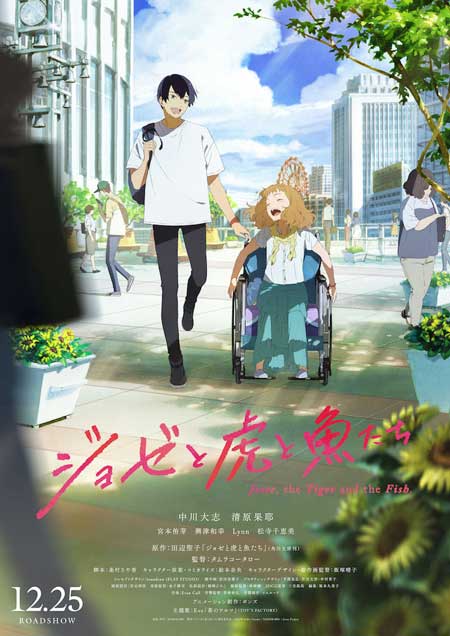
    Now obviously Josee is one of the lead characters in this film, but we are first introduced to the other main character, Tsuneo Suzukawa, a Marine Biology student and enthusiastic diver who wants to study abroad in Mexico and is saving up money to do so by working several jobs. He comes across the titular character Josee by chance after he saves her from being injured, after her wheelchair was pushed down a hill. Her grandmother, very thankful for helping her out, offers him a job as a caretaker providing that he never takes her outside. Josee, however, is an artist fascinated with the ocean, and one day after her grandmother leaves home, he takes her to see it. From there, Tsuneo introduces her more and more to the world she has been cut off from.

    Yes, this is not the most original film in the world. It is very much a sweet romcom and is kind of typical of Anime tropes if you watch a lot of Anime like this. I will say however that it is really good in that department. I think Anime fans are tired of characters being teenagers in high school and will appreciate that both Tsuneo and Josee are in their early to mid-twenties. I know it does not sound like much but trust me, when you have seen a ton of romcoms with characters in their mid to late teens, it makes a massive bit of difference. As a result, we never get a typical high school setting. Tsuneo is a university student but there are not too many scenes of him actually in university, though he does build up quite a rapport with one of his professors who is trying to get him a scholarship. But most of the side cast really consists of Josee’s grandmother and Tsuneo’s friends from the diving shop that he works at.

    Another thing that this film does well is its fascination with the ocean. The best stories of the ocean capture what is so fascinating about the ocean in real life, the fact that it is both otherworldly yet terrestrial, almost real yet unreal. You cannot believe how diverse it is in both life and scope, and this film nails it! We do not actually see too much of it in the literal sense, but the film does do an excellent job through Josee’s art, and art becomes a major plot point later on as well as several other factors, like a trip that Tsuneo and Josee make to an aquarium. The other thing is that despite the fact this is an obvious romance film right from the start, they had to do a very good job building up the chemistry between the two leads and they do not do the one thing that I really hate in romance fiction: having one of the characters take up all the character traits while the other one’s personality is almost entirely comprised of the fact that they are either in a relationship or want to be romantically linked with another character. They do a pretty good job with both Josee’s character and Tsuneo’s.

    Despite the fact that Tsuneo is a caretaker—and, in fact, Josee throughout the entire film refers to him only as “caretaker”—he certainly is not doing much of what you would expect from a person in that position. Josee is shown to be a fairly capable character, being reminded more and more just how capable she is as Tsuneo brings her more and more out of her shell. I also like the fact that they avoid a lot of tropes that are really getting boring in films like this. For example, despite the grandmother’s resistance towards the idea, when she finds out, she does not immediately ban Tsuneo from visiting the home; she actually assesses the situation and comes to the conclusion that she might have been in the wrong in this scenario, seeing how well Josee is doing.

    The film has a stronger second half than it does the first half. That is not saying the first half is weak, but the film’s biggest strong points come through in the second half. For one thing, I have not really been discussing much about the fact that one of the leads is a wheelchair-bound character; the film never specifies why Josee is wheelchair-bound. However, she does not use it all the time, having alternative equipment to get her around the house and do her tasks. Most noticeably, we see her having some steps to reach the kitchen work surface to cook. What is pleasantly surprising is the fact that the writers do not make the fact that she is a disabled character (apologies if that is the wrong phrase to use, feel free to correct me in the comment section) her entire identity, but actually make her a fully three-dimensional character. She is a talented artist who is very cynical to begin with but does slowly come out of her shell to people that she grows attachments towards; she can be very angry and stubborn but also has a very caring side; and they really do nail the slow growth in chemistry between her and Tsuneo, who they wisely show to never be taking pity on her. Both characters grow throughout the film and are both fully three-dimensional. As a result, their relationship is very believable and sweet. But it is also the fact that both of them have, what is in basic writing terms, a want and a need, and the film does a very good job delivering character arcs that feel satisfying by the end.

    The side cast however is kind of all over the place; they actually do not play much of a role outside of Josee’s grandmother who might be one of the funniest characters in the film. There is also Matsura Hayato, who is basically the archetypal best friend/comic relief character, as well as Mai Ninomiya who is basically the ‘third wheel’ in the love triangle, and probably one of the weakest parts in the film. No offence to the actors who portray them—they are doing a fine enough job—but Mai is kind of the weakest part of this film by simply the fact that she only really fulfils an archetype role and does not really have much of a character arc. They at least give her character a good pay-off that feels mature but I could not really tell you much about her, apart from the fact that she obviously has a crush on Tsuneo and kind of resents Josee for taking up so much time up with him.

    Also, this film is really funny; there were several moments where I found myself laughing. But this film also makes you really care about the characters, which any good film like this should do. If anything, it tries to replicate the effect that the Makoto Shinkai films did, minus the paranormal elements that are part of his films. While I do not think it reaches the heights of Your Name or Weathering with You, I do think it has excellent writing and does recapture some of the effects. I have also seen Josee, the Tiger and the Fish compared with Silent Voice but I do think that is a much better film. However, even though I have all of this Anime to compare it with, the film that it really reminded me of was from five years ago called Me Before You. If you do not remember it, it came out in 2016 and was based on a book by Jojo Moyes. It was also a film that told a romance story between a wheelchair-bound character and their caretaker, though in this case the gender of each of those roles was reversed. It probably got more attention than it maybe would have done as it starred Emilia Clarke at the height of her fame from Game of Thrones. This is the film that Me Before You should have been—you might recall that I did not review that film very favourably as I found it a bit of a boring mess with an ending that I found rather problematic by adding in a very heavy subject matter that did not really belong. It tonally felt off, the chemistry did not really feel there between the two leads, and it did not really know what it wanted to do with the subject matter. It is almost like the writer wanted to do a completely different story partway through in order to get this ending but then forgot to write the build-up that led to that ending, but then left all the build-up they had written in.

    While Josee, the Tiger and the Fish does have its rather heavy moments, it does not actually happen till we have time to get to really know these characters, something that Me Before You really forgets to do, and as a result, those moments hit harder. Plus, it never really dives into incredibly heavy subject matters like Me Before You tries to, so the film tonally weighs a lot better. Plus, the big difference is it is not just the fact that the chemistry between the love interests is better, it also actually has a much better view on living with a disability. Now, I will stress that the writers of Me Before You did not set out to create a negative film about disability, and I will not spoil why for people who have not seen that film but trust me, if you really want to know about it, type in the film’s title plus either “rant” or “review” and you will find a few people that actually can explain the point quite well. It also tends to lead to a Channel 4 debate with the film’s director. But man, does it not nail that aspect, and even if they did not set out to make it as negative as it was, they inadvertently still did. If you want me to do a full article that spoils both films where I really go into detail about what Josee, the Tiger and the Fish gets right and everything Me Before You gets wrong, I will definitely consider doing it. But, yes, what everything Me Before You gets wrong, Josee, the Tiger and the Fish gets right.

    Josee, the Tiger and the Fish is also beautifully animated. The animation quality is fantastic here, including some excellent sketch artworks. The Little Mermaid is definitely a theme that is used regularly throughout the film with a lot of mermaid imagery, though this one ties back more to the Hans Christian Andersen story than it does the Disney film. It also does an excellent job showing the beauty of Josee’s artwork as well. And let’s not forget the soundtrack! There are some excellent songs by artists and bands that you will recognise if you watch a lot of Anime, though the film’s score is also excellent. I would not expect less considering that this is another score from Evan Call, who also did the soundtrack for Violet Evergarden, and he hits another banger out there.

    Josee, the Tiger and the Fish is a beautifully animated, well scripted and phenomenally acted film. I saw the film in the English language dub as I saw it a week after release and the performances were all excellent, especially the performances of Howard Wang as Tsuneo and Suzie Yeung as Josee. The writing is excellent, the character dynamics are great. It is a film that really nails the three-act structure brilliantly, and as a film that portrays a relationship between one character in a wheelchair without having to stop and talk about it every 5 minutes, thus allowing Josee to be a fully-functioning character and not an archetype, which is what I was really worried about going into the film. I have heard some people talk online to say that this film only exists for political correctness, which is really annoying in every sense of the word. But that is Twitter—what are you going to do about it? They are being complete arses because they are missing out on an amazing film. Plus, I am getting really sick of the idea that people in Japan cannot have progressive ideas and sick of people saying that Japan is pandering to a Western audience. Trust me, as someone who watches Anime for a living, Anime is still way more focused on a Japanese audience than it is a Western audience, even with its global coverage right now.

    This film is beautiful, and I really recommend you watch it. It is one of the few well-written romcoms you are going see, and if you are worried on the other scale of things, there is absolutely nothing problematic in this film; it is fantastic. Although, do not be like the audience I saw it with—actually stay for the credits as there is a lot of visual storytelling taking place during the closing credits and a brilliant post-credit scene that ties the whole film together.
     
    Calvin – Nerd Consultant

    Share This Post:
    Facebooktwitterlinkedinmail
  • The Legend of Zelda: Skyward Sword HD – Game Review

    The Legend of Zelda: Skyward Sword HD – Game Review


    The Legend of Zelda: Skyward Sword HD

    (Available for Nintendo Switch only)

    While Zelda’s 35th anniversary appears to be a bit of a bust with not much coming out for it, the re-release of the Wii game Skyward Sword in HD, is a milestone for the Switch. The game was announced to not only improve the graphics to 1080p when docked, and 720p Handheld, but also improves the frame rate to 60 fps and offer the ability to play the game without motion controls, mostly to appease owners of the always portable Switch Lite’s. Now unlike Wind Waker HD and Twilight Princess HD on the Wii U, this game does not have a ton of new features but like my review of Mario 3D All Stars, I will not so much be commenting on my thoughts of the game itself, but more the transition to the Switch and the small number of new features. However, I suspect Reece and Elliot who are co-reviewing the game with me, will be describing that in more detail.

    As such I will get most of my thought of the original game, I love the storyline which feels like more of a character piece for Link and Zelda as well as a more personal story for the duo. The world is cool and well-designed (even if it kind of goes overboard with the Dungeons), the motion controls are okay, but I ran into a few issues especially with flying the Loftwings. I am not a fan of the combat, though it is not as bad as some people have made it out to be, and I will be honest, my least favourite aspect of the game is the amount of back-tracking you must do. I was going to mention that it was cool that there was a lot of elements that would be included in ‘Breath of the Wild’, like the stamina meter and the parasail which is something the HD versions are marketing. However it is very clear in hindsight that these are not fully realised in Skyward Sword, and that Breath of the Wild did a much better job with how these gameplay elements were handled (something that became apparent with Skyward Sword HD when I tried to play it like BOTW). Overall, I would give Skyward Sword on the Wii an 8.2 out of 10, it is a good game and has all the elements of a great Zelda game, however not all the elements are well executed and that kind of holds it back. Pretty much everything I said here applies to my thoughts on Skyward Sword HD, so here are my thoughts on the updates brought to the HD version.

    Pros

    • Graphics: Skyward Sword HD is not as big of an upscale as Twilight Princess HD or Wind Waker HD, but it is a very well done job. Skyward Sword already was one of the best-looking games on the Wii, and it does do well in this upscale to 1080p. It does not look quite as good as the upscale for Super Mario Galaxy as part of Super Mario 3D All Stars, and it does not really do well compared to the other Switch Zelda games like Breath of the Wild and Link’s Awakening remake, but is a really good game graphically.
    • Frame Rate: The game now runs at 60 Frames per Second (the first 3D Zelda to do so) and it is all the better for it. It means that not only does the game move better and have a better pace, but it also allows for way better reaction time in combat and is the biggest improvement to the game.
    • Full camera control: The game now offers full control of the camera and it allows you to assess the environments well and make more precise movement, I certainly fell into larva way less during this playthrough than on the Wii

    Mixed

    • Motion Controls: The motion controls this time use the gyroscopic features of the Switch Joycons, applying the right Joycon to the sword and the left one to the shield. The motion controls do work for the most part, but I found them a little uncomfortable and not as responsive as the Wii version at times and would use button controls way more regularly. They also had a similar problem to other HD Wii ports of the Switch as there was no bar sensor like the Wii had. They do require calibration and I did find myself recalibrating the controllers a lot. In fact, I even died a couple of times at the final boss because of a calibration fail. The major benefit from the motion control is the greater ease of moving the camera, which cannot be understated. Oh, but under no circumstances use motion controls for flying as it is somehow even worse than on the Wii.
    • Button Controls: Now I personally preferred the button controls to the motion controls since it felt more comfortable and I found the inputs more precise, which in certain battles was a big deal. They work by having the shield tied to the left analogue stick, and the right analogue stick tied to the sword (which I must admit is not the most innovative way to translate the controls to the new form function but it could have been way worse). The inputs are precise except for one thing which drags the button controls down, and that is trying to pull off a swing strike or a finishing blow. With motion controls these simply require you to quickly move both Joycons for both actions, though in the case of the finishing blow as before when locked onto an incapacitated enemy. With button controls it requires quickly flicking the right analogue stick and it is so precise in whether it will register or not, that it often will not respond no matter how hard you try. This does not help when it is required to beat some bosses, including the 2 final bosses, which were a nightmare because of this and in the case of the final boss I had no choice but to swap to motion controls to get the job done. I asked my co-reviewers if this was a problem with them just to be safe in case I was playing it wrong, but they assured me they had the same issues. honestly if it wasn’t for that issue, I would have put it in the pro’s section
    • Amiibo Support: The game has launched with a new Amiibo of Zelda and her Loftwing from the game. It comes with the function of allowing for fast travel to the sky from anywhere, which is much welcome quality of life feature added. I will say I think the function is excellent, though it is not necessary since there are tons of bird statues for this function, scattered throughout the world. The Amiibo is the only way to get to the sky’s when in a dungeon. It does however feel pretty bad that one of the best qualities of life improvements is locked behind a product, that is at this point only really available through second hand sellers. It also feels weird there are no bonuses for owning any of the other Legend of Zelda Amiibo, which is a downer for someone like me who has collected all of them.

    Cons

    • No new significant content: This to me was extremely annoying, compared to Wind Waker and Twilight Princess when they got their HD editions, there really is no new content. While the quality-of-life improvements are there, they do not feel as significant as other updates such as new items or dungeons. In the case of Wind Waker, it fixed many of the issues that the game had, by introducing stuff like the Fast Sail and Twilight gave a new challenge dungeon and brilliant Amiibo support, but there is not anything like that in Skyward Sword HD. Also, the fact it is charging more than when it was new 10 years ago with minimal changes, make it feel overpriced and it also ties into my other problem.
    • Doesn’t really fix too many of the issues I had with Skyward Sword: Many of the issues I had with Skyward Sword that I listed are still here and have not been fixed. The combat still feels slow and sluggish, the backtracking has not improved much and with a lack of new area’s people diving back into it after playing the Wii version, we could really get an extra sense of how repetitive the game is especially in regard to environments. The tedium of some of the task like puzzles, is really highlighted now that there is an option to play with traditional controls, which speed up the tasks and lowers the peril (in my experience). It also is way too long, this game needed to cut down some of the run time because by the end you still really feel it.

    Overall thoughts

    Skyward Sword HD is the definitive version of this game and I do like the game though it didn’t really fix my issues with Skyward Sword. It is a good game and I like it though compared to other Zelda games it is not quite as good. What it excels at it still does, while it is a little too long, I still think the story is great, the graphics look great, and I really like the art style. There are some creative puzzles, but I could not help but feel I was going through a repeat playthrough of the Wii game. However, the updates that do work, really work. I have issues with the button controls, but that option really allowed for some more comfortable sessions when I did not want to exhaust myself using motion controls, the frame rate is great and I really appreciate a full 360 camera. If it is your first experience of this game you will probably get more out of it than a repeat playthrough however I will reiterate, if you think Skyward Sword is the best Zelda game, you should play this version. At the end of the day, I am a big Zelda fan that likes Skyward Sword, and thinks it is a good game, but I do not think it is a great game.

    Score: 8.4/10

    I recommend buying this one for big Zelda fans only, and people who did not get chance to play the Wii version. Once again, it is Nintendo first party so it is £50 and don’t expect a price drop at any point. If you want to pay less for this game, you can try to look for it at a slight discount at CEX at around £45 second hand, but that is as cheap as you are probably going to get. Skyward Sword is a bit of a marmite game amongst Zelda fans so I imagine the stocks will be there.

    Calvin
    Nerd Consultant

    And now for Reece’s review

    My experience with The Legend of Zelda: Skyward Sword HD is that I have beaten the game and unlocked “Hero Mode” with a time of 17 hours and 39 minutes. I played most of the game in Handheld Mode on the original model of Nintendo Switch from 2017, before the release of the Nintendo Switch OLED Model, and not playing on the revision of the Nintendo Switch that came out in 2019.

    The Legend of Zelda: Skyward Sword HD is an action-adventure game published by Nintendo for Nintendo Switch. It is a remaster of the original The Legend of Zelda: Skyward Sword on Wii (from 2011) and ported to Nintendo Switch by Tantalus Media released on July 16th 2021.

    Tantalus Media was the talented Australian Developer team behind Sonic Mania on Switch and the console ports of Cities: Skylines (both in 2017), and most importantly for this review they did the previous Legend of Zelda port Twilight Princess HD for Wii U in 2016.

    Pro:

    Graphical Improvement. Compared to Skyward Sword on the Wii, the HD remasters is a much improved product, progressing from being 480p on Wii to full HD at 1080p docked or 720p Handheld Mode.

    While the original Wii version was able to mask the lower resolution due its softer art style, the new port definitely helps as it has removed all the jagged pixels so everything has a much crisper look to it. Which really helps the almost painted quality of the art style. A prime example of this are the character models or in game cutscenes which look incredible with the higher resolution.

    Framerate Increase. To go along with the increase of resolution, the new Remake also features a higher framerate (Going from 30fps on Wii to 60fps on Switch).

    For most people unaware what a framerate is, it is how many frames of a game are shown per second (Hence it is called frames per second or, for short; FPS), so the higher the framerate then the smoother the video. This helps considerably in that everything from traversal to combat now runs at twice the FPS so the whole game is much smoother to play and less choppy, the biggest improvement is in combat as you now have more frames to react on if the opponent is attacking you so it gives you more time to either move out of the way, block the attack with your shield or strike them first with your weapons.

    Button control scheme. In the original Wii version, you were forced to use motion controls if you wanted to play Skyward Sword.

    This of course was a big hindrance to players who were disabled or had poor motor skills, as it meant that it was difficult for them to have the same ease of play as other players.

    Myself, who has Dyspraxia (Developmental co-ordination disorder), where I have problems with my co-ordination skills, means I struggle more than the average person when it comes to motion controls, especially with this game, since you had to physically swing the Wii Remote and nunchuk to perform strikes with your sword or shield respectively.

    New in the HD remaster is the ability to switch to button controls, so you no longer have to physically swing the Joycons to perform the actions as now you can perform Sword Strike just with the right thumb stick located on the right Joycon. This is a very welcome adaptation for players who may not of been able to play the original Wii version at all due to the forced motion controls.

    These controls are not perfect as it means that the camera control is longer as it is changed using the right thumb stick (for sword strikes), so the player must hold in the left bumper on the left Joycon (I explore this issue more in the Con’s section below).

    So while it’s not as “immersive” as using the motion controls, it is definitely more accommodating to a wider audience and more play options are never a bad thing in my opinion as its makes more games inclusive and thus more players can play games 

    Autosave. This is a big plus for the Remake as it now features an autosave mechanic, so that when you enter another area or just pass by a Bird Statue, the game will now automatically create an autosave file for you.

    This is very useful because in the Wii version, if you made a lot of progress in game but forgot to save (as you could only save at a fixed Bird Statue and not any time you wanted), and turned off the Wii or if there was a problem that resulted in your Wii losing power, then you would have lost all that progress.

    It never happened to me, but a vocal minority of the player base have complained when it happened to them using older Internet forums. This is a very much welcome quality-of-life improvement with no downside as there is only a benefit to the player, especially when playing in Handheld Mode on Switch because if your battery runs out then you will not have lost all that progress.

    Skip dialogue. One of the biggest annoyances for me with the original Wii version is that you could not skip or fast forward through dialogue as you had to wait for each word to manually load one at a time, which made textboxes take forever to get through so you could keep playing the game.

    This was most apparent at the beginning of the game when you were hit with a constant barrage of textboxes of all the tutorial messages for the first hour of the game, but now by pressing the ‘B’ Button players can skip through textboxes. 

    Ignoring Fi. When Fi has something to say, her icon on the screen will flash, and the player can hit down on the D-pad on the left Joycon to hear her thoughts. This means the player can choose when they want to interact with Fi instead of being forced to listen to her comments all the time whenever she has a remark to make on the current situation. This was the case back on the Wii, where the player had to sit and wait as the textboxes slowly loaded.

    It is not perfect though, as Fi will still pop-up during the story with no way to permanently turn her text off, but still, it is a big improvement over the original and the companions from previous Zelda games.

    Skippable cutscenes. In the original game you were forced to sit through every cutscene in full no matter how long it was (Skyward Sword does have some of the longest cutscenes in the series). This was true even when playing on “Hero Mode” (A more difficult game mode where you play through the game again), so even if you had beaten the game before, you were still forced to sit through the cutscenes again which makes repeated playthroughs or speed running the game, very time consuming and annoying.

    Thankfully this has been changed now the Remake in that most (not all) cutscenes are now skippable, which definitely helps cut down wasting time on subsequent playthroughs where you just want to play the game and already know the plot.

    Streamlined introduction. A lot of the tutorials have been either removed or are skippable at the start of the game, meaning that the player can actually play the game instead of stopping every few feet when you are given a new tutorial.

    A prime example would be the tedious rolling tutorial where a child teaches you how to roll into a tree, as with the slow non skippable textboxes took way too long, but now you are free to walk past the child and not interact with him.

    Non repeated Item Descriptions. Another major annoyance from the original game was that whenever you turn the game off and return to it later, and then pick up a collectible, then it would replay the collectible pickup cutscene and redisplay the same textbox again telling you about the item.

    Whereas now you only get the mini cutscene and textbox for the very first time you pick up that item, and it is never displayed again, which is a big time-saver (as I do not need to see the same cutscene and slow textbox every time I pick up a green Rupee). This means that the game does not suddenly stop every 2 minutes when you pick up another collectible.

    Con:

    Motion controls. I am not sure how but Skyward Sword HD somehow has worse/less responsive motion controls than the original game did back in 2011 (a decade ago).

    Using the Joycons for a short period of time will show that they get desynced after a short period of time and will need to be recalibrated by pressing the ‘Y’ button on the right Joycon, meaning you cannot recalibrate using the left Joycon.

    One possible explanation created by the community, is the lack of the Sensor Bar that the original Wii had, and due to this, the Joycon loses track of position in the 3D environment. I found this happened the most with the Beetle item as Link sometimes spins around when trying to aim it.

    Another problem I had was with trying to charge a Skyward Strike (which is normally done by holding the Joycon straight up to the sky), as I found that I had to keep pulling the Joycon closer towards me so that it was almost inverted, as it desyncs when attempting to hold it vertically.

    I also had a few dropped inputs when trying the Button and thumb stick controls for the Sword, as sometimes when attempting to do a diagonal strike it would sometimes come out as a horizontal strike or occasionally a vertical strike.

    For a good breakdown of the topic, I would recommend watching the YouTube video “Wii vs Switch – Which Skyward Sword Has the Better Motion Controls? In-Depth Comparison + Analysis” by YouTube channel GameXplain, as they do a great breakdown of the topic and really show off the difference between both versions of Skyward Sword.

    Camera control. This is only an issue when using Button controls, as when using Joycons you can freely adjust the camera around Link with the right thumb stick. When using Button controls the right thumb stick is used for Sword swings so if you want to freely adjust the camera then you must hold in the left bumper while moving the right thumb stick. This can be awkward as you must remember every time, or take your hands away from certain controls on the left Joycon as you attempt to move the camera. This can be very impractical when combat is an issue, and you have to keep the enemy in sight so you do not get attacked from offscreen as this can lead to frustration from the player.

    Limited Exploration. Unlike Wind Waker which has plenty of islands for the player to explore on the Great Sea, the Sky is mostly barren with small islands that contain a treasure chest or two that the player unlocks throughout the game.

    The Sky is way too big and barren as the player needs to traverse it constantly whenever they complete an area, and need to return to Skyloft to progress the main plot. To traverse the Sky you have a Loftwing (a giant bird) to ride but the Loftwing itself is very slow, and to try and speed up traversal, the player can use the dash move for a quick burst of speed, but the player can only do this 3 times before they have to slowly wait for a dash icon to refill. 

    This is slow and tedious as The Sky does not need to be nearly as large as it is since there is not much worth exploring outside of where the plot takes you and your Loftwing flies so slowly.

    They fixed this issue in Wind Waker, as you could buy the Swift Sail (where it acts as if you always have the wind behind your sail, so you move at top speed always) on the very first island you reach after getting your boat. Skyward Sword could have implemented a similar feature where you either naturally fly faster (same speed as if you were continuously dashing), or just give us the option to instantly travel back to Skyloft where we leave the surface world back to the Cloud Barrier.

    Another example of limited/limiting exploration is that each of the “3 surface areas” are completely closed off from each, meaning that you are forced to return to The Sky if you want to travel to each of the areas, which means another slow traversal of The Sky until you reach the hole that leads to the area you want in the Cloud Barrier. This is instead of being able to travel between all 3 on the ground, so you do not need to sit through the cutscenes and loading that comes with going to The Sky, and descending in another area as this just leads to unnecessary added padding to the game, that could have been stripped out in my opinion.

    Paywall for Quality of Life improvement. Unlike previous Legend of Zelda HD ports that included quality of life improvements for free like the Swift Sale (From Windwaker HD) or the Poe Lantern (From Twilight Princess HD) which can be used to instantly find Poe Souls (which cuts down a very long and arduous side quest and gives the feature to instantly transform into Wolf Link via the Wii U Gamepad).

    The feature that this Amiibo unlocks, is fast travel between the surface and sky, which is greatly needed as Skyward Sword HD features the most backtracking out of any Legend of Zelda Game in my opinion, as Skyward Sword sees the player returning to 3 main areas at least 3 times during the campaign (possibly more if the player needs to return to the areas to collect more materials).

    So to try and alleviate the slog of moving between the areas and finding a Bird Statue to warp to the Sky and slowly fly to the next area, the Amiibo allows you to set a fixed flag, that you can instantly warp to in The Sky, by using the Amiibo and then straight back down to the same spot you left on the ground when you use the Amiibo again. 

    So this helps if you cannot find a Bird Statue to go back to the Sky and had already completed the area as you can just warp straight up using the Amiibo.

    The main problem with this Amiibo is that it is a lot more expensive than the standard Nintendo Amiibo, as in the United Kingdom it cost £25, compared to normal Zelda Amiibo’s which are used in other Zelda games is roughly £15, so you are paying on average £10 more for an Amiibo that is the only usable Amiibo in this HD remaster.

    This does not take into the account the fact that most of the time this Amiibo is sold out in stores so if you want one, then you will probably have to buy from a 3rd party seller where they have increased the price to an unreasonable level to take advantage of the demand for it.

    Limited Amiibo support. Unlike the other Legend of Zelda games that have been releasing since the Wii U, Skyward Sword only supports 1 Amiibo and that’s the exclusive Zelda & Loftwing Amiibo (Which I talked about before) as even all the Amiibo that was supported by Breath of the Wild is no longer supported here, when they could of been implemented.

    It also makes collectors of Amiibo have a redundant collection, as Breath of the Wild supported 22 Amiibo alone from a variety of games from Breath of the Wild, Super Smash Bros Ultimate and even Amiibo released for Legend of Zelda’s 30th anniversary. 

    If you were a person who bought all 22 Amiibo to use in Breath of the Wild and Twilight Princess, then you spent £330 minimum, which cannot be used in Skyward Sword HD.

    Music. Unlike previous entries of The Legend of Zelda series Skyward Sword features very few stand out music tracks like Ballad of the Goddess (the core of which, is Zelda’s lullaby backwards) and Song of the Hero. But the overworld music for the 3 main zones, is lacking in my opinion as well as the final boss music (compared to other final boss themes like in Twilight Princess HD).

    As Eldin Volcano (the 2nd main area you explore), has the most unfitting music as Death Mountain from Breath of the Wild has a much more fitting theme for an active volcano that expands upon the mystery of the area while having the creepy factor unlike Eldin Volcano that has chimes and weird trumpets.

    Tadtones section. This may just be an issue that I found but the main storyline quest that features the 3rd return to Faron Woods, that has the player collect 17 sets of Tadones (77 in total), for the Water Dragon as you need her part of the Sony of the Hero from her (Even though you have already saved her life, cleared out 2 dungeons for her and are wielding the Master Sword as you still are not ‘worthy enough’).

    This involves the player slowly swimming through a flooded forest as they try and collect these tadtones that are floating about. All the while there is a constantly delpleting oxygen gauge for Link (so you have to keep going back to the surface to refill it or grab a tadtone to get a sliver back). Poison oxygen bubbles damage you when you run into them. These bubbles do not help colour-blind players, as normal bubbles are blue and poison are purple, this could have been helped if they put a symbol like a skull on the poison bubbles).

    To help players, there is an oxygen potion to make your meter deplete slowly, but if you did not know you were about to face a long swimming challenge, then you have to backtrack all the way to Skyloft to buy one (That involved finding a Bird Statue that can send you to The Sky, then the process of flying back from the Faron Woods hole in the Cloud Barrier back to Skyloft, which takes several minutes alone), and even then the potion only lasts 2 minutes and takes up a precious bottle (you are only guaranteed one by this point), and most players would prefer to have a health potion to heal back any damage you take.

    Imprisoned boss fights. Out of all the boss fights in the game the boss I disliked fighting the most was the devil avocado himself; “The Imprisoned”. 

    It is bad enough that you had to fight him once, but you are forced to fight him 3 times in total! Which is more than any other boss in the game and only equal number of times to Lord Ghirahim, but the difference is that Lord Ghirahim is fun to fight compared to The Imprisoned, and actually has a personality.

    The frustrating thing about fighting The Imprisoned, is that you are forced to fight him in a small arena that slowly spirals up from the ground to The Sealed Temple at the top, and in the second fight he moves incredibly fast for a giant demon avocado, making breaking his toes to make him fall over difficult as he moves so fast and each step creates a huge shock wave that will knock Link over if hit taking a lot of damage.

    In my second fight I had knocked him down, but the ledge spiralling upwards was too narrow so he knocked me down to a lower level, and by the time I ascended back up to him, he had got back up. All that time I spent attacking him was pointless as he does not take damage, unless you hit the Sealing Spike on his head (so it was about 5 minutes wasted).

    I just found no enjoyment fighting him for the second time, unlike the other bosses in the game and thought that the game would have been better off if you did not fight him the second time, and was just the first and third time as they were when they were fun and interesting.

    Conclusion: If you have not picked up the original version of Skyward Sword over a decade ago in 2011, then I would say definitely pick up this HD remaster as it is a piece of Zelda history, and is very important to the Zelda timeline (currently the first game).

    Although if you have the option I would say play the original, and get a physical copy if it is not too steep a price, or even buy the digital version on the Nintendo Wii U eShop to play with the better motion controls and to compare both. The games do feel quite different and while the HD remaster changes a lot, it somehow made the core mechanic of the game (Attacking with your sword) worse after 10 years since the original Wii version came out.

    Score: 8.2

    Reece Imiolek
    Anime Amigo and Nerd Consultant

    And finally Elliots review

    The original The Legend of Zelda: Skyward Sword was first announced around the perfect time for me. I had just finished The Legend of Zelda: Twilight Princess which I happily proclaimed to be my favourite game of all time when I did (a title it would maintain until I eventually played Dark Souls), so, needless to say, I was in a state of Zelda fever. When I first played it, I remember having some problems with the motion controls, but overall, I found myself loving the game to bits and having a lot of fun with it. Now, nearly ten years after the original games release, to celebrate The Legend of Zelda’s 35th anniversary, we have been given The Legend of Zelda: Skyward Sword HD which was first announced in the February 2021 Nintendo Direct and eventually released on 16th July 2021 for the Nintendo Switch. 

    The game takes place at the beginning of the Zelda timeline. You, of course, take on the role as Link, a knight in training within the village of Skyloft. After taking on and passing your final exam to become an official knight and going on a celebratory flight with you childhood friend Zelda, you both come face to face with a black tornado, blasting you away and sucking Zelda into the surface below the clouds. That night, a mysterious figure named Fi leads you through Skyloft and towards a powerful sword called the Goddess Blade. After being told about a prophecy foretold by the goddess Hylia, Link draws the sword and sets off on a journey to the surface below to seek out Zelda and to defeat the being known as Demise who threatens to bring destruction to the world. While most Zelda games are very story focused, this game especially is, even doing things like having less dungeons to explore specifically to have more story moments. While this might seem like a downside gameplay wise, which it is to an extent, it leads to what is in my opinion one of, if not, the best stories in the Zelda series. It also means that there is more room for character development, which leads to some of the best characters in the entire series, like Groose who has one of the best character arcs in Zelda, Ghirahim who acts as a constant threat and is an excellent villain because of it and Zelda herself, who, if I must confess, is my favourite rendition of the character in the series.  

    The art style the game goes for is a mixture of Wind Waker and Twilight Princess, having the graphics and some characters seem somewhat cartoonish while having more realistic designs to character models. It works well, leading to an art style which has barely aged in the last ten years. The performance of the game has been improved from the original, the character models and environments look a lot smoother, and the game runs at a consistent 60fps, which is a major improvement from the Wii versions’ 30fps. The music as well is excellent, each song is very memorable and leads to one of the best Zelda soundtracks of all time, only probably being beaten by Twilight Princess’ (but hey, I’m petty and biased), seriously though, Ballad of the Goddess might just be the best song in the entire series. 

    The game plays like you would expect any other The Legend of Zelda game to, with you traversing open environments, exploring dungeons, solving puzzles and killing a boss at the end. I decided to try and 100% complete this game, a task that was not nearly as difficult as I thought it would be in all honesty. A couple of the mini games were a headache, but aside from that it was honestly pretty easy. 

    To compensate for the fact that this is on a home and portable system, it has two separate ways to play, either with motion controls or button controls. Using motion controls means you are essentially playing the same way that you would on the Wii version, using motion controls for every single action, from swordplay, to flying your Loftwing, to simply crossing a tightrope. Now with the Joycons, you would expect that the motion controls are not as good as they were in the Wii version, and you would be absolutely right. Considering the fact that with the Wii version you not only had a sensor bar, but you also had to use the Wii Motion Plus because of how precise you had to be with the motion controls and the fact that the Joycons are not as good with motion controls as a regular Wii Remote, the motion controls of this game is vastly inferior. I constantly found that the game’s gyro went out of sync from the slightest movement, leading me to recalibrate it every thirty seconds, and a lot of times even that would not work, leading me to struggle in certain sections simply because of the controls. 

    By the halfway point, I was exclusively using button controls, which had you using the left analog stick to replace the motion controls and had you use the right analog stick for combat. However, even though I very much suggest this control scheme over the other, there are still a few problems I have with it. First of all is the camera – yes, this version, unlike the original, has a camera – because you use the right analog stick for combat, to use the camera you have to hold down the L button. While I can see why it is done, it is still very annoying to have to constantly hold down the L button when not fighting something, in fact, to quote the youtuber BeatEmUps, I wish they did it the other way around, it just would have been a lot easier. Speaking of combat, when using this control scheme, it also is not very good. You are required to use the right analog stick to swing your sword, and it is incredibly difficult to make precise swings in the direction you want as opposed to using motion controls. To make matters worse, there is about half a seconds delay between you flicking the right stick and Link actually swinging the sword, meaning that for when an enemy gives you an opportunity to attack from a specific direction, which a lot of enemies do by the way, you’ll have to be extra quick, in fact, a lot of the times, because you also use the stick to simply point your sword in a certain direction, Link will not even swing his sword, instead just point it in that direction, it gets incredibly annoying really quickly. Then there is the spin attack and the fatal blow, when using motion controls, all you have to do is swing both Joycons in the direction you want to do the attack, so you would expect that all you would have to do is flick both analog sticks in the same direction, instead you have to flick the right analog sticks in three times in opposite directions (left, right, left for example) to perform it. While for spin attacks it is not too annoying, for the fatal blow it is infuriating. To do a fatal blow you need to have the enemy on the floor, during that you’ll have a split second to perform the attack. A lot of people, including myself, will struggle to do this motion in such a short amount of time, which is worse when you realize that these attacks are required to defeat the last two bosses (one of my friends legit spent over 4 hours fighting the final boss specifically because of this… at least I hope that’s why).

    One of the big editions of the game is The Sky, which you can explore on your Loftwing. The Sky is how to travel to the surface, and you are able to travel to small islands spread throughout, these will have things from minigames, collectables and side quests to do when on them. Though, unless you are planning on completing the game 100%, there sadly is not that much for you to do in The Sky aside from travelling to the surface and to story areas. 

    Aside from just The Sky, you also have the surface to explore. There are a total of three areas on the surface, Faron Woods, Lanayru Desert and Eldin Volcano. It is in these three areas that you will be doing most of your exploring, doing things like looking for collectables, talking to the strange characters that reside in these areas, and seeking out the dungeons that the series is well known for. There is some criticism that there is a lot of backtracking in these areas, as you will be returning to them on numerous occasions, but personally I do not mind it because it almost always leads to new things and areas, and it never feels like I am there for too long. 

    But of course, one of the biggest draws to any Zelda game is the dungeons and bosses. There are a total of seven dungeons in the game, and as to be expected they are very fun. Though, because there are only three separate areas, the themes of the dungeons do repeat, and while each one does not feel in anyway like the others, I would have liked to have different themed ones (and yes I know that Ocarina of Time also had repeating themes, but that game had more dungeons). Also the puzzles, while still fun and made me think at times, are pretty easy, which is odd as I remember having a lot of trouble with them when I played the original game, but this time I just had an easier time with them – and I cannot just use the “I’ve played the game before” argument because it has been ten years since I last played this game – though I still had a lot of fun with them and I still love their creativity. Of course, you will also find items in these dungeons that will aid you in your quest, from regulars like the bow and bombs, to new equipment like the whip and the beetle. In terms of bosses however, despite how much I love the fights against Ghirahim and the final boss is pretty fun, they are definitely on the weaker side. I either found them too easy or too annoying, at times having unfair tactics that do not make the fight any harder and just leads to frustration, and I am going to refrain from talking about the Imprisoned fights, otherwise this review will double in length and a lot of it will have to be censored. 

    Just like other games in the Zelda series, there is a lot to collect. First of all, there are of course the Heart Containers, just like in other games you can find them from exploring the world or completing side quests and mini games and finding four of them will increase your health by one heart, though there are only twenty-four in this game, which is a good amount less than you would find in other games. Spread throughout the surface is a series of Goddess Cubes, these are easily spotted and when found all you have to do is use a Skyward Strike on it (hold up your sword till it is glowing and swing), after doing so you will unlock a Goddess Chest that you can find in the sky and will be marked on your map, these will contain collectables like wallets, Heart Pieces and medals (which will increase the chances of you finding certain items when you carry them with you) , and sometimes just a lot of rupees. Another thing for you to collect is Gratitude Crystals, there is a monster in Skyloft named Batreaux who wants to be human and will ask you to find Gratitude Crystals for him, of which there are eighty, in exchange for a number of really useful items such as bigger wallets and rupees, you can find these crystals by searching Skyloft and other sky islands at night and by completing side quests for people you’ll find in those locations. As you simply play the game, you will also find materials and bugs. Bugs are not really that useful outside of selling to Strich, who will pay you a certain amount for what bugs you have. Materials will allow you to upgrade your equipment if you have the right ones, or if you do not really care about that, you can just sell them at the night market.

    Of course most of the stuff I have been wittering on about was already in the original game, and this is a HD remaster of it, so what new editions does this game have to offer… well honestly, nothing. I mean, there are some quality of life improvements, like the previously mentioned improve framerate and camera, but aside from that, the only thing that I can really think of is the Zelda and Loftwing Amiibo, which, when used, will let you return to the sky from anywhere without the use of a bird statue and will let you leave a dungeon and allow you to return from the exact spot that you left, which is honestly something that I never used aside from once, when I realised that there was a collectable that I forgot to get and wanted to save my place in the dungeon I was in. When you consider how little of an improvement they have made to the game, Nintendo really should not be charging it at the price that they are, especially when you consider the fact that this game costs more than it did when it first came out on the Wii but also when you consider all the improvements the added in Wind Waker HD and Twilight Princess HD. In those games, not only did they add some quality of life improvements, they also added more collectables and with Wind Waker and full on changed the part when you are hunting for the Triforce shards to make it much easier for the player, hell, in Twilight Princess, when you scan the Wolf Link Amiibo, you gain access to a new dungeon. If you need another example, just look at Miitopia, that game not only had improved graphics and character creator, but also had a ton of features added like the outing tickets and even a bloody horse, it just staggers me that Nintendo would put that amount of care and improvements into a remake of a 3DS game that not as many people will care about, and not into a remaster of a game in one of their most celebrated series. When you compare this game to them, it is seriously lacking and is not really giving you much incentive to play this over the Wii version, especially given the terrible motion controls.

    Don’t get me wrong, I still loved my time with this game, I had an insane amount of fun and would happily do it again, but if you asked me which version I preferred, I would probably say the original. While I did have problems with the Wii version that this one fixes, the better motion controls and combat ultimately makes me prefer that one a little bit more. I do still recommend this game to everyone who did not play it when it first came out as it is still a great game, but honestly, with this remaster, especially since this is to celebrate the 35th anniversary of The Legend of Zelda, I expected better.

    7.3/10

    Elliot Chapman
    Anime Amigo and Nerd Consultant

    Share This Post:

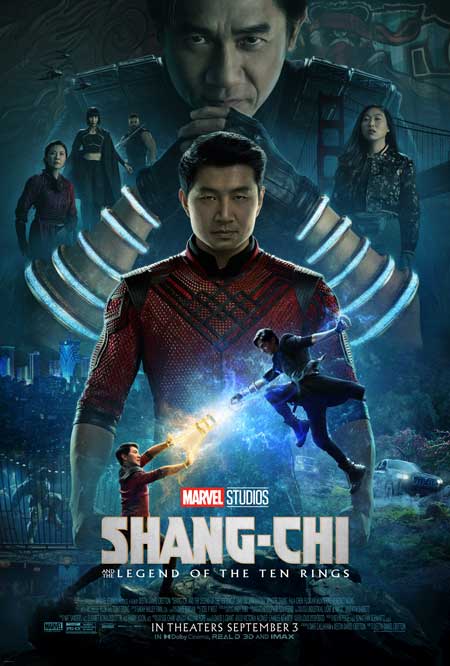
    Facebooktwitterlinkedinmail
  • Jungle Cruise – Review

    Jungle Cruise – Review


    “JUNGLE CRUISE”

    Jungle Cruise is the latest Disney film to try and attempt to capitalise on Pirates of the Caribbean’s success of making a Disneyland ride into a film. Previous failures include The Haunted Mansion and Tomorrowland. And, if anything, those films kind of proved that Pirates of the Caribbean just happened to be the right cast with the right director at the right time. Not deterred by that, Disney’s having a go at it again, hiring director Jaume Collet-Serra of shark movie; The Shallows, and that awful House of Wax remake. And once again Disney’s gone for a named actor for the main lead, hoping to repeat the success of Johnny Depp in the role of Jack Sparrow. In The Haunted Mansion’s case it was Eddie Murphy, in Tomorrowland’s case it was George Clooney, and this time they’ve gone for Dwayne Johnson.

    Thing is though, Jungle Cruise is a weird decision. It’s not one of the rides in either Disney World or Disneyland you’d go to next—I would’ve thought they’d go with something like Space Mountain, for example. But, again, I’ve always kind of thought these movies don’t take into account that Pirates of the Caribbean was more an excuse for Jerry Bruckheimer to make the pirate film he always wanted to make. The ride was just an excuse to pitch it to Disney, really, and this is clear in the script. As a result, it doesn’t feel like as much of a marketing ploy. All these examples—and, spoiler, Jungle Cruise kind of falls into this as well—do feel like marketing for the theme park. It doesn’t feel as much effort has been put into making a great script. Now, none of the films I’ve mentioned previously are really bad (possible exception being The Haunted Mansion which is all over the place) but they do feel very forgettable. The plot of Jungle Cruise centres around Lily Houghton (played by Emily Blunt), who steals an arrowhead that would lead them to a flower in the Amazon that can cure all illnesses. After she steals it from a London research society, she travels to the Amazon with her brother McGregor (played by Jack Whitehall), whilst being pursued by one of Kaiser Wilhelm’s sons, Prince Joachim (played by Jesse Plemons). Lily and McGregor hire out-of-work tour guide and skipper Frank Wolff (played by Dwayne Johnson), who seems to believe he’s the only one who can get them to the actual location.

    If there’s anything this film really reminded me of though, it’s Stephen Sommer’s The Mummy. Remember that film starring Brendon Fraser? It feels almost exactly like it. I almost get a sense that Disney are annoyed they didn’t make it and told the writers and directors, “Make that film for us.” Even Emily Blunt and Jack Whitehall’s characters seem to really reflect the brother/sister dynamic that was in The Mummy. And I haven’t read many reviews for Jungle Cruise so I don’t know if I’m one of the first to point these comparisons out with the Stephen Sommers film but it really is apt. Because the film has no sense of picking a villain and just sticking with it, it introduces a second group of villains who are made up of a group of conquistadors that went searching for the flowers, only to be cursed by the Amazon, led by Aguirre (played by Edgar Ramírez), who definitely feel somewhat similar to Imhotep in The Mummy but way closer to the undead pirates in Pirates of the Caribbean. I kind of feel like this film if anything, was definitely made to feel like a tribute to 90s action films—this feels right out of the 1990s, to such an extent that I think you could play it alongside a lot of films from that era, and you wouldn’t notice the difference other than how the camera effects have improved. As a result, the film feels rather uninspired; and not very original. Instead it feels like a bunch of gags I got bored of 10 years ago being recycled again. It also means it is frightfully predictable. I saw most of the plot beats and where they were going throughout most of this film, and as a result my role as a viewer feels like a very passive one rather than an active one.

    Now, the casting is actually pretty good. Emily Blunt’s giving a decent performance and the artist formally known as ‘The Rock’ is pretty much great in almost anything he’s in. In fact, if anything, you fail to get a good performance out of The Rock and that’s on you, not him. But there’s also a ton of thankless roles. For instance, I don’t understand what they’re doing with Jesse Plemons’s character. They set this during WW1, which seems to have become the new go-to for historical conflicts where we can have a German villain since we made too many WW2 films and we don’t want to be seen to be ripping off things like Raiders of The Lost Ark. But Jesse Plemons is a really good actor; I really liked him in the Black Mirror episode ‘USS Callister’, but his performance feels wasted here. And it’s not his fault; he’s clearly been given bad direction and writing because they can’t decide whether they want to make this character an intimidating villain or a comedic villain. It’s also not helped by the fact that this film introduces too many villains and can never really stick to one of them. For example, Paul Giamatti plays an early antagonist but he’s a glorified cameo—what a waste of the actor!

    The most controversial casting, however, has come from Jack Whitehall’s casting since he’s playing a gay character. I personally don’t believe I’m the right person to be commenting on this though what I will say is, when the controversy started, I genuinely thought it would be a very minor part of his character but they actually make it an integral part of his characterisation. It explains why he’s so willing to follow his sister into danger despite the fact that he’s genuinely very scared and out of his element—she’s one of the few people that stood by him after coming out and his family disowning him. Ignore the fact this film is set is 1916 so he’d have a lot more to worry about being openly gay at that time. But I actually appreciate the writers putting in real effort to try and make this work, though I will say McGregor is kind of annoying as a character. He doesn’t reach this terrible stereotype you’re thinking of, though they do really recycle the prissy, over-the-top rich person thinking it’s a holiday, stereotype. Though, if this is Jack Whitehall’s attempt to break into America, I’m not sure this will be it, but I commend him for the effort since he’s giving a decent performance all things considered.

    If there’s one thing that I really thought was lacking in this film, and it’s not the computer effects which are fine, it’s the lighting. This film has some of the worst lighting I’ve seen in a while. There are several scenes where a lot is going on but I can barely see anything happening. Far too much of this film is shot in dark places or at night, not helped by the fact my cinema screening forgot to turn off the lights until 20 minutes into the film. And it’s a real shame because the on-location shots that they did where it’s bright and in daylight are fantastic, they look great. But, as I say, there are way too many scenes that are shot in too dark an environment. Just a couple of extra lights would have made a difference.

    Jungle Cruise is a decent film; I actually think it’s better overall compared to Tomorrowland and The Haunted Mansion, but this is not the next Pirates of the Caribbean. I ultimately think it will be yet another forgettable film based on a theme park ride. The decent performances are really ham-fisted by a poor script and an uninspired storyline that borrows from much more successful films, and ultimately the film doesn’t feel like it has much originality. And coupled with the fact they seem to weirdly insert a re-recording version of Metallica’s ‘Nothing Else Matters’ which Metallica actually re-recorded for the film but feels out of place, it doesn’t fit the scenes that it’s in. And this is coming from someone who’s a huge Metallica fan and yet still found it weird that he’s hearing it whilst looking at the Walt Disney introduction logo. So, Jungle Cruise isn’t a mess and it’s not exactly great either. But it’s still a better film to take your kids to than Space Jam, I’m telling you that right now!
     
    Calvin – Nerd Consultant

    Share This Post:
    Facebooktwitterlinkedinmail
  • Anime Amigos podcast: our thoughts on Demon Slayer Mugen Train and Gundam Hathaway

    Anime Amigos podcast: our thoughts on Demon Slayer Mugen Train and Gundam Hathaway


    Our thoughts on Demon Slayer Mugen Train and Gundam Hathaway

    We finally give our opinion on 2 movies we finally all had a chance to see.
    Calvin – Nerd Consultant
     

    Share This Post:
    Facebooktwitterlinkedinmail
  • The Suicide Squad – Review

    The Suicide Squad – Review


    “THE SUICIDE SQUAD”

    Not to be confused with the 2016 film, The Suicide Squad acts as a semi-sequel/soft reboot of Suicide Squad, and is yet another film in the DC Extended Universe. If you liked Suicide Squad, don’t expect too many returning characters—the only cast members to return are Margot Robbie playing Harley Quinn and Jai Courtney playing Captain Boomerang. The big deal with this one was the fact it has been written and directed by Guardians of the Galaxy writer/director James Gunn who was poached to do the project by Warner Bros just after he was unceremoniously fired from directing Guardians of the Galaxy 3 after some edgy joke tweets—anti-Trump comments—that he wrote online were uncovered by right-wingers. Now, this was a major get for Warner Bros, though Gunn’s involvement in future projects might be slightly compromised since, after Disney got a sense of perspective, they hired back Gunn to direct Guardians of the Galaxy 3.

    Now, how does The Suicide Squad actually do, considering that this is the third Suicide Squad film I’ve reviewed, the second one being the straight-to-DVD animated film? Now, I’ve always made it clear that I’ve never been a fan of Suicide Squad. I didn’t really like the 2016 film all that much; I thought it was okay at best. And the comic series has never been really up my alley; it always feels a bit of a weird one, especially considering that DC never needed to create it. They had a superhero team made up of villains called Secret Six, it’s actually very well-written, and I actually personally prefer Secret Six to Suicide Squad. Nonetheless, there was obviously some demand for a sequel to Suicide Squad, mainly because DC and Warner Bros treated the first film more like a fashion brand before it was ever to be a film.

    This latest incarnation, however, really pretty much starts from scratch. The plot is once again very similar to the first film. Amanda Waller, once again played by Viola Davis, has a mission for the Suicide Squad: they’re to uncover the secret weapon that’s been developed by Supervillain Thinker, played by Peter Capaldi, that’s in a facility of a fictional Latin-Caribbean nation that’s recently had a revolution and has now turned anti-American. And Rick Flag, played by Joel Kinnaman reprising his role, once again recruits a team of criminals staying in Belle Reve with the condition that if they refuse to do the mission he’ll turn against them and they’ll have their heads exploded by a chip in their brain. Okay, it’s a very standard plot and I won’t give away too much of what’s going on since there’s a little bit to uncover, but it does dive into quite a bit of DC lore, especially considering that James Gunn appears to have uncovered a ton of B-list villains for this one. It’s surprising how much the DC Universe is brought into this. The problem I had with the first film was that it had an excessive amount of Batman villains. Granted, there are quite a few Batman villains in this one. You have—pretty much the main character—Bloodsport, played by Idris Elba, Harley Quinn’s obviously back in that role, and there is Polka-Dot Man who’s played by David Dastmalchian. But the villain selection is actually surprisingly interesting this time. Killer Croc’s been replaced by King Shark who’s played by Sylvester Stallone and is one of the best parts of the film. And the back and forth that Bloodsport has with Peacemaker, played by John Cena, is hilarious. If there’s one thing that James Gunn is great at it’s scripts and character-writing, and that’s what he really brings to this film.

    The other thing that helps it out? It’s R-rated, or 15-certificate in the UK, meaning that James Gunn can go all out. Granted, I think we’re seeing an excessive number of R-rated comic book films coming out since Deadpool’s success, but I would argue The Suicide Squad feels like the right place to do it. As a result, it’s a lot less afraid to go gory. One of my problems with the 2016 film is that it wasn’t willing to kill off enough people; this one does not have that problem. It also didn’t suffer from having one of the most boring villains. Not only do you have the Generals that have taken over the fictional Latin-Caribbean nation, you also have Peter Capaldi’s Thinker who is pretty good in the role actually, all things considered. I’m not too familiar with that character so they did a pretty good job establishing him and his motivations. Another stand-out character for me was Ratcatcher played by Daniela Melchior, again a reinvention of a Batman villain though this one establishes that she’s the daughter of the original Ratcatcher, but her entire character is pretty much a film creation. Considering how well she’s written in this one and the great dynamic between her and King Shark, I wouldn’t be surprised if she actually gets written into the comics. If there’s one thing I’d say against it it’s that she almost seems a bit too good. I think they made should have added a bit more of an edge to her—you kind of wonder how she ended up in a prison for the worst of the worst at some points. It also helps that James Gunn really knows how to direct action and he doesn’t shoot the majority of this film at night in environments where none of us can see what’s happening. That’s something I really hated about the first time we saw Suicide Squad.

    As for the performances, I think it’s pretty much good all-round. Idris Elba looks like he’s having a lot of fun, Margot Robbie clearly still loves playing Harley Quinn, and John Cena actually feels very well-cast for the role even though he’s arguably probably the most identifiable cast member in this, especially for American audiences. And James Gunn for once actually knows how to blend his serious action roles with his comedic roles which has definitely been where his stronger performances have come from. Also, one thing I felt was really strong about this film is it actually has a lot more to say than many of the DC films. It definitely feels like James Gunn is commenting on not only imperialism and, to a certain extent, the American justice system, but he also seems to really be commenting on US interference and foreign policy with dictatorships with some of the plot elements later in the film. I’d have to go into a spoiler talk to really dive into it but trust me, the film feels like it has a point. If there’s something I would like to say, however, it’s that it feels like it might be 10 or 15 minutes too long. There are a couple of scenes I felt could have been cut down a bit and some jokes don’t really land. I also don’t think this is going to impress people that were impressed by the first Suicide Squad film—the audience I was with—or fans of the Birds of Prey film (well, the people that actually saw it after that film bombed in the box office).

    The Suicide Squad is also not the film that’s really pushing the DC Cinematic Universe into a direction. In fact, that’s been a big problem I’ve had with all the DC films of recent. I’m glad they’re much more self-contained so they work better standing alone but it doesn’t feel like the DC Cinematic Universe at this point has an end goal. There’s certainly not going to be another Justice League film, and the fact that they can’t seem to nail down a bunch of directors to get some of these characters off the ground is definitely not helping things. This film also doesn’t leave an impact in the same way the most successful films have. In the pecking order, I would still put this film below Shazam! and Wonder Woman, though I would put it above pretty much every other DC film up to this point. The reason I say I don’t think it will impress a lot of the Birds of Prey fandom is that Harley Quinn has long moments where she doesn’t get much to do, and the films are tonally very different. I get the sense that James Gunn kind of made a film for himself and a lot of the diehard DC fans so I think a general audience might not get as into this as some of the other films.

    That being said, I actually really liked The Suicide Squad; I think this is generally a very good film, though I’m reluctant to say it’s great because I think it runs on a little too long and some of the jokes don’t land. It does, however, have very well-directed action scenes, it’s an R-rated film that really feels like it needs to be R-rated, and it has very good character dynamics and dialogue, something that James Gunn is known for. You can really feel Gunn’s fingerprint on this product. However, I don’t see this connecting with a large audience in the same way Guardians of the Galaxy did, or fundamentally changing the public perception of that team in the same way. For example, Guardians of the Galaxy is getting a videogame later this year, and considering that less than a decade ago audiences were just starting to get to learn who they were, I don’t think we’re going to see that fundamental team dynamic change within the comics, for example. I’m just glad after the last two weeks I finally got a film that I was actually happy to see.
     
    Calvin – Nerd Consultant

    Share This Post:
    Facebooktwitterlinkedinmail
  • Old – Review

    Old – Review


    “OLD”

    Old is the latest film written, directed and produced by M. Night Shyamalan. However, unlike his previous projects where he maintained almost complete creative control, this is not his own concept. Shyamalan is adapting a French graphic novel named ‘Sandcastle’, which I was not aware of prior to watching the film. However, for the record, I have looked up the graphic novel post-film and, from what I gather, in terms of the plot points, it is a faithful adaptation. Now, most people know my opinions on Shyamalan, as I have reviewed two of his films for this site: The Visit and Glass, (the latter of which I really did not care for). Now, Shyamalan rarely creates adaptations, so how does it work out when Shyamalan must put his own stamp on something?

    The plot of Old describes a family going to a resort, whereby they are offered to visit a secluded beach by the resort manager on the other side of the island (something he only offers to his favourite sorts of customers). When they arrive there however, after they find a dead body, they decide to try and leave the beach, only to find that they cannot escape. They then begin to notice that the kids are ageing quickly—after a few hours they have gone from looking six years old, to looking like they were eleven. They realise that for every half an hour they are on the beach, they gain a year in their life, and that there is some sort of force preventing them from leaving. The concept of Old is really good. I know it sounds ridiculous, but it does kind of have that sense of horror with the idea of ageing very quickly.

    However, Shyamalan is really being Shyamalan here; you can tell that he wrote the script. Honestly, if I did not know this film was his idea, I would have still believed it was because includes all the hallmarks of his films; the terrible hokey dialogue, the strange characters that seem to act kooky for no reason, and some plot holes you could drive a bus through. I am not going to go into spoilers for anyone who wishes to see this film, because there are actually some people who will enjoy this kind of film, and I have always said that no matter how bad the film I saw was, I would try to keep things spoiler-free. Interestingly, something that got pointed out to me post-film is that when they first arrive at the beach, they meet a rapper named—and I am not making this up—’mid-sized Sedan’, who has been on the beach since the previous night (waiting for his friend to return from their swim), but it does not seem like he has aged at all overnight. The rules therefore seem rather inconsistent.

    There are several moments where things to quite happen in the way you expect. For example, the story is very consistent about how the children are physically ageing but seem to go back and forth on whether they are emotionally ageing as well. The two main children are eleven and six when they arrive, and the daughter of another couple (who is also six), turns up on the beach, but they do not seem to act like it at times. The film fails to mention that you emotionally mature over experience and, yes, they are getting a whole lot of experience over a short time period, but it is weird. The characters do not speak like human beings at all—they constantly remind you of their professions. For example, the father of the main children, ‘Guy’, played by Gael Garcia Bernal, constantly reminds people that he is a surveyor who does assessments for insurance companies and constantly spouts out statistics. And the dialogue surrounding the doctor played by Rufus Sewell is really bizarre, especially considering what the directors are going for with that character.

    If there is one thing, that I will praise about the film, it is the fact that the actors actually do resemble each other quite well. They did a very good job choosing a cast that look like each of their counterparts and looking like they are going through various stages of life. It is kind of weird because they only seem to have put a few stages of life in there: pre-teens, teenagers, and then full-blown adults. But I will say the ageing makeup that was used on some of the actors was great, even if you can tell it is just ageing makeup. It is one of those instances where you can sort of see the process to get to that stage just by looking at it.

    Now, Shyamalan’s writing once again means that a bunch of moments that are supposed to be very frightening, end up inadvertently hilarious, to such an extent there is a sequence later in the film where I had to stop myself interrupting the entire cinema because I was nearly pissing myself laughing. I looked around and was thinking, “How are you finding this scary? This is unintentionally hilarious as hell!” The film does have a nice message about enjoying the time you have in the moment, but I do not think it executes it as well as Shyamalan would have liked.

    Additionally, there are some uncomfortable scenes to watch. There is one that admittedly was in the graphic novel, but I kind of wish Shyamalan would have cut it because even though you fail to see what happens, just the implications from what you do see, makes you feel like you really do not want to be watching this. This film is also shot appallingly; some of the basics of cinematography were not followed. There are characters that are cropped out of shot, so they are not centered very well. And this film loves long shots, but I do not understand why you would have long shots for these scenes; they do not maximize the tension, or ‘show off’ some choreography that makes something feel real, it is more just because they can. In my opinion, there were no shots where I thought you could not have cut or changed a camera angle; I never thought it had to be a long shot. Additionally, they have tons of those terrible shaky-cam running scenes that I am so sick of now. I thought we grew out of this!

    Also, as you would expect with a Shyamalan film, there is a twist, and I managed to successfully guess it in the first five minutes. Not all of it, mind you, but a significant part of it. And that is the thing about Shyamalan films now: I do not feel like I am watching them to let the story unfold; I am instead watching them, trying to guess whatever strange twist is going to happen, and as a result, you realise you are not paying that much attention to what is going on with all the characters. In his better films like The Sixth Sense and Unbreakable, the plot twist is actually really pushed to one side; there is more focus on the characters, so you are not trying to think of what the twist could be. Granted, those were his first two films, so he was not known yet for plot twists, but my point still stands. If you go back and watch those films, you will fully see my point.

    Old is a really good concept for a film, but Shyamalan has put so much of himself into it, that I do not think he is aware that he was not really pulling it off. The writing is poor, the acting is not great, the cinematography is all over the place, and the film is just remarkably weird. I think many other writers and directors could have taken this on and done a decent job with it, but this is the film I watched, and this what I have got to review. And, again, I cannot ignore the fact that there are plot holes through the roof when you really stop and think about this film. Normally that is not an issue if things are kept mysterious, but this film goes out of its way to explain everything that is happening and offer possible explanations, and as a result, those plot holes are pushed more and more to the front. As for the twist, it is not the worst of a twist in a Shyamalan film, mainly because he did not come up with this one—it is in fact the exact same plot twist from the graphic novel—but it is also not one of the better ones from his films as it opens up to several questions. The film is kind of a mess but as a whole, you can do a lot worse. Overall, it is not a train wreck, but it is not really a good film either, and it is certainly not as bad as The Happening.
     
    Calvin – Nerd Consultant

    Share This Post:
    Facebooktwitterlinkedinmail
  • Monster Hunter Stories 2: Wings of Ruin – Game Review

    Monster Hunter Stories 2: Wings of Ruin – Game Review


    Monster Hunter Stories 2:
    Wings of Ruin

    (Available for Nintendo Switch and PC )
    (Nintendo Switch version used for both reviews)

    Monster Hunter Stories 2 was announced in the exact same Nintendo Direct Mini Partner Showcase as Monster Hunter Rise and after the excellent reviews of that game it could not be coming out at a better time. Unlike Rise, Monster Hunter Stories 2 is a turn-based RPG which you create a young Monster Rider character, that builds bonds with newly hatched monsters in order to protect your home village. The call to action comes when investigating a forest that is home to the guardian Rathalos. Rathalos protects an island in which a mysterious girl named Ena hands you an egg, instructing you to guard it with your life. You then set out on a journey to investigate the mysterious lights that are appearing and causing the monsters to go into a violent rampage. In the game, you will take part in many monster battles as well as lots of small dungeon crawls (known as Monster Dens), that are randomly scattered all over the map. The question is; Is this one worth picking up for fans of Rise, given that Monster Hunter Stories 1 on 3DS, received mixed reactions from Monster Hunter fans (mainly from newer fans introduced to the series with Monster Hunter World).

    Pros

    • Story: With the title ‘Monster Hunter Stories’, you would hope the story would be good and it meets the expectation. You do not need to have played the first game to enjoy this one. Whilst it is confirmed to be a direct sequel by some of the dialogue in the game and returning characters, it does also feel very detached from that story and is very much its own thing. Whilst the customisable protagonist you create does not have too much personality, they surprisingly gain some later, with the bond between the protagonist and the hatched Rathalos (named Ratha). This bond is a big core aspect of the story. The story is also good with how it introduces characters, the world, and the eventual antagonistic force. It also helps that the voice cast helps to bring life to all the characters. I have heard some people say that your feline companion within the game (who kind of acts as a mouthpiece for the protagonist Navirou) is a bit annoying, but I personally did not see a problem with him. If anything, the game feels less like an epic adventure, and more like a good family film, similar to that of the Studio Ghibli films, and I was very invested from start to finish.
    • Combat: A real highlight of the game is how combat is handled. The game really captures the feel and strategy of Monster Hunter, transferring it to an RPG setting. The way it achieves that, is to have you select one of three kinds of attacks; Power, Speed and Technical. If a clash occurs between characters, the clash becomes a ‘rock, paper, scissors’ type of scenario, with Power beating Technical, Technical beating Speed and Speed beating Power. If you think that is hard to get your head around, do not worry as it is all colour-coded, and the action menu shows arrows to remind you which attack beats which. However, you have to learn the patterns of monsters to figure out how to take advantage. It also affects which partner Monster you bring into combat, and you have to take into account that you do not control your Monster’s attack like you do in Pokémon. You also have to take into account each weapon you use, since different parts of monsters are weaker to different kinds of weapons, and it is a good idea to swap them mid-battle, for example, use a sword for Attacks on the tail, but use a bow and arrow for the head. It all adds up to a very enjoyable combat system that will require a lot of strategy during battle, and really will suit JRPG fans. It feels like a very interesting take on turn based RPG combat, as it really encourages you to think on your feet.
    • Art style: I really like the way the game looks. Like the predecessor, it retains the style of Monster Hunter whilst also giving it a more cartoonish look, almost like a Manga brought to life. The world design helps compliment things, giving a variety of locations that feel straight out of Monster Hunter.
    • Monster selection: The selection in this game takes more monsters from across the series, to have an even bigger variety than Monster Hunter Rise did. As a result, this game (in contrast to the previous), feels like a celebration of Monster Hunter as a whole. Most of the monsters have excellent move sets and abilities to experiment with, so I would recommend a good variety of Monsters in your party to try out, not only for battle, but also for exploration since many chests and supplies are blocked by environmental obstacles that only certain monsters can use.
    • Multiplayer: The multiplayer is both online and through local wireless on the Switch. They mainly consist of raid missions, which you can co-op with another player. This is good idea as it can increase your chances of obtaining rare monsters (this is how I got my Rathian), which is going to be a big part of the updates to come. There is also a battle mode where you can fight another player and their monster. Both worked out well and I did not experience many issues at all, other than being partnered with players that would jump ahead to get supplies, leaving me to fight alone. It is a side task, but a really good side task and if you have good internet, it is worth adding it to your play time.
    • Handling of free updates: Like Monster Hunter Rise and many other Nintendo Switch games, Stories 2 is going to get free updates over the next few months; the first of which is already out, and includes the Palamute from Monster Hunter Rise. Unlike other many games of this type, it does not feel like this is finishing the game off, and all the additional content is post-game content, which meant I felt that I could finish the game now and return to it later, to try out the new monsters. The game is also due to have a large amount of updates going on until the autumn of this year, and is so far receiving more updates to the game than Rise has had so far.
    • Soundtrack: It is a Monster Hunter game, which is already a series with great soundtracks and this one is no exception. It especially has a particularly good battle theme, which fits the game well, as well as a lot of very casual atmospheric songs for the environments.

    Mixed

    • Variety of quests: This depends on how much you enjoy the gameplay loop. I really liked the monster hunting quests, so this did not really bother me, but I can see other players get bored with this loop since it does not really have too much variety in quests (though the multiplayer does help to expand this).

    Cons

    • Frame rate choppiness on switch: This is probably less of a problem on the PC version (especially if you have a good PC), but the switch version was quite choppy with the frame rate at points, particularly in battle. The game is a turn based RPG so this is not the end of the world, and it was not so bad that it was too distracting, but it seems weird that game designed with the Switch in mind does have some frame rate troubles, given that Monster Hunter Rise (which is also a Capcom game; built with the Switch in mind) does not have frame rate issues.
    • Battery Life in handheld mode on Switch: If you have the Red box Switch, a special edition switch for Animal Crossing or Mario, or you are upgrading to the Switch OLED model later this year, this will not be as much of a problem. But if like me you have an original Switch, you might want to make this a docked exclusive game. This game drained the battery faster than most of my library, and I checked to make sure it was not a side effect of my Switch beginning to show its age (I’ve owned it since 2017). Other games still run fine and I can clock around 3 hours at full brightness, but Monster Hunter Stories 2 is quite a bit shorter and I found myself able to use it less than I would have liked to on train trips. I also am aware that my co-reviewer Recce, was running into the same issue prior to him sending me his review and since he is using the same Switch model as me (which was purchased not long after mine), I believe this is a game issue rather than our hardware. If we are correct, and I really believe we are, then I think it is a big oversight for a Switch game, especially for Switch Lite owners who will be playing it exclusively portable.

    Overall thoughts

    Monster Hunter Stories 2 improves on its predecessor and creates a great and engaging RPG that really fits within the Monster Hunter world. The gameplay is great and adds levels of strategy to combat and traversal, and the art style is fantastic, making it another great looking game on the Switch. Whilst the gameplay loop is a bit repetitive, the story motivated me to really sink a lot of time into it, and there are plenty of side quests and content to keep you engaged (with more on the way in the coming months). It does have some issues with its frame rate on the Switch, which is a little disappointing but not so much to sink the whole thing, and I would say if you love Monster Hunter or RPG’s, then give this one a go.

    Score: 9.4/10

    While the PC version is available, I would recommend picking up on Switch since it has got the Amiibo support, as well as benefits for having save data from Monster Hunter Rise, which also works the other way round.

    Calvin
    Nerd Consultant

    And now for Reece’s review

    My experience with Monster Hunter Stories 2: Wings of Ruin, is that I have completed the main story, and I am working my way through the post-game (with over 50 hours clocked in so far). The system I was playing the game on was Nintendo Switch and not the PC version, so all the pros and cons I make may not apply to the PC version.

    Monster Hunter Stories 2: Wings of Ruin is a role-playing video game developed by Capcom and Marvellous, and published by Capcom for the Nintendo Switch and Microsoft Windows. It is a spinoff title in the Monster Hunter series and a sequel to Monster Hunter Stories (2016). The game was released worldwide on 9th July, 2021 and has since sold over one million copies since its release.

    Pro:

    Graphically fidelity. One of the most striking aspects of the game is its high graphical fidelity, especially for the Switch as it is a vast improvement over the original Monster Hunter Stories 1, which released back on the 3DS in 2016, and still runs on the same game engine, but due to running on more powerful hardware the textures has been vastly improved.

    Combat system. On the surface the combat system for Monster Hunter Stories 2 seems very simplistic, revolving around a kind of ‘Rock-Paper-Scissors’ mechanic; instead it is Power-Technical-Speed. It is a triangle system where Power beats Technical, Technical beats Speed and finally Speed beats Power.

    This system seems similar to how Pokemon does its Type mechanics where moves can be super effective, neutral or not very effective. Instead of Pokemon, where you have 18 different Types to consider and how they interact with each other, Monster Hunter Stories 2 only relies on the 3 Attack Types. The Monsters themselves use each Attack Type for their moves, but when they reach their rage mode then they will switch up the move they will use, so you cannot rely on spamming the same Attack Type move repeatedly, because if you use an Attack Type move which is weak to the opponent, then the Monster will inflict damage to you whilst only taking a small amount of damage in return. So you are encouraged to learn Monster patterns so that you can use Attack Type moves that are stronger, allowing you to beat them in special head-to-head events. If your Monster is using the same Attack Type as you, and you win the head-to-head event, then you will inflict much higher damage to the enemy and it will skip the enemy Monster’s attack. By using this method, you can repeatedly make the enemy miss their turn and constantly inflict damage to them and they will usually die after a few tries of this.

    Another aspect is the Weapon Type mechanic, where players can choose up to 6 weapons that are categorised into 3 Types; Slash, Blunt and Piercing, with each weapon more effective against certain Monster parts. These weapons are the Sword and Shield, Great Sword, Hammer, Hunting Horn, Bow and Gun lance.

    Each of these weapons have their own unique set of skills and mechanics that Hunters can use to break different parts of the Monster to limit the Monsters’ range of attacks, so you cannot just use the same Weapon Type on every part of a Monster (as it will take longer to break the part), so you are encouraged to experiment with each of the different weapons.

    After inflicting enough damage to the enemy with your character and your Monstie, then you fill up the “Kinship Gauge” which allows you to choose a particular Monstie skill so you can perform double attacks more often or if you max the gauge then you can “Ride” the Monstie; where your character refills the majority of your lost health and can then perform “Kinship attacks” which are massively damaging moves that feature a cutscene unique to each Monstie, that are a visual spectacle.

    Large Monster variety. You can find and form a kinship with over 80 Monsties that each have their own unique appearances and abilities. Then all of these Monsties are ‘rideable’, meaning that you can ride everything from a lowly Aptonoth to a high flying Rathalos. These Monsties mostly have unique traversal abilities (like the aforementioned flight ability of the Wyverns), swimming through deep water with the Leviathans, or climbing ivy to reach higher areas with the Arachnida Nerscylla, to reach out-of-reach areas, with treasure chests and collection points.

    Player customisation. In Monster Hunter tradition, the player can craft weapons and armour from fallen Monsters, and each Monster leads to a unique set of armour with unique skills that you will not find on other armour sets.

    Along with player customisation, you can also customise the outfits for Ena and Navirou using either in-game outfits, or purchasing them as DLC. These outfits give no tangible benefit to the player and are only cosmetic, which is a big relief in this modern era of microtransactions.

    Monstie customisation. Monster Hunter Stories 2 features an in-depth customisation system for the Monsties in that you can have a maximum of 9 skills on each of them, and you are free to transfer skills from other Monsties to the one you are using. However, you can only transfer one skill at a time and when it is transferred then you lose that original Monstie.

    This gives you the freedom to transfer any moves you want onto another other Monstie. One skill I had from near the beginning of the game till the end of the story, was transferring the “Venom” skill from my Pukei-Pukei to my Tigrex so that I can poison other Monsters.

    You can also change the elemental type of a Monstie by giving it genes from another Monstie as long as it boosts the elemental attack over the original Monstie’s natural elemental attack (e.g. Putting an Ice attack up gene on an Aptonoth will change its primary damage to Ice and change the hide colour of the Monstie so that it takes on a blue tinge).

    This allows you to have a completely different Monstie set up to another player, as you are free to include whichever genes you want, and even get a boost if you include genes of the same colour (e.g. putting in 3 Ice genes in a column will give you a small boost to that Monstie’s Ice attack stat). Then, if you fill all 9 gene slots, you can skyrocket the Monsties attack. For the story mode there is no wrong way to customise your Monstie with genes, as long as they are a decent level and you have a Monstie of each attack type you should be fine.

    Multiplayer. Expanding upon the multiplayer from the original game that used the 3DS StreetPass system to exchange battle parties and equipment to fight them at a later time in the Rider Arena. 

    In the sequel, you can challenge other players (in real-time) to combat in the Arena or team up with others to depart on quests, to hint certain Monsters and collect eggs together. As I was writing this review, Capcom put out free DLC, letting you find eggs for the Palamute from Monster Hunter Rise in all the elements (Water, Ice, Electric, Fire, Dragon and finally normal Dog).

    You can do these quests either online using the Internet to connect with others or embark on them locally with friends, or people nearby. 

    The only downside to these quests is that you cannot create a custom quest and have to select one of the already predetermined quest types from a list e.g. Hunt a Legiana.

    Self-contained story. Whilst being a sequel to the original game, the plot for Monster Hunter Stories 2 is standalone, so you do not need to play the first game to understand the story. The only thing you are missing out on, is the context for some of the supporting characters and their backstories; the most obviously example being Navirou and what happens to him is unexplained in this game and does require knowledge of the previous game.

    The story itself is quite enjoyable, and shows a new angle to the Monster Hunter universe in that the “Hunters” (which you normally play as in all the main series of games), are not always the good guys in the story. As for Monster Hunter Stories 2, they show an almost bloodlust or disregard for the Monsters’ lives, as they start by attempting to kill the elderly guardian of your characters home village, without warning or regard for your peoples’ culture. In the mainline games, 9/10 times you are hunting and killing these creatures to create weapons and armour from their hide and claws, just under the pretence of a quest that you are doing the right thing, but this is never expanded upon and you just take these quests in good faith, not bothering to see if these Monsters are worshipped by any indigenous peoples or cultures.

    The story has good pacing, with some high quality cutscenes that gives your character a reason to traverse all of these different locales, attempting to unravel a long mystery that involves many twists and turns, that keep players entertained with fun and well-made cutscenes, and situations that are probably some of the best in the Monster Hunter series.

    Varied locales. True to all Monster Hunter games, the different locations in Monster Hunter Stories 2 offer a wide world to explore and each area feels distinct and to accompany these areas are Monsters that would make the most sense in these areas (e.g. The Wolly mammoth-like Monster Gammoth being in the snow area or the lava spewing leviathan Agnaktor lives in the volcano area). 

    What helps you to appreciate these areas more, is that you are able to ride your Monsties to further explore and find hidden areas, treasure chests or “Royal Monsters” (Monsters that have appeared in an different area, earlier on in the game), which rewards exploration and smart-party building so you can take on a Monster normally way higher level than your current party.

    Music. Whilst quite understated in this game (compared to the most bombastic and in-your-face songs from the traditional Monster Hunter games), Monster Hunter Stories 2 has a lot of great tracks that go underused due to wanting to focus on the environmental songs.

    My favourite probably being “Scarlet Land lit up by the Heavens” which is sung in English if you are playing the English dub of the game, which was a nice touch that many games do not bother to accommodate for and is also sung at the beginning of the game, as well as the ending of the game. I will not spoil the ending version, but the beginning version shows beautiful visuals of the starting island where your Rider is from, as well as the traditional culture of your people (seems to be similar to Moga Village from Monster Hunter Tri) and gives us a great insight into your characters culture compared to traditional Monster Hunter games, where you are just a normal Hunter who does not have much connection to your hometown as you tend to just focus on the Monster Hunting.

    I wish the background tracks for the zones were more prominent, as otherwise you are exploring the environment in almost silence, so a lot of the time I just put some music on to fill the void.

    Con:

    Battery drain. In Handheld, I found that my Switch battery charge would drain from 100% down to 20% in just over 2 hours. So I would recommend everyone who wants to play this game, to either get the revision of the original Switch (HAC-001(-01), released in late 2019), as that helped solve some of the battery issues, as the original model battery life went from 2.5 – 6.5 hours on a full charge up to 4.5 – 9 hours, or to wait till the Switch OLED model comes out to get a longer battery life. 

    For reference, I was playing on an original Switch model from 2017 so it may just be due to the natural process of self-discharge, where all batteries naturally start to lose maximum charge overtime.

    Of course this battery issue is only for the Switch version of the game and does not apply to the PC version, since most PCs are directly plugged into the mains and not portable.

    Quest variety. While the quests are fun during the main story, the main bulk of these breakdown into either; Go to location A and kill a particular Monster, or gather a certain amount of resources e.g. Flowers. These are a fun distraction and encourage you to explore each of the new zones. It is a shame that they have no impact on different zones, as all of the zones are the same from when you first enter them, to when you finish the story, missing out on doing some environmental storytelling that this game would have benefitted from.

    Framerate. Unfortunately, Monster Hunter Stories 2 suffers a lot from its large variable framerate. This is because the framerate itself is not capped, meaning that the FPS (Frames per second) can vary wildly depending on the situation that can make gameplay very jarring, as I have experienced it go from the overworld being mid 20s with occasional stuttering when moving the camera to the FPS jumping, to about 60 when in the smaller enclosed den areas, as the Switch does not have to render the entire overworld map at once when in a den.

    I have heard that these issues are less prevalent on PC, but it is a shame that the Switch version is poorly optimised as this is my major gripe with the game, and hopefully it gets fixed with a patch or the rumoured “Switch Pro” in the future.

    Repetitious Dungeon Design. The most important part of the game is the “Monster Dens” where the player goes into to find new monster eggs, and as you go through the game, you encounter potentially hundreds of these dens and you realise that most of the rooms that make up these dens, are recycled quite often and that they all start to blend together. 

    So more unique dungeon rooms would have been appreciated, especially when you are farming for high quality eggs, spending several hours in a row trying, it can be frustrating and would rather just be put straight into the Nest than just running through the same rooms over and over.

    Late game battles. Whilst for the most part, the battles are not normally that long, but this changes a lot for late game and postgame battles, where they can last for over 20 turns. Whilst there is an option to speed up gameplay, it does not help that much.

    This is a problem that a lot of JRPGs suffer from towards the end of most games, in that no matter how high your stats are, that the enemy has too much HP (Health Points), and are basically just health sponges that take a long time to whittle down, leading to aggravation if it is a difficult Monster that cycles through a lot of different Attack Types 

    Ally Artificial Intelligence. The Battle Buddies you encounter throughout the story that join you for battles, are completely outside of your own control meaning that they will perform whatever options they want, targeting random monster parts even when the monster part you and your Monstie are targeting is almost destroyed, they will still have a good chance of targeting another part that is probably at full health.

    This is not a bad idea in itself, but they always appear to make the poorest options in battle. This is mostly evident in that they do not adapt to enemy Monsters’ attack patterns when the Monsters change their pattern to use new moves, and will almost always use the weakest move compared to what the enemy is using. This means they will lose a lot of the time in the head-to-heads against the enemy monsters. Also, they use potions with reckless abandon, as I have had times when they use potions or steaks when they have only lost about 10HP and have a health pool of over 200HP.

    Writing. While this game does have a good voice acting cast for both the English dub and Japanese dub, with almost all fully voice acted cutscenes, a problem I had was with some of the writing that lead into bad line reads. The character that exemplified it the most, is the feline character of Navirou, who is the tag-along character who is constantly making cat jokes and repeating information, that is either obvious to the player or holds no relevance to the situation.

    Save system. A minor problem that really bugs me, is that you cannot save at any time whilst playing the game, or in the overworld, and you have to instead fast travel to a “Caravan Stand” and select the save option from there. I do not see a reason as to why they have done this as if you are in a new area or far away, then you have to fast travel to one then spend a while trekking back to where you were as the game does not have an “Auto Save” feature. However, I found that the system is not as reliable and it mostly saves when you enter or exit an area.

    Conclusion: This was a fun foray back into the JRPG series for Monster Hunter, and is definitely a good game. If you can get past the poor framerate for Switch, or if the framerate was patched to have a better performance, then it may of scored similar to Monster Hunter Rise when that launched.

    So if you are a Monster Hunter fan, I would recommend this easily, and even if you have not played a Monster Hunter title and only play more traditional JRPG’s like Pokemon, then this is a good transitional game if you want to bridge the gap to get into the Monster Hunter series. 

    Score: 8.6

    Reece Imiolek
    Anime Amigo and Nerd Consultant

    Share This Post:
    Facebooktwitterlinkedinmail
  • Space Jam: A New Legacy – Review

    Space Jam: A New Legacy – Review


    “SPACE JAM: A NEW LEGACY”

    >The original Space Jam is not a great film in my opinion. It has its moments, don’t get me wrong, and it’s at least decent in the fact it didn’t take itself too seriously. But, as a whole, it’s not the greatest film ever; it’s probably not even one of the better Looney Tunes films. But it has obviously built up somewhat of a cult following. And Warner Bros—keen to cash in on nostalgia—have made a brand-new film, Space Jam: A New Legacy, hiring director Malcolm D. Lee for the project, someone I’d never heard of, though from what I gather one of the things he’s known for is Scary Movie 5 and doing a bunch of wedding comedies… We’re already off to a bad start. And instead of Michael Jordan, to update it this time it’s LeBron James.

    Now, the plot this time round is that Warner Bros has created an algorithm for their new online supercomputer called Al G. Rhythm, played by Don Cheadle, who becomes obsessed with LeBron James, and after having his offer rejected by LeBron sucks him and his son into the supercomputer like it’s Tron and tells him that they both are going to form basketball teams for the fate of both him and his son and everyone watching the livestream. And LeBron forms a team with the various Looney Tunes characters who get back together after they’ve been tempted out of their own area to go work in other Warner Bros properties. If this sort of thing is sounding familiar to you, it’s basically because this film is ripping off Ready Player One, leading to the tagline ‘Ready Player Dumb’ being used in several reviews. And they’re right—Space Jam: A New Legacy is possibly the worst film I’ve seen this year so far.

    Where do I start with this one? How about the fact that for a film that’s putting the Looney Tunes front and centre again, they’re never allowed really to show their personalities. They seem to want to just put them in various movie parodies with no sense of why they’re there. Yo Samdy Sam is in Casablanca because his name is Sam but they don’t do anything with that. Elmer Fudd ends up in Austin Powers because he’s short and bald, and that’s the gag. And there are various other examples that are like that. This whole thing is a massive advertisement for Warner Bros and their products, particularly their investment in HBO Max, hence why Game of Thrones is rather front and centre. By the way, Game of Thrones coming anywhere near a U-rated film is already making me raise eyebrows. And there’s also a cameo from another animated series that I forgot Warner Bros owned, featuring some characters who should really be nowhere near a U-rated film, and features the voice actors giving one of the most forced cameos I’ve heard in a long time. Not to mention, of all the Warner Bros properties they throw in this thing, most of the ones on the sidelines you can clearly tell just look like cosplayers, and they don’t even look like they’ve put much effort in. I’ve been to conventions that had much more convincing lookalikes than this—just hire those people! You’ve put all this effort in to digitally impose the Looney Tunes in films that you own, so why not go that bit further and actually employ some more of that CGI? Oh yeah, I forgot: all the stars are not putting it in their contracts so you’re not allowed to do that.

    There’s also the fact that this film has really bad villains. I don’t know how Don Cheadle was directed to act in this film because he’s a good actor but he can’t even ham his way out of the bad writing in this one. The way they force in the WNBA and NBA stars into this is really forced. LeBron James’s son—incidentally not played by his actual kid—is an up-and-coming videogame designer creating his own tech and actually scans the data of their plays into his phone for his videogame, which AL G. Rhythm then uses for his team. Anyone who’d actually been involved in videogame design will tell you if you’re doing this you have to do days worth of motion capture; you can’t just scan it into a phone. Also, that is a dumb way of getting a load of NBA stars into this thing. They don’t even come up with cool designs: they just make one of them like a spider, one a snake-woman, and one’s made of water. And they’re not even playing proper basketball; they’re playing this weird invented videogame version of basketball which has a ludicrous scoring system because it’s based on LeBron James’s son’s videogame. Which means if you had any interest in the sport, you can’t follow what’s happening!

    I don’t know what any of the writers were thinking (this film has 6 credited writers) but they made LeBron James incredibly unlikeable early on, and they also have several lines that prove how derivative this whole thing is. LeBron James actually says at one point that athletes and acting never really goes very well. Yeah, you’re proving it—your performance is terrible. Michael Jordan in the first film was also kind of wooden but he actually kind of leaned into the absurdity of everything. LeBron doesn’t really do that. It also really doesn’t help that this film has 6 writers; it’s a clear example that too many cooks spoil the broth. It’s a ton of ideas all chucked in together, and the whole thing really exists as an advertisement with some of the most blatant product placement I’ve seen in a long time. Nike is flashed constantly on the screen. Hell, LeBron James crashes into the Looney Tunes world and actually creates a Nike-shaped crater, though obviously Warner Bros is the big advertisement part of this film and, man, is it so blatant what they’re doing. I actually saw a joke article that said a “skip ad button turns up at the beginning of Space Jam: A New Legacy and actually skips the entire film”, and I completely agree with that joke.

    What’s more, I don’t understand why the Looney Tunes are here; they don’t really do anything. Modern writers really think the Looney Tunes were just these insane, constantly moving characters but if you actually go back and watch some of those old clips, while movement and physicality were big factors of what made them so funny, they also knew when to tone it down. People think of Daffy Duck as flipping out but the whole point was that he would appear calm and collected most of the time, and the joke was seeing the transition to that more wigged-out persona as things constantly go wrong for him. Daffy is one of the funniest Looney Tunes characters ever but he’s got nothing to do in this. They put him in a coach role but he only really gets one or two funny moments. And some of them don’t even get that. For example, I can’t think of one thing Elmer Fudd did that made me laugh, Sylvester and Tweety are so pushed to the sidelines I don’t understand why they’re here. And yes, you can easily have the zaniness mixed in with the basketball like the first film did but it really doesn’t work this time. The first film actually did a pretty good job working off the personalities of the characters, and it only really chucked in a pop culture reference once which was a Pulp Fiction reference. But this film? The game actually stops in the middle for Porky to have a rap battle for no reason, and they actually score some points from that. I don’t even understand why they hired Zendaya to play Lola Bunny in this one as she doesn’t really get anything to do.

    As a result, this film is strange, bizarre, and I just hated watching it. Space Jam: A New Legacy is a Warner Bros advertisement first and a movie second. It doesn’t really care about its subject being the Looney Tunes and doesn’t really make its athlete-turned-actor likeable. It’s a mess of a film with terrible 3D CG animation that takes all the expressiveness out of the Looney Tunes who aren’t even allowed to really give their all, leading to one of the worst films I’ve seen all year. It was a drag to get through this. Save your money—this is not the film to take your kids to the cinema with.
     
    Calvin – Nerd Consultant

    Share This Post:
    Facebooktwitterlinkedinmail
  • Black Widow – Review

    Black Widow – Review


    “BLACK WIDOW”

    Black Widow is the first Marvel Cinematic Universe film to come into cinemas since Avengers: Endgame, and honestly it felt brilliant to see these films in cinemas again. Granted, this hasn’t really been the triumphant return to Marvel after the Endgame concluded what was an over 20-film story arc, mainly because Disney decided to air the TV series for this phase on Disney Plus during the pandemic, and you can definitely tell that Marvel Studios really intended this to be the first thing out of the gate post-Endgame. The fans have been demanding for years that Black Widow get her own film, despite the fact that out of all the Avengers that have so far been in the movies, she wasn’t the only character not to get her own film. Hawkeye still hasn’t had his own film, and Vision didn’t get their own film but later got their own TV series. But considering how much the Marvel Universe has been expanding, it more than made sense to give Black Widow some love. 

    People were wondering how Marvel would kick off things after such a big moment like Endgame. The answer is they did do the smart thing: they kind of didn’t go big. Black Widow is what would best be described as a Marvel filler film; it doesn’t really add much to the grand storyline. It’s just a small film to tide you over between films. Think the Antman movies or the Spiderman films. It actually takes place between Captain America: Civil War and Avengers: Infinity War. Black Widow, played once again by Scarlett Johansson, is on the run, and after obtaining some information she reunites with her sister Yelena, played by Florence Pugh, who informs her the infamous Red Room is still active. As Natasha puts it herself, “I haven’t got anything better to do,” so they decide they’re going to take it down with the help of their parents, Alexei (aka Red Guardian), played by David Harbour of Stranger Things fame, and Melina, played by Rachel Weiss.

    Now, this is a Marvel film that also is the first one in a long time to have no super powers really on display. None of the characters really have super powers; they’re all just highly trained individuals, and that comes down to the villain being Taskmaster this time. If you played the Avengers videogame last year (and if you did, I sincerely apologise and hope you haven’t been too badly affected by how awful of a game it is), you might be surprised to find that the Taskmaster is slightly different to his comic counterpart. This has been a big complaint from the comic fanbase of Marvel, although personally—this is probably going to be my own controversial statement—I prefer this version of Taskmaster. Let’s be honest, Taskmaster is not that interesting of a villain in the comics, but this version is much more interesting, though I won’t go into spoiler territory on how this one is different. But that being said, I like the new costume design for Taskmaster and they did keep that they’re an expert that can copy any Avengers abilities almost on sight alone. And it allows for the mood sets of characters like Captain America and Black Panther to come into the mix. If there’s one little niggle I’d say it’s that it feels bit weird having Taskmaster in a Black Widow storyline given that they’re primarily an Antman/Avengers villain, but again, the way they put him in kind of works.

    But Taskmaster is kind of pushed to one side for this new villain, Dreykov, the Master of the Red Room, played by Ray Winstone, who keeps on every third word slipping out of his Russian accent and back into his normal accent. He’s a fine enough villain for the film he’s in but Dreykov takes up pretty much all of the second half of the film and just isn’t that interesting, especially considering that the villains were one of the aspects of the Marvel films that were starting to get better with every entry. As per Black Widow herself, one of the things I was surprised to find was that they could get another character arc out of this character; I didn’t think there was much more space for this character to go but they managed to find something to work with, and it does a decent job all things considered. I did like the bond with her and her family and I kind of like the message they go with.

    The biggest problem I have with the film was the fact that it isn’t paced very well. Marvel films often suffer from feeling like they’re just going from one set piece to another, and this one definitely felt like that. I was actually surprised to find this film is 2 hours and 13 minutes long including the post-credit scene, because it feels like a short film. There are also a couple of things that they just seem to pull out of nowhere, and stuff where you say, “How did they know that was going to work? If one thing went wrong, your whole plan is out of the window!” It also doesn’t feel like a huge deal, and even the biggest filler Marvel films have sort of felt like a big deal; this feels like a much smaller production and doesn’t seem like a lot of the budget went to this one. It’s also not doing anything new or expansive with the Marvel Cinematic Universe even though it’s tried bringing the espionage edge to the film. But again, it’s not like that hadn’t been explored—that was in Captain America: Winter Soldier, and there have been other productions to explore that side of the Marvel Cinematic Universe. It doesn’t help that this came on after the trailer for the Eternals film which looks like it going to be doing something very different with the Marvel Cinematic Universe; I’m actually looking forward to seeing what the team will be doing to bring that to the big screen.

    Now, as for the fight scenes, they’re actually really good, as you’d expect from a Marvel film. But it’s very clear director Cate Shortland does know how to shoot these kinds of scenes. These are meant to be highly trained characters and we’re allowed to see that in effect. It also does not shy away from the fact that this is one of the first female-led Marvel films. Granted it’s not the first, as that was Captain Marvel back in 2019, but it’s definitely the first one to put that aspect front and centre, and it actually as a result leads to the film going to rather darker areas than I was expecting. I was watching the opening credits and thinking to myself, ‘This is a family film, right? This is Marvel?’ I know the Marvel comics can go dark but the films have always kind of strayed away from this. As for the performances, Scarlett Johansson’s still great in this role and I actually thought the newcomers were pretty damn good. Florence Pugh does a really excellent performance and she actually plays very well off Scarlett. David Harbour is also really good in the film, although he’s very clear he was brought in to be the comic relief. That being said, Red Guardian is one of the best parts of this film (I’m glad David Harbour has recovered after being in Hellboy), and Rachel Weiss also gives an excellent performance. The standout performance in this film I can’t give away for spoiler reasons.

    Black Widow is a good film all things considered, though if I were to put it on a tier list with all the Marvel films, it’s very much middle tier. It’s not one of the lesser Marvel films in quality but it’s also not one of the higher films in quality either; it’s right slap bang in the middle. There are some good things to say about it: the fight scenes are well-choreographed and shot, the plot is actually pretty good overall, and I like the dynamic between the cast. Its pacing however is where it’s a bit off—this film feels like it goes by a bit too quickly and doesn’t allow for moments to sink in. And by the end, while it does do one good villain, it does another rather lazily. If you’re really into the Marvel films this is one to go back to cinemas for, though considering its place in the timeline you obviously don’t have to worry too much about it spoiling things at this point. The post-credit scene actually does set up something in the future, though I’m not quite sure what. For the first film of phase four, it doesn’t really set up a this-is-the-next-central-conflict-in-the-Marvel Universe like Ironman did or even how the Avengers did by the end of its post-credit scene. And I think we may be waiting a while to find out what the next central conflict in the Marvel Cinematic Universe is.
     
    Calvin – Nerd Consultant

    Share This Post:
    Facebooktwitterlinkedinmail
  • In The Heights – Review

    In The Heights – Review


    “IN THE HEIGHTS”

    In The Heights is the latest film from Warner Bros, based on the lesser-known Broadway musical written by Lin-Manuel Miranda, the creator of Hamilton. The film certainly feels like it’s come at the right time; Hamilton fever is certainly still around in spite of the fact that no one’s been able to go and see the thing for over 15 months.

    In The Heights certainly feels like a passion project from Lin-Manuel Miranda, playing very heavily into his heritage that he’s very proud of, his parents being from Puerto Rico. And that influence is definitely more on display in this project than it was in Hamilton though both definitely draw from that, tapping into the fact that Alexander Hamilton was born in the Caribbean and therefore was the only Founding Father that could not become President. In The Heights definitely feels like it was made as part of negotiations to get a Hamilton movie made, though I think Disney would have to make that now considering they do have the rights to the broadcast of the special film version of the stage show on Disney Plus, leaving many to question if that will even be happening. In The Heights also comes off the fact it’s the first time a Broadway musical has been turned into a live-action film for a big-budget studio since Cats in 2019 which was the biggest flop of its year, barely making back a tenth of its budget. It was such a flop that it was considered to possibly be the death nail for the movie adaptation of Broadway musicals, to such an extent, I believe, that if Hamilton had not been as big a success as it was, I don’t think Warner Bros would have even remotely taken a chance on it.

    Now, I would like to talk about the plot of In The Heights but I don’t feel I really should talk too much about it, for many reasons: not just because I don’t want to spoil the film but also because In The Heights is very much clear it was a Broadway show and not written to be a film. In The Heights does not have a very typical 3-act structure, and in many ways it wasn’t changed when translated to film. In fact, if you divide it into 3 acts then the first act does not actually have too much set-up per se; they kind of just go from moment to moment. The film doesn’t really follow a traditional structure until an inciting incident about halfway through where the Washington Heights district of New York has a blackout, something that the film counts down to leading up to it and counts away from after the fact. There are really two or three plots going on, the third one you could count as the daily lives of the various residents of Washington Heights and the fact the block is kind of disappearing with people being priced out of their businesses and homes. There’s a very tight-knit community of Latin-Caribbean immigrants and their families—as well as the children of said immigrants who have been born and raised in this district—being forced out. This is brought up in particular way in regards to the fact the dreamers might be getting kicked out, something that is still very politically charged in spite of the fact that Donald Trump is no longer President. In fact, there’s a lot of emphasis on that aspect of the storyline in the trailers, but I was surprised to find it doesn’t really play much of a factor until the final act.

    The main plot centres around the sort-of main character Usnavi, played by Anthony Ramos, and his goal to gain the funds and reset up his father’s bar in the Dominican Republic and eventually move back there, trying to convince the block’s matriarch as well as his cousin Sunny to move back with him. There’s also a plot around Nina, played by Leslie Grace, who feels the pressure of the block putting a lot of their hopes in her, despite wanting to drop out of college to not only stop her father sinking every penny he has into her education but also for her own personal reasons which get revealed later on in the film, as well as a burgeoning romance with childhood friend Benny, played by Corey Hawkins (who you might recognise as Dr. Dre from Straight Outta Compton). Nina’s subplot is definitely one of the most interesting ones, even if I thought it ended on a rather anti-climactic note. And I did like Usnavi’s plotline; he’s one of the most likeable characters in the film. But again, I do have to stress: this is very much a Broadway show brought to a film. And Broadway plays, particularly musicals, often do not fit the 3-act structure, particularly considering they are often longer than films and allow for intermission, something that was very much felt with In The Heights, being a 2-hour and 23-minute movie. Having not seen the play and not being aware of how it’s structured, I cannot say if any of this was cut for time in a similar way to how the Les Misérables adaptation that Tom Hooper directed had about 30 minutes of plotline cut but was of a similar length to In The Heights.

    If there’s one thing this film has over a lot of recent movie musicals it’s that the songs in the set pieces translated very well to the film world. For one thing, they could actually film in New York which benefitted them greatly in many ways. Don’t expect to see too many landmarks though; the only one that shows up a lot is the Brooklyn Bridge. They also, for example, can shoot the entire song that takes place at a swimming pool actually in a swimming pool—and, by the way, that song is one of the best ones in the entire film. It’s also very clear that Lin-Manuel Miranda really knows how to translate these songs to film, better than, say, Andrew Lloyd Webber did with both his Phantom of The Opera and Cats adaptations, and I bring that comparison up very deliberately because both creators were very heavily involved in the film versions. 
      Lin-Manuel Miranda even has a small part in the film, though he only has one short song to himself; he does not put himself front and centre like he does in Hamilton. But it’s also very clear that he’s been heavily involved in the production and as a result has been able to put his vision to the screen and actually understands how these songs and set pieces are going to look on film, so doesn’t make a lot of the mistakes that recent movie musicals do. In fact, in many senses, from a visual perspective, some of the really out-there moments kind of reminded me of Moulin Rouge—though the films visually are incredibly different, they both go completely out there and do not try to ground themselves too heavily in realism, something that the Oscar-chasing movie musicals have done to their detriment. If you want a better explanation of how that has happened, I suggest watching Lindsey Ellis’s videos on the subject, particularly her videos on Phantom of The Opera and Cats.

    The other problem a film musical like this has is where they have to chose whether the song’s going to be diegetic or non-diegetic (i.e. Are the songs actually happening within the world and narrative of the story or are they, say, in the characters’ imaginations? An example of the latter would be Chicago.) In The Heights kind of seems to try both, some songs being diegetic and some being non-diegetic, and they also kind of break the fourth-wall considering that some of the songs go back to the framing device of Usnavi telling a bunch of kids the story on a beach. The songs, however, are really good. There are a couple of duds in there that don’t fit so well but the title track is great, the pool scene searching for a missing lottery winner is great, and I actually thought the song about the life of one of the Cuban immigrants that lived in the area was incredibly powerful. And ‘Tell Me Something I Don’t Know’ will be in my head for days after seeing this film, though probably for all the wrong reasons.

    Now, the film’s been sold quite heavily on the fact that this film is also a hip-hop musical similar to Hamilton, however rather like Hamilton it doesn’t just go completely hip-hop; most of the rapping songs are done by Usnavi and Sunny. The other songs take quite a few influences, mostly from the music of Latin-Caribbean countries, though I did get a sense of a bit of a salsa influence as well since it also has to reflect the community which is made of up of several Latin-Caribbean cultures, including Puerto Rico, Cuba, and the Dominican Republic. If there’s anything that the film really exemplifies it’s the idea of community spirit. There’s one particular number that really nails the togetherness that people feel from this block, and that charm is really what made me enjoy the film. However, I’m wondering how much people will take to this movie considering that it is a bit of a slow film to transition from moment to moment and character arcs often feel kind of sped up at times; they don’t flow the way the would do in a traditional 3-act structure. Again, because this film does not have a traditional 3-act structure; it’s a very literal translation of a Broadway play. But as a whole, I think it comes together at the end to a satisfying final product.

    The film’s directed by Jon M. Chu who—I’ll be honest—does not have the best filmography for his directorial credits, having directed G.I. Joe: Retaliation as well as Justin Bieber’s terrible documentary. But that being said, I really enjoyed one of his previous projects, Crazy Rich Asians. And it’s not his first time directing musicals, having directed the two Step Up sequels, but I think this film dwarfs those in terms of the fact he does an excellent job directing these scenes and really understands how to do a good musical sequence; I actually was really impressed by his direction in this one. And whoever the cinematography team was also did a great job knowing the right moment to go minimalistic with certain aspects of the scenery and then over-the-top at other times. The use of colour in this film is excellent also. Plus, they genuinely picked actors who could perform these songs; I didn’t get a sense that there’d been much auto tuning or fixing in the mixing booth, similar to what’s happened to some of the Disney live-action films.

    In The Heights is a pretty damn good film all things considered—the acting’s great, the musical numbers sell and it actually does a pretty good job transferring a Broadway production to film, which is not something we’ve seen so much in recent memory. It’s not perfect by any means and I think some people might be turned off by some of the choices and the structure of the film, and I did actually think it went on a little bit longer than I would have liked. But as a whole, I thought this film was great. It’s well worth a watch. It hasn’t come onto any streaming services at this point in time so I would suggest if you’re at all interested to go and see it in the cinema. I’m now fully vaccinated so I felt comfortable with the fact that I was in a mostly full cinema to see this film on a Saturday afternoon and I thought this was a film that was worth a gathering of that many people. If you feel comfortable going back to the cinema, this is a good one to come back to. I will say though that if you are a fan of Hamilton, don’t go in expecting Hamilton 2.0; this is a very different sort of story.
     
    Calvin – Nerd Consultant

    Share This Post:
    Facebooktwitterlinkedinmail
  • Ender Lilies: Quietus of the Knights – Game Review

    Ender Lilies: Quietus of the Knights – Game Review


    Ender Lilies: Quietus of the Knights

    (Available for Xbox One, Xbox Series X and Series S, Nintendo Switch and PC )
    (PC version used for review)
    (PlayStation 4 and 5 version in development but will release in third quarter of this year due to a delay)

    Ender Lilies: Quietus of the Knights is the latest game from indie studios Adglobe and Live Wire. It creates a Metroidvania with some mechanics from Dark Souls brought in, if you’ve played games like Hollow Knight or the Ori games it’ll seem familiar to you. Rather like Hollow Knight, the game also put emphasis on the boss fights incorporating them in a big way though the gothic design of the game has drawn comparisons to Bloodborne by many people. I would say that the comparison is certainly somewhat warranted but I’ll go into my thoughts on what the big difference is in a narrative sense in the review. I got a head start on Ender Lilies buying the game when it hit early access on steam in January, and I was somewhat impressed (but was reserving judgment until I could play the other 5 areas that would release with the full game). The game has finally fully released.

    Pros

    • Story: The story of the game revolves around a gothic world of Lands End which has been corrupted by a never-ending rain known as the ‘blight’, which corrupts creatures with both immortality and subsequent madness, twisting the land into a dark landscape filled with ghouls and monsters. The task falls on the last of the White Priestesses Lilly, to purify the various souls that have been corrupted by the blight. Lilly is a young girl who is incapable of defending herself but is guarded by the spirit of the Umbreal Knight. Over time, as she purifies the various over corrupted souls, their spirits will join her. Upon defeating these warriors, the game triggers a cutscene which dives further into the characters past and their connection to Lilly adding a sense of tragedy to their defeat, since while they have been corrupted by the blight for the most part, they aren’t monsters. The game has a good sense of foreboding a despair within the story, and similarly to games like Dark Souls and Bloodborne, the story largely unfolds through diary entries and various texts you find thorough the world (putting the onus on the player to discover the full story leading to a sense of reward for exploring the world uncovering all these various plot points going on around Lilly). The tone of the story and world has been compared to Bloodborne quite a bit, but I think the difference is that while both worlds portray a gothic-design town filled with corruption and tragedy, Bloodborne provides a sense that by the time your character shows up- all is lost and everything you do is just for survival (there is no hope for Yharnam). In contrast, while there is despair and slim chance of success in Ennder Lillies, the game offers hope that Lilly can purify this world and bring Spirits to peace and thus there is some hope for Lands End. The bottom line is, that if you like a good gothic action story with big worlds to discover, this is the game for you. However, don’t expect as many speculation videos on the plot line to this game, compared to Hollow Knight.
    • Combat: The combat was one of the best things about this game. As mentioned in the plot synopsis, Lilly can’t fight. She can move and jump, can dive move to dodge from attacks, and can call on a prayer to heal herself; however this requires a short time to pull off standing still and has a limited amount before each rest area.
    • The attacks from the guardian Spirits: The first is the Umbreal Knight which is a basic sword attack, but after you beat each boss and mini boss (and they have added one of their attacks to your arsenal), it’s up to you master these moves and to know which environments and enemies work best for them. You carry 6 at a time though you can only activate 3 each time, swapping between them (using the RB button on Xbox/ R button on Switch). Strategic thinking also comes with knowing how to work best with your gameplay style, as you have to map each attack to one of 3 buttons on a controller (in the case of the Xbox controller I used, it was X,Y and B). Combat feels both fluid and challenging, and really rewards experimenting with different combos for traversing each environment and figuring out with spirits you want to upgrade with the currency you pick up throughout the world. There is no one combo that will win every fight. You’re also going to want to experiment with Relics and find ways to hold as many as possible. Trust me some of the boss fights I would have lost had I not changed from one relic to another in the loadout
    • Soundtrack: It’s a phenomenal soundtrack. The piano and violin are regularly used instruments to really suit the world and can be both foreboding and atmospheric with excellent songs for the boss fights. One song of note is the theme of ‘Ulv the Mad Knight’. My favourite song however is ‘Harmonious’ which is used early on in the game and actually features the main character humming along to the tune to really add to the effect of how bad things have gotten.
    • Graphics and world design: Ender Lilies art style is amazing. It has a brilliant almost hand drawn art piece-feel to it, and while lots of mute colours are used, some areas have very vibrant colours used as well (particularly the Catacombs and the Witches Thicket) with an overall apocalyptic gothic horror look to everything. It’s a Metroidvania, so if you’ve played recent releases like Hollow Knight, Ori and the Will of the Wisps, the structure will be familiar to you. Castlevania however, is a clear influence in both art and world structure. As usual for this genre, the map slowly opens as you acquire new items or abilities- usually following a boss fight. For example, when I played the game in early access, I came to a wall (which although the map told me there was an exit in this area) I hadn’t accessed before. After defeating another boss, I gained the ability to climb walls and then I was able to access the exit and a completely different area. Another example is Lily’s inability to swim underwater until you beat another boss (who also gives to the best ranged attack in the game, but I digress). The structure did remind me of Castlevania games like Symphony of the Knight and Order of Eclisiaz, and the game rewards you for memorising areas and making notes to go back to areas once you’ve gained new abilities, since there can be collectibles like health boosts, resources to increase stats and relics. These will help you improve your combat capabilities, especially in the late game when really tough enemies are abound. Exploration is also helped with the fact the map is really good at showing any missed exits and is colour coordinated to indicate whether you acquired all the collectables in an area or not. Plus, there are a ton of fast travel locations which you return to upon death and most areas offer permanent shortcuts, so exploration rarely feels like a chore.
    • Boss fights: This is where the Bloodborne comparisons are very apparent. The boss fights are incredibly memorable but also very difficult giving a sense of reward to beating them. You have to experiment with each spirit and relic you acquire in order to win, and these bosses pull no punches with all having at least 2-3 phases. For example, I was very much used to having at least one ranged attack at all times, but when I got to the final non-optional boss, they were damn near useless since he was immune at most times and the charge-up time meant I’d get hit before performing the attack. This meant I had to swap to more effective close-range attacks. Take your time, learn patterns and remember you’ll die a lot. Whilst none of them reach the level of difficulty of Dark Souls or Bloodborne, some get damn close but the satisfaction of victory is great. Put it this way, I played for an hour and half straight just to beat one boss when playing to make this review…that’s how determined for victory I got.

    Mixed

    • Not too much cost to dying: I’ve heard this criticism banded around a bit for this game and while I would agree you don’t have as much risk in dying as in games like Dark Souls or Hollow Knight, there was also a ton of complex areas with a lot of tough enemies, and having to return to them after putting so much work, made some deaths feel really awful. The reduced risk does kind of make you less worried to die in certain areas (especially when there’s tons of rest areas so you won’t be thrown too far back upon death, this is especially the case in the late game). I think it comes down to personal taste on this one, but I will agree while you don’t lose much dying it can be quite frustrating.

    Cons

    • Feels a bit short: Ender Lilies is pretty short clocking in at around 21 hours for completionists, if unlike me you rarely die. It is shortened however and doing the bare minimum will mean this game really is only 10-12 hours which might actually suit some players that don’t want incredibly huge experiences. However, I kind of got a bit of a feeling by the end of my run, that I hadn’t had my fill of the game and could’ve done more. Granted I wasn’t going for 100%, but my run time still felt a bit short. Although as there is a save point before the final cutscene, I was able to go back in and explore more. While I wish there was a few more hours of enjoyment for each playstyle on the spectrum of play, bare minimum to 100% completion what I got while playing was well worth it.

    Overall thoughts

    Ender Lilies is a fantastic Metoridvania which rewards exploration, has some amazing combat and very difficult boss fights which drew me to the end of my tether. However, it also had a great sense of accomplishment upon victory. The look of the game is also fantastic using great backgrounds and character models to make a very beautiful yet ghoulish world in its gothic charm. The story is very typical for this kind of game, relying on the player to uncover much of the plot and world, but it’s rewarding to do so and no matter how many times I died, I kept getting up and wanted to keep going because I was having a blast. In fact, my only real criticism is that even going for 100%, it didn’t feel as long as I would’ve liked and I wish I got a bit more, but that being said it is still an experience well worth having.

    Score: 9.5/10

    I would say pick this one up- it’s not too expensive because it’s indie, and despite the short length, the run time goes up significantly if like me you died a lot so you get a lot of worth for your money.

    Calvin
    Nerd Consultant

    Share This Post:
    Facebooktwitterlinkedinmail
  • Mario Golf: Super Rush – Game Review

    Mario Golf: Super Rush – Game Review


    Mario Golf: Super Rush

    (Available for Nintendo Switch only)

    This is a first that all 3 of us are going to be reviewing this game. The Switch has been revitalising a lot of Nintendo franchises, though it’s only had one Mario Sports game so far, that being Mario Tennis Aces. I would describe Mario Tennis as an improvement compared to its poor Wii U predecessor, but not something I’d go nuts over and I kind of wish that it hadn’t held back as many characters as they did. Mario Golf Super Rush is now here with a large character roster, featuring lots of new modes for multiplayer fun, including a new mode called Speed Golf (which was shown off in a big way during the marketing campaign for the game), and a single player experience that would harken back to the series handheld experiences on the Gameboy Colour. All in all, it has the appearance of the more well regarded entries in the series and is the first time a Mario Golf game has been on a home console since Toadstool Tour on the GameCube (I know a lot of people consider the Switch a handheld but I consider it a hybrid which Nintendo treats like a home console and it’s my review) so I had to see how it stacked up.

    Pros

    • Graphics and character models: It might be just a Mario Sports game but it does look very good, giving off a Mario Kart vibe. The courses also really pop out with each feeling like lush environments (though I’ll talk about the designs of the courses themselves in the mixed section of the review). Characters have also received great new costumes for the golf setting and the team managed to really think about how to transfer the look of the characters to a golf setting, even if Bowser does look pretty ridiculous in his get up.
    • Button Controls: The game offers two control types; button controls or motion control. The button controls are superb as it really allows you to make correct assessments on where to aim, and how much power and control to put into each swing. It is a golf game so obviously it is not the most innovative control scheme, but sometimes simple is best and deserves praise.
    • Great multiplayer (especially with Speed Golf): If there’s one area where Mario Golf excels it’s the multiplayer. There are three modes in the game, starting with regular Golf which is what you can expect (though it does have the option for both the traditional way of playing Golf, of everyone taking turns, or you can speed things along with everyone swinging at once. It even offers split screen offline multiplayer. However, it only allows 2 players to use this feature offline in comparison to 4 players online or via local wireless multiplayer. Speed golf is a big new feature which shows all the players swing at the same time, and race to get their ball in the hole at the fastest time, coupled with best accuracy (though a mode for best time is also available). The game adds extra strategy as each swing adds 30 seconds onto your time and it has good use of strategy in terms of when to make dashes or use each character’s unique power swing. Speed Golf is the best thing about the game and is very much worth the price of admission, especially if you have friends with their own Switches for local Wireless or online multiplayer. There’s also Battle Golf but I’ll discuss that in the mixed section.

    Mixed

    • Course design and number of courses: The designs of the courses are fine and there’s really nothing objectionable about them. My only issue is there are only 6 at launch and not many of them feel like they could be in the Mushroom Kingdom with the major exception being the one based on Bowser’s castle. There are plans to add more at later dates with the next being based on New Donk City from Super Mario Odyssey, but at this point it might not have my attention by the time it comes out.
    • Battle golf: Battle golf is fine and involves 4 players on a 10-hole course competing to beat their scores and get their ball into 3 holes first. There’s obviously once again each character’s unique power move but also there’s environmental hazards to watch out for. Overall, I did have a couple good matches, but I found the game a bit unbalanced, and the environmental hazards are more frustrating than I would like. I know my co-reviewers; Reece and Elliot had similar issues.

    Cons

    • Not all courses unlocked at the start: This is a multiplayer focussed game, so why can’t I play the other courses? The game forces you to play an 18-hole game on each course to unlock the next, and it has to be regular golf. So, it’s going take a long time until you and your friends have access to everything.
    • Single player experience: The single player experience is a decent attempt to recapture the RPG like gameplay of the old Gameboy games, but I found the story mode a slog to get through. There are a ton of challenges that the mode presents (most of them are not that fun or provide much incentive to continue). Plus, the game has a shop for better clubs and clothes to improve your stats (which both myself and Elliot failed to realise until Reece told us, because the game didn’t convey we were supposed to do that). In the end I gave up, as unprofessional as it is I didn’t want to play anymore single player because it was too slow and dull.
    • Online net coding needs work: I ran into more issues than I would’ve liked with the online multiplayer. I did get into a couple of stable matches, though more often than not rooms would break down or games pace and graphical fidelity would collapse. Now in all fairness I did consider that the internet at my home at the time might’ve been an issue, but I have good internet at Axia’s office and found myself with similar issues. When you get into a match with good connections, it’s great but otherwise it really isn’t.
    • Motion controls: They are so unresponsive; I’ve seen some people get them to work fine but in my experience everything about them is counter intuitive and made the game tougher to play.

    Overall thoughts

    Mario Golf is a step in the right direction for the Mario Sports series in many ways and plays well. Speed Golf in particular, is a great feature which I had a ton of fun with and even the regular golf hands good mechanics, making the game easy to learn but hard to master, and while I ran into some online multiplayer issues, mostly worked out well. The single player experience is a step up in many regards, though it’s also where the game kind of fall down as it’s it is very slow and not too interesting to experience (especially with a lack of plot line or interaction with Mario characters). I also am not a fan of how much is locked at the beginning. That being said, the only thing I also had a real problem with was motion controls which are fortunately optional. In fact, the game is pretty good and if you have friends you should try it out. However, I think this should’ve been treated more as a multiplayer experience than it was.

    Score: 6.2/10

    I really recommend picking this one up when your friends buy it (or agree to buy it as part of a pact), as that’s the most fun you’ll have. Definitely make sure you have good internet as well to play this.

    Calvin
    Nerd Consultant

    Next is Reece’s review;

    My experience with Mario Golf: Super Rush, was that I am the only member of the Anime Amigos to beat the arduous single player story mode.

    Mario Golf: Super Rush is the sixth game in the Mario Golf series and is still developed by Camelot Software Planning, whom have been creating the Mario Golf games since the second entry to the series Mario Golf (1999) for Nintendo64.

    The game is split into several modes for the player to experience, ranging from Golf Adventure (The single player story mode) and play solo rounds of golf with any character on any course if you have unlocked them to online modes where you can play against other players from around the world or local. 

    Pros:

    Graphics. The game looks nice, and all the characters are distinct in their Mario art style, with each being recognisable and most do have golf inspired outfits.

    Gameplay mechanics. At the core of Mario Golf Super Rush, it has the same golf mechanics as other golf games with the player being able to aim their shot, put and curve on the ball. Then there is a large selection of clubs so the player feels like they always have good option for their shot.

    New/Returning characters. The roster is quite decent for this game and features some great new characters like Pauline from Super Mario Odyssey.

    Special shots. Each character gets their own special shot for them to use when their energy gauge is maxed out. Although many of these share the same mechanics for how the ball behaves e.g. knocking other balls away on impact or knocking away other balls on the way to the hole.

     My favourite of these being Pauline as she summons a mic and stand, while singing a small section of Jump Up, Super Star! (The main theme of Super Mario Odyssey) then smacks the golf ball with the mic stand.

    New Modes. New to this game are Speed Golf and Battle Golf. While these modes aren’t ground-breaking, it is nice that they tried to implement new gameplay modes to spice up the gameplay.

    Speed Golf is where everyone plays golf at the same time and races to the hole together, and the first one to win the hole in the lowest time is the winner. This all happens whilst having the deal with the other players and obstacles using their special shot or special dash to clear the way.

    Battle Golf is similar to Speed Golf, except it takes place in an arena where the player has to score any 3 holes from the available 9-holes, adding to the strategy of either trying to out speed your opponent and aim for the hole they are going for, or aiming for a separate hole (that no one else is aiming for), but taking longer to score the point as it’s further away.

    Cons:

    Online Modes. The main problem that I have with the online modes is that there is no ranking system, so you can be matched up with someone who is playing with the game for the very first time or with someone who has put 40+ hours into the game. This creates a big imbalance with the matchmaking as it’s not accommodating for people’s skill level and for the competitive players. There is no real point to online as there is no leader board ranking to try and aim for.

    Also, another big missing feature is that even Smash Bros. now has is tournaments, so that players can’t set up their own personal ones or join one created by Nintendo.

    Connectivity. One issue I found was that when one of my friends got kicked from the match due to losing connection, that he wasn’t allowed to re-join a lobby already in progress, so we had to cancel the current 9-holes and create a new round of golf so he could get back in. This has also happened a few times online with random people, when they have been kicked for losing connection and is very frustrating when it happens.

    Locked courses. Unlike the characters (which are all unlocked from the beginning), the courses are all locked until you either complete them in story mode or play 18-holes on your current highest tier golf course. This was fine for me as I had completed story mode, but when it came time to play multiplayer with my friends who didn’t have all courses unlocked, it was up to me to create the lobby as otherwise they would of had to have slogged through story mode first (which they had given up on) or done 18-holes on the previous course (and considering it takes 50 minutes to an hour to play 18-holes, they weren’t willing to do that either for multiplayer and I don’t blame them).

    If all characters were unlocked for multiplayer mode, why weren’t the courses? This instantly limits the fun you can have on multiplayer and makes no sense, as the main draw of the Mario Golf series has been the multiplayer. 

    A workout I would suggest is to either unlock them all from the start, or only require the player to do 9-holes instead of 18 on the highest course they have, as that way it would be much more manageable to do that than slog through 18 holes.

    Story Mode. Although I completed story mode, I would not recommend it as it is just a grind fest. The story mode this time uses a typical RPG trope including stats and levelling up said stats through the gaining of XP by playing golf in the single player.

    The most difficult world is world 2 where you have to do Cross Country Golf (XC Golf for short) as you have a limited number of shots to complete the level and if you don’t have a high enough level, then your stats won’t be high enough to beat the level. This happened to me as I didn’t have a high enough Power stat or Control stat, so my ball didn’t go far enough or would veer mid-air in the wrong direction and bounce off a cliff ruining your shot, forcing you to restart from hole 1 again.

    The “Story” in the story mode is also really bad as you start as a rookie working your way up through the league which is typical for a golf single player, but this plot point is dropped half way through as the plot falls off a cliff, when you have to stop an evil snowman who put Bowser to sleep and team up with Mario (Which the game makes a big deal about but he is immediately captured in the next cutscene making his involvement unnecessary).

    If people buy this game for the single player story mode, then I would say don’t buy it and wait for the game to be on sale, as the story mode once you beat the XC world is really short and easy and will only take you a couple of hours.

    A.I (Artificial Intelligence). Or should I say the lack of A.I, as what has been clearly obvious via having an A.I bot in the multiplayer matches, I participated in with my friends is that they clearly lose on purpose (This was most evident with King Bob-Omb, who deliberately over shot the green twice on one hole and another time we had a DK who missed every shot either by shooting short or overshooting massively).

    Another problem is that as far as I could tell that there is no difficulty level for A.I’s as they are all stuck on deliberately bad for multiplayer.

    Character Design. For the most part the character designs are great but 5 characters from the roster don’t have their own golf outfits and are instead in their default Mario art style designs. These are Yoshi, DK, King Bob-Omb, Boo and Charging Chuck. It feels like Camelot just ran out time and didn’t give them their own outfits for some reason as it is really jarring compared to the rest of the roster.

    World/Course Design. The courses are uninspired and if they didn’t include classic Mario enemies as the occasional obstacle then the courses don’t even look or feel like they are part of the mushroom Kingdom and feel completely generic.

    This is brought to a head in the online Battle Golf mode where there are only 2 stadiums to choose from and they both look almost identical and blue; this is even worse when the main hazard which is water and that just happens to be blue and blends in with the stadium so it’s very easy to run into the water without realising or putting your ball in the water. 

    I personally would have changed the colour of the environment or swapped the water out for either sand or water, so it doesn’t blend in as much.

    Music. Unlike previous Mario Golf games this soundtrack falls completely flat, and I don’t remember a single song from it. It’s a bad sign when the only memorable song is a 5 second clip of Jump Up, Super Star! for Pauline’s super, which I’m sure is just the clip imported and clipped directly from Super Mario Odyssey and isn’t rearranged for this game.

    UI (User Interface). This is clearly straight from the main menu as there is no style or effort put into the user interface as all the options are just put into generic square boxes. In comparison if you look at Super Smash Bros. Ultimate’s main menu, you can see an interesting layout with unique icons, colours and shapes to differentiate them from the other options. Whereas Super Rush only uses generic character art within the game images for the background, except the “Golf Guide” and “Solo Challenge” boxes in which case it appears that they forgot to put an image behind Toad and Bowser as they are just on a blank background with some polka dots.

    Conclusion:

    This game has been a big disappointment for myself and my colleagues since the series has been silent since the last entry Mario Golf: World Tour for 3DS back in 2014 and it came out in this current state.

    I would not recommend people buy this game at launch and wait until there is a sale on, as this game does not deserve paying full price and I would say buy one of the previous Mario Golf games instead for a better playing experience.

    This game barely scores above average score of 5 for me (although this is probably too generous) as the core concept and implementation of golf is still there so at best it’s an average golf game but a bad Mario Golf game.

    Score: 5.2/10

    Reece Imiolek
    Anime Amigo and Nerd Consultant

    And finally Elliot’s review

    I’ll be the first to admit, out of all the Mario sports games, Mario Golf is the one I know the least about. Admittedly the only Mario sports games I really played when I was younger was Mario Strikers Charged Football (a series that really needs to come back) and the Nintendo DS version of Mario and Sonic at the Olympic Games. That being said though, I have, for the past while, had a bit of an interest in the series and have been looking for an excuse to finally try to get into it. So when, during the February 2021 Nintendo Direct, we got a trailer for Mario Golf: Super Rush, I got very excited and was super looking forward to finally being able to get into the series. I would love to say that this game succeeded in making me a fan and that me and my friends have a really fun time playing it, sadly though that didn’t happen, and, honestly, it left me incredibly disappointed.

    First though, some positives. The game looks really good, all the character models look as good as they ever have, with some pretty awesome golf costumes that look perfect on the characters wearing them. The courses are incredibly colourful and vibrant, all with unique environments and obstacles for you to overcome. The music as well is fairly good, each course has its own theme and fits very well. That being said though, they are somewhat forgettable, honestly if you asked me to hum the theme for any of the courses, I wouldn’t be able to. Of course, the stats you have will ultimately depend on which character you play as, each one has varied stats that will either be to your benefit or your detriment depending on what mode you’re playing. Each character also has their own special shot, which, when the meter is charged up, will add an extra ten meters to your put, it’ll also possibly lead to disadvantages for your opponents and will make their next shot more difficult for them to perform well. 

    And thus ends the positive and more structured part of the review. Now if you don’t mind, I will proceed to rant and complain about how much this game irritated me. 

    To start off, the motion controls are downright terrible. When I first played this game, I had the full intention to play it using only motion controls and only occasionally play it with button controls to prepare for this review. After about fifteen minutes of playing, I switched to button controls and didn’t go back because of how terrible they were. I’m not sure if it’s a problem with the game or the joy cons, but it was near impossible to get the shot you wanted. I would use almost the same amount of strength when swinging the joy con, yet, according to the game, the power in the swings constantly fluctuated, so I would be making multiple mistakes that I didn’t mean to. Even the motion controls in Wii Sports were better than the ones in this game, and that came out fifteen years ago (Seriously?! It’s that old?! Good god… I’m a corpse.)

    Then, there’s the Adventure Golf mode of the game. This acts as the game’s story mode, where you interact with Mario characters as your own Mii, while also levelling your character up. This mode is almost entirely pointless as it doesn’t really add anything to the game. It’s way too short for one, only really lasting a couple of hours, and it’s only real purpose is to act as an elongated tutorial on how to play the game and to level up your Mii to use in the normal golf modes, as well as unlock the rest of the courses, which the only other way for you to unlock them is by playing 18-holes in a row of each of them in the Standard Golf Mode, which would take hours for you to achieve. 

    Another issue with the Adventure mode, which is also a problem with the game as a whole, is that it’s too easy. The CPU players, at multiple times, will make bad plays that will only serve to their detriment to make things easier for the players. It’s not even like they’re accidental either, there are numerous times where I saw them intentionally turn away from the hole, even when they were certain to make it in. What makes it worse is that there’s no option anywhere in the game to change their difficulty, therefore you’re stuck playing against terrible opponents unless you play with other people. You could argue that it’s a kid’s game and they were just making it easier for them, but that’s just insulting. Super Mario Odyssey is a kid’s game, and I still find plenty of challenge in that. 

    I also found the game way too infuriating when just playing it normally. I will admit that I’m really not good at the game, and that I need serious improvement (that I won’t get because I’m not playing this game again), but still. It never feels like I’m actually aiming where the ball goes, it instead feels like I’m giving it a mere suggestion on where to land, and it never ends up where I want it to. I understand that I need to keep the direction of the wind in mind and the angle of the slope, but even when I do, it still feels like it’s completely random on where the ball goes. 

    What’s worse about the game though, is just how mind numbingly boring it is. I was only able to play about an hour or two a day at most because there’s not enough happening and not enough different about each session to keep me entertained. When you look at other games, like Mario Kart or Super Smash Bros, those games are so chaotic that not a single match will be the same, I could play those games for hours and not get bored. This game however, each match just felt so samey with little variety, thus leaving me to get tired of them way too quickly. Even when playing with friends, I found it tiresome. While it was more fun to play with them, and I did enjoy seeing them make a ton of mistakes that, for lack of a better term, completely screwed them over, it still left me bored and made me wish I was playing something else with them instead.

    There are three separate modes in the game, the first being Standard Golf. This, admittedly, is the most fun mode I had with the game. Strangely enough, just playing regular golf as Mario characters was kind of fun at first. I could see why people would enjoy it, it’s relaxing and rewarding when I have a really good run. The one real problem with it is that it gets really boring quickly, as well as all the other issues I’ve stated thus far.

    The second one is Speed Golf, where you have to race everyone to try and get your golf ball into the hole first, getting judged by how quick you are and how many shots it takes. While this is the favourite mode of most people, and I can totally see why, I wasn’t really that into it. It felt like I was rushing to make a shot and barely had any time to aim it properly, and because of that I made a ton of mistakes. Also, while it can be somewhat chaotic, it’s not nearly chaotic enough to keep my interest for too long. 

    Battle Golf is the final mode and is easily the worst part of the game for me. You’re put into a small arena and have to try to make three puts before your opponents do, all the while being bombarded by projectiles like bob-ombs. I was excited for this mode, thinking it would be like the regular golfing modes but with Mario Kart items to help you. First of all, it has the same problem that I have with Speed Golf, where I’m rushing through with little time to properly aim my shot. Second of all, when you’re aiming for a hole and an opponent gets it before you, the hole disappears, which is understandable, but when it does, the game doesn’t automatically aim you at a different hole or even change your golf club, meaning that you either have to do it all manually, wasting time, or you have to make the pointless put with your current club and then the game will aim you at a different hole, wasting even more time. Finally, as mentioned, the arena bombards you with items and projectiles to mess up you and you shot, this is insanely infuriating and you’re given little time to evade the items, and when you’re aiming your shot at a hole and a bob-omb, for example, is about to hit an area that you’re in, you’re unable to cancel your shot and run away before aiming again, and because of how slowly you make your shot, you’re practically guaranteed to get hit. I could only stomach playing this mode for a short amount of time, it frustrated me so much.

    I have no idea how this game stacks up to the other Mario Golf games (though I have seen that some fans aren’t big on this game either), but if the rest of the series is like this one, then count me out. I played for an hour or two of this game every day for the past week and every time was just as insufferable as the last, sometimes even more so. Believe me when I say that there are much better multiplayer games, even multiplayer Mario games, for you to play on your Nintendo Switch. Personally, I suggest you stay away from this game, especially for the price that Nintendo’s charging for it, it’s seriously not worth it.

    4.4/10

    Elliot Chapman
    Anime Amigo and Nerd Consultant

    Share This Post:
    Facebooktwitterlinkedinmail
  • Raya and the Last Dragon – Review

    Raya and the Last Dragon – Review


    “RAYA AND THE LAST DRAGON”

    Raya and the Last Dragon is yet another Disney film to come out within the last few weeks that is played on both Disney Plus and in cinemas as part of the Disney Plus Premium package and has also become available on Amazon as well. It had been out for a while before I actually sat down to watch it, and considering that my opinion of Disney is all over the place at the minute, I’ll say Raya is pleasantly pleasing in many ways.

    The film’s plot revolves around a group of dragons saving the world from dark beings that turn people into stone, only to then disappear from the world and leave behind a sacred gem. The world then divides into several nations, the gem being guarded by the people of Heart while the other four nations try to gain control of it and the people of Heart try to bring people together. However, things get exacerbated when, during a gathering, the gem is broken and each of the nations take part of the gem, only to have the plague return. It’s up to the daughter of the chief of Heart, named Raya, to bring the pieces back together after successfully reviving the dragon Sisu who can bring the world back together and save it.

    It sounds like a basic plot but, trust me, there’s a lot more to it. My goal with the plot synopsis is to not give away too much about the film. Raya takes a lot of inspiration from Eastern mythology, though it doesn’t really tie itself down to any one culture. There seems to be a mix of Southeast Asian countries like Thailand and Vietnam; there’s a bit of China in there, and Mongolian inspiration is also a part of it. I think we must get to the big elephant in the room: the comparisons with Avatar: The Last Airbender. Now, I’m not the first person to draw these comparisons. There obviously was the recent drama with Lindsey Ellis being hounded off Twitter for making the comparison, for stupid reasons because people perceived a neutral comment as being racist, but let’s not go too into detail about that. Trust me, it was really dumb. Watch her ‘Mask Off’ video—she does a good job explaining why it was dumb and gives her side of the story. To be fair, I think she definitely had a point about the fact that these two are very similar. She also mentioned in that video that the creators have repeatedly said that Avatar was not an inspiration but they don’t mind the comparison. Having said that, this is really a lot like Avatar: You have the four nations and the big MacGuffin that can unite the world. There’s also a good use of martial arts, though that reminded me a lot more of Shounen Anime than it did Avatar. But again, that show borrowed a lot from those tropes as well.

    However, Raya definitely stands apart, mainly because, for one, it has a certain sense of authenticity that Avatar did not quite achieve because its entire cast is made up of Asian-American actors, and everyone delivers a fantastic performance. Kelly Marie Tran—who you’ll recognise as Rose Tico from the Star Wars films—does a brilliant job in the lead role. Gemma Chan, star of Humans, does a brilliant job as the antagonist Namaari, and Asian-American rapper Awkwafina does a good job providing the comic relief role in Sisu. I say comic relief because she’s also supposed to be the all-powerful character trope and her character did remind me quite a bit of the Genie from Aladdin, though with less shape-shifting. But there are other fantastic stars as well. Daniel Dae Kim is used along with Benedict Wong and Sandra Oh, who actually feels kind of underused considering that she’s come off another career-defining performance in ‘Invincible’.

    The big difference is, unlike Avatar, with the exception of one nation, they don’t really nail down each of the nations to one particular culture. In Avatar it’s fairly simple: the Water tribes are meant to represent the Greenland Inuit tribes. The Earth Kingdom is clearly based on Chinese traditions in architecture, and the Fire nation is very heavily inspired by Japanese culture, which will be particularly familiar if you’ve played the game Ghost of Shushima on PlayStation. The Air Kingdom is based on Tibet, particularly the monks of the Dalai Lama, though a bit of the Shaolin monks’ mythology is thrown in as well. They don’t really do that as much; I think one of the nations is very much based on Vietnam, though they don’t make it immediately obvious, and one of the nations is particularly based on Mongolia. But they do a fantastic job. While the film doesn’t tie any of this down, it does make each of the nations feel rather distinct in several ways, and they do show off a lot of big open environments. Open-world video games definitely were a big inspiration in the making of the film, particularly in the early-on stages. And while we’re on it, I think this is one of Disney’s best animated films in recent memory; they do a phenomenal job with the animation. There are so many gorgeous sequences and the use of lighting is also particularly great. If anything, a lot of the scenes reminded me a lot of the Kung Fu Panda films which also do a great job with action and lighting. The film is quite good at moving from each of the nations to deliver a nice story, and I did like the way the story progressed and different characters came to different resolutions in their arcs; there are very good character arcs in this film.

    If there’s any problem with the film it’s that they did skip ahead a few points, though not by much so I wouldn’t say it damages the film tremendously. They got an hour and 40 minutes to tell this story and they do a good job building characters. If anything, this doesn’t really feel like a Disney film until Sisu shows up; up to that point it feels like a different sort of film. It also doesn’t resort to the surprise villain that Disney films have been overly using recently (I think Disney is kind of getting the message on that one). That being said, I don’t want to give away too much because, in all honesty, I actually kind of really enjoyed Raya and the Last Dragon and did so in several ways. Those of you who don’t like musicals will be happy to know that this is not a musical; it doesn’t have any music numbers. Personally, I’m glad at that decision as I don’t think it needed it and I actually think I took the film a little more seriously because of it. It’s also another film that’s shown how Disney is doing a very good job moving to 3D animation, something that Ghibli seems to be struggling to do right now, and I hate saying that as a massive Studio Ghibli fan.

    The big question at the end of the day is whether you should go and see this at the cinema or decide not to take the risk if you feel there is one (for example, you either live with a vulnerable person or not enough people in your inner circle have been vaccinated). If you’re not wanting to take the risk but you really want to see this film, this is worth Disney Plus Premium. However, I would urge you, if you want to go back to cinemas this is a good film to go back for since the colours and the lighting and the action will really pop out in that environment. And I also think the issue with seeing it on Disney Plus is you won’t get that effect unless you’re watching on a very big TV with very good resolution; I was very happy I got to see the film in the best quality. But if for example you choose to watch this film on a laptop screen, you’re not going to get the best of it, I’m afraid. However, do not let that make it sound like I’m bullying you to go and see this in the cinema—if you absolutely don’t want to take the risk, that is fine. It’s all the more reason to get yourself vaccinated at the first chance you get so you can feel safe in a cinema environment.

    Raya and the Last Dragon is another excellent animated film from Disney. However, I don’t know how I’m going to feel after a second viewing. For example, people will know that I believe I should have reviewed Moana better than I did at the time. And also with Raya, I actually think this film is going to get better—it’s got a nice message, an excellent cast, and the animation is fantastic. It really is a film you should try and see, and I reckon kids will love it.
     
    Calvin – Nerd Consultant

    Share This Post:
    Facebooktwitterlinkedinmail
  • Anime Amigos Podcast: Best of Spring 2021

    Anime Amigos Podcast: Best of Spring 2021


    Best of Spring 2021

    We discuss our favourite Anime from the Fall 2019 season in another discussion
    Calvin – Nerd Consultant

    0:00​ our thoughts on the season
    05:47​ our Best Holdovers
    12:12​ our Best OP’s
    27:30 our Best ED’s
    39:04​ our Biggest Disappointments
    53:01​ our Biggest Surprise’s
    1:08:34 our Best Animation
    1:18:18​ our Best Female character’s
    1:35:10 our Best Male character’s
    1:45:02​ our Best Sequel’s
    1:57:01 our Best Original’s
    2:10:12 ​choosing our Anime of The Season
    2:14:29 ​what we’re looking forward to in summer 2021

    OUR TWITTER HANDLES
    @Atkinson_Calvin
    @Rimiolek
    @syracrow
    @FourTablesMTG


    Share This Post:
    Facebooktwitterlinkedinmail
  • Nobody – Review

    Nobody – Review


    “Nobody”

    Nobody comes from writer and producer Derek Kolstad who was one of the writers on the John Wick films, and is directed by Hardcore Henry director Ilya Naishuller. The film serves to be pretty much an action film developed for Breaking Bad star Bob Odenkirk. The film centres around him playing a veteran and family man, Hutch Mansell, who after putting up with the monotony of his life has his house broken into by a pair of burglars, and, eventually, after his daughter’s cat bracelet is taken by accident by the burglars, decides that he’s had enough and wants to take back what’s his. However, by doing so he gets into a bit of a situation and ends up pissing off the wrong people. Long story short: now there’s a big Russian mafia out for him. But it turns out he wasn’t just any sort of soldier; he’s what’s known as an “auditor”, which in his words were the last people you’d want to see turn up at your doorstep because it meant you were dead.

    There’s a lot to talk about in this one, but in reality it’s very similar to John Wick, not surprising considering that, again, this was written by Derek Kolstad. But it’s unmistakably also visibly similar to that of John Wick. They even kind of hint at this idea of a very secret society that exists almost parallel to our own, with mysterious characters like The Barber who’s played by Colin Salmon. It doesn’t really dive into it as much as John Wick, however. Now, in John Wick’s case, those films do a very good job with their world-building: the first film keeps it rather conservative with how much it reveals and then the later films tend to expand on it. But if that’s the plan, it might be a bad one considering that I’m not sure Nobody’s going to get a sequel given its ending. If there’s one thing I can definitely credit the film for it’s that Bob Odenkirk is very good at appearing like the average person, the everyman who you’d spot in the office. I mean, we know he can obviously do menacing because, again, he was Saul Goodman. But it is a bit of leap for just how destructive he is, and the film really builds up the idea of him just looking for an excuse to snap and go back to being able to beat the living tar of anyone he wants to. There’s actually some very interesting editing early on which I think highlights this and really gets down the absolute bore and inanity of the everyday, doing the exact same routine again and again.

    Okay, and also credit to the direction of this film—the action scenes are alright. However, they don’t have the excellent choreography and stuntwork to the same degree that John Wick or even the director’s previous film Hardcore Henry had. There are also a few smaller roles down the line: a man on the other end of the intercom who’s played by RZA, and Christopher Lloyd plays Hutch’s father which might be one of the best things about this film. Trust me, he steals it in the final sequence of the film; in fact, the final sequences are actually excellent as a whole. But if I’m going to make the comparisons with Wick, another thing is that John Wick is a sympathetic character in the first film; the only reason he’s returning to the life he left behind is because he’d been traumatised and didn’t know what else to do, and the people that had wronged him had done something monstrous to him. You kind of wanted to see him mow down the bad guys. Hutch is just not as sympathetic. Yeah, you get a sense that he wants to do right by his family and that’s his core motivation, but you also get a sense he’s a bloody psychopath that could have done this anyway and was just looking for the excuse. As a result, he’s ironically a less interesting character. It kind of comes down to which you prefer: the character who has something to lose vs the character who has nothing to lose?

    The thing is also that this film’s a lot less believable. I can kind of buy an underground world of assassins that have an honour code and bureaucracy away from the rest of society. That’s kind of buyable in my opinion, especially considering a lot of the revelations around criminal networks that have been discovered in the last few years, something that the John Wick films actually tap into. Nobody, on the other hand, has to have me buy that the US government is training super soldiers that can maintain their skills and be killing machines well into the later years of their life, and it can be kept so secret that barely anyone knows about it. Here’s the thing I have to tell all people that believe in conspiracy theories: world governments can’t cover anything up! Every example you’re about to give to refute that statement is proof positive of that because we know all about them; they always get out. The American government couldn’t keep a surveillance network of our emails from coming out or even that the President of the United States was having an affair with an intern! What chance do they have of covering up a load of super soldiers? In fact, this world kind of has to buy into the idea that Edward Snowden wasn’t a thing because I think if this was reality you would have thought an Edward Snowden or a Julian Assange would have leaked it.

    See what I’m getting at with why John Wick worked a little better? You didn’t have to buy into multiple cover-ups, more the idea that for a general public and law enforcement it was more comfortable to just leave them to their own devices, and they had the money to buy their way out of any situation if necessary. In fact, the code and credence of the organisation was more to just keep things the way they were, something again which is true in the real world. You can read The Rich List all you want but most of the richest and most powerful people actually pay tons of money to remain anonymous. It’s why you know that Donald Trump isn’t a real billionaire because real billionaires don’t host game shows, as Mitch Benn put it in one of his videos on YouTube. The point I’m getting at as well is that if you really think a lot about Nobody, it doesn’t make much sense and expects you suspend your disbelief a lot more than I was able to. I also think it’s interesting that a lot of the side characters are just very trusting of Hutch, in a way they probably shouldn’t be.

    That being said, I didn’t think Nobody was a bad film. In fact, if anything I actually think it was an okay movie, just incredibly average. It’s a very good action film all things considered; with this team you would expect that to be the case. But the thing that came to my head was that I really hope this means we’re eventually going to get a John Wick 4. Bob Odenkirk is fine in this role and the side cast do a decent job in their performances, though I think the villain is a little too over-the-top for my liking. If you feel the need for an action film in the cinema, this might be worth going back for, but otherwise there are better things playing now that are worth more of your money.
     
    Calvin – Nerd Consultant

    Share This Post:
    Facebooktwitterlinkedinmail