Author: Linda Buchan

  • Axia Administrative Assistant Announcement


    “As a consequence of spending time with Renwick, talking about his role within Axia ASD Ltd, stressing how exciting it is to be working at Axia ASD Ltd
    and then subsequently her attending our post-diagnostic support group which she thoroughly enjoyed, as did I, my niece, Amy Buchan (for those of you who were at the group will be aware of her presence at the group) she has decided to leave her job in Peterborough and come and work as an Administrative Assistant to support the sterling work of our Administration team.
     
    So, welcome Amy and thank you to Renwick and the group for giving her such a positive experience to enable her to make this big decision”
    Dr. Linda Buchan
    Consultant Clinical Psychologist
    & Director of Axia ASD Ltd.

    Share This Post:
    Facebooktwitterlinkedinmail
  • LDT – Epilepsy medication impact ‘trans-generational’

    LDT – Epilepsy medication impact ‘trans-generational’


    News –
    22nd January 2018
    Signs of autism and a greater propensity to seizures can now be traced trans-generationally.
    New evidence suggests some people currently living with autism may not be doing so had their grandmother not been exposed to a common drug still being used to treat epilepsy.
     
    CONTINUE READING…
    Share This Post:
    Facebooktwitterlinkedinmail
  • Our January PDSG – Note

    Our January PDSG – Note


    We are very much looking forward to our first Post-Diagnostic Support Group of 2018.
     
    Originally there was meant to be a presentation by Calvin on the portrayal of Autism in the media as a follow-up to his previous presentation. This was going to be done in December but we swapped things round and put him in for January without remembering that he was going to be away on holiday on a heavy metal cruise ship.
     
    However, we feel this now gives us a welcomed opportunity for an informal discussion led by Linda who would very much like to share with you some exciting new developments and giving people a chance to book early for our conference in September of this year.
     
    There will also be a question and answer session after the break. Unfortunately, we won’t have Calvin’s cakes but we will ensure that we have some cakes to share with people including a gluten free option.
     
    So, if you would like to think about any questions that you would like to ask any of the Axia team we shall endeavour to answer them.
     
    Looking forward to seeing you all.
    Linda
     
    Dr. Linda Buchan
    Consultant Clinical Psychologist
    & Director of Axia ASD Ltd.

    Share This Post:
    Facebooktwitterlinkedinmail
  • LDT – We should only treat people who are ill

    LDT – We should only treat people who are ill


    Hazel Watson – Learning Disability Today
    Blog, 15th January 2018
     
    We should only treat people who are ill
     
    Under the overarching mental health law covering England and Wales, people with a learning disability and/or autism can be detained for assessment and treatment, even though their conditions are not medically treatable. This needs to change.

    The Mental Health Act defines ‘mental disorder’ to describe the cohort of people who may be subject to the application of the Act. The existing definition is clear that learning disability itself is not a mental disorder. However, it then says “unless that disability is associated with abnormally aggressive or seriously irresponsible conduct on his part”. That additional clause allows the Act to be applied. This means in effect that people with a learning disability and/or autism can be detained for assessment and treatment, using the same legislative framework that is applied to people with a treatable mental health condition.

    “We have seen too many examples of people detained in hospital, sometimes many miles away from their families, resulting in distress for both the person and their families to precious little therapeutic benefit.”

    The Mental Health Act review offers an opportunity to change the law. Myself and a number of colleagues from both NHS England and NHS Improvement are arguing that the issue of detaining people with learning disabilities and/or autism who don’t have a diagnosed mental health condition ought to be included in the review.

    READ THE FULL ARTICLE HERE
    Share This Post:
    Facebooktwitterlinkedinmail
  • NAS – Urgent opportunity to change the law

    NAS – Urgent opportunity to change the law


    A plea from the National Autistic Society

    On 3 November, your MP has the chance to help change the law. You can make sure they do.

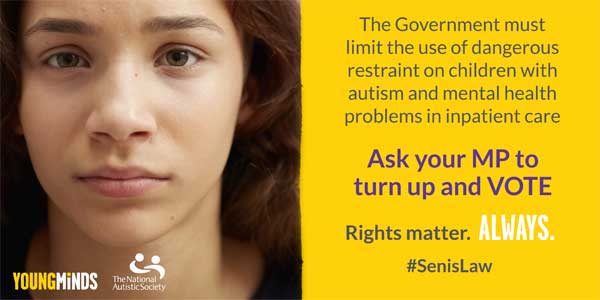
    You have an urgent opportunity to help change the law to limit the use of dangerous restraint on children and young people in mental health hospitals. Take action now and email your MP.

    In February we launched Always, a joint campaign with Young Minds. Nearly 10,000 of you signed our petition calling for strong, enforceable rights to protect children in mental health hospitals, and their families, when they need it most. Right now, we have an opportunity to change the law to protect vulnerable children in mental health hospitals. Practices like face-down restraint can be very distressing and in extreme cases, can also lead to serious physical injury.

    You can influence a vote in Parliament.

    On 3 November, Steve Reed MP is taking the Mental Health Units (Use of Force) Bill to Parliament. This will be a vote in Parliament which could limit the use of restraint on children and improve staff training in mental health hospitals. The Bill is being referred to as Seni’s Law, named after a young man called Seni who was tragically killed in a mental health unit after being physically restrained.

    We need as many MPs as possible to turn up on the day to vote to make sure this Bill goes through to the next stage. Every MP will count. Will you take action by emailing your MP and asking them to turn up to the vote?

    Email my MP >

    Good quality, safe care is a lifeline to many children with mental health problems. But for others, including some on the autism spectrum, their mental health can get worse in hospital and they and their families can struggle to get help that is right for them.

    Rights matter. Always. Stronger rights for children and their families mean they always receive the support that’s appropriate for them. Make sure your MP knows that.


    Share This Post:
    Facebooktwitterlinkedinmail
  • Psychological professions unite against conversion therapy

    Psychological professions unite against conversion therapy


    Mental Health Today – 16th October 2017
    An updated memorandum of understanding (MoU) against conversion therapy has been launched today, which makes it clear that conversion therapy in relation to gender identity and sexual orientation (including asexuality) is unethical, potentially harmful and is not supported by evidence.

    Conversion therapy is the term for therapy that assumes certain sexual orientations or gender identities are inferior to others, and seeks to change or suppress them on that basis.

    The primary purpose of the 2017 MoU is the protection of the public through a commitment to ending the practice of ‘conversion therapy’ in the UK. The 2017 MoU updates one released in 2015 at the Department of Health, which focused exclusively on sexual orientation, and is endorsed by the lesbian, gay, bisexual and transgender charity Stonewall.

    The MoU also intends to ensure that:

    • The public are well informed about the risks of conversion therapy
    • Healthcare professionals and psychological therapists are aware of the ethical issues relating to conversion therapy
    • New and existing psychological therapists are appropriately trained
    • Evidence into conversion therapy is kept under regular review
    • Professionals from across the health, care and psychological professions work together to achieve the above goals.
    READ MORE
    Share This Post:
    Facebooktwitterlinkedinmail
  • APA – Recognising Emotions in Others: Study

    APA – Recognising Emotions in Others: Study

    American Psychological Association
    October 10th, 2017

    Best Way to Recognize Emotions in Others: Listen
     
    Voice-only communication more accurate than visual cues for identifying others’ feelings, study says

     
    WASHINGTON — If you want to know how someone is feeling, it might be better to close your eyes and use your ears: People tend to read others’ emotions more accurately when they listen and don’t look, according to research published by the American Psychological Association.

    “Social and biological sciences over the years have demonstrated the profound desire of individuals to connect with others and the array of skills people possess to discern emotions or intentions. But, in the presence of both will and skill, people often inaccurately perceive others’ emotions,” said author Michael Kraus, PhD, of Yale University. “Our research suggests that relying on a combination of vocal and facial cues, or solely facial cues, may not be the best strategy for accurately recognizing emotions or intentions of others.”

    In the study, which was published in APA’s flagship journal, American Psychologist®, Kraus describes a series of five experiments involving more than 1,800 participants from the United States. In each experiment, individuals were asked either to interact with another person or were presented with an interaction between two others. In some cases, participants were only able to listen and not look; in others, they were able to look but not listen; and some participants were allowed to both look and listen. In one case, participants listened to a computerized voice reading a transcript of an interaction — a condition without the usual emotional inflection of human communication.

    CONTINUE READING…

    APA – Recognising Emotions in Others: Study

    Share This Post:
    Facebooktwitterlinkedinmail
  • Special Needs and Legal Entitlement – Review

    Special Needs and Legal Entitlement – Review


    I have just received a copy of the following book:
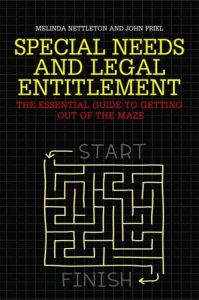
     
    “Special Needs and Legal Entitlement”

    The Essential Guide to getting out of the Maze

    by Melinda Nettleton and John Friel
    Jessica Kingsley Publishers
    Both Melinda and John have an interest in the area, both as parents and as lawyers. The chapters are as follows:

    A brief description of the new system for children and young people with special educational needs and disabilities with a comparison with the old system. It then goes on to talk about how to identify children with special educational needs, health and social care issues including Children Act assessments and Care Act assessments, the code of practice, the duty to delivery education and choice of schools, practical issues in relation to EHC Plans, information required to prepare a case and expert evidence, the right of appeal and mediation, appeals from the first tier tribunals enforcement, an interesting chapter called On the Naughty Step. There are some obvious ones such as solicitors representing local authorities against under-represented parents making some very inappropriate tweaks, less obvious is the fact that most families are not eligible for legal aid and in any event legal aid has never covered the hearing itself but does point to how legal aid can be obtained. It also looks at independent schools and where mistakes have been made, for example, ceasing to maintain the EHC Plan.

    The next chapter looks at Deputyship, what is it, do you need it. Chapter 13 is described as follows
    “42 common problems: 42 is the meaning of life, the universe and everything and all that”.
    Then there are a number of appendices. One about reasons for appeal, two examples given. The next is two examples given of expert reports, the next appendix is the special educational needs and disability regulations 2014. Appendix 4 looks at the first tier tribunal procedure rules. Appendix 5 provides a table of cases and Appendix 6 is guidance for witnesses who seek to give expert evidence in SEND.

    It is quite a thick book but I am sure would be extremely helpful for anyone who is trying to make sense of EHC Plans and their legal rights of children and young people with special educational needs. Indeed, one person describes it as the “must have book” in respect of the new Education and Health Care plans.

    I shall be bringing it along to the post-diagnostic support group. Anyone who has had experience of EHC Plans who might want to review it for us would be more than welcome.

    Dr. Linda Buchan
    Consultant Clinical Psychologist
    & Director of Axia ASD Ltd.

    Share This Post:


    Facebooktwitterlinkedinmail
  • Sept. PDSG: A Note from Linda

    Sept. PDSG: A Note from Linda


    Looking forward to seeing everyone on Wednesday where we will have a presentation from Dr Peter Mason, the ADHD specialist for Cheshire.

    I have managed to review another book prior to the group called “The Illustrated Guide to Dyslexia and its Amazing People”.

    I think the ex CEO of Dyslexia Action sums up the book as follows:
    “A really imaginative book which manages to impart a lot of good and accurate information in a way which will engage young people and their parents too.”

    Dyslexia is a learning difference not a difficulty. It is clearly articulated throughout the book and the strengths of Dyslexia, as well as the challenges, are also noted.

    There are very few words in the book and mostly images and this is quite rare for any books on Dyslexia but obviously of enormous benefit.

    I have also been told I need to bring copies of my book, apologies for the self-promotion but just in case anybody would like to borrow the book.

    We may be down on numbers of staff due to holidays by various members of us which has resulted in a bit of a backlog and, as always, we would be grateful for input from members of the group to help us with this.

    Many Thanks,
    Linda
     
    Dr. Linda Buchan
    Consultant Clinical Psychologist
    & Director of Axia ASD Ltd.

    Share This Post:
    Facebooktwitterlinkedinmail
  • MHT – Half of CCGs to cut mental health spending

    MHT – Half of CCGs to cut mental health spending


    Mental Health Today
    18 September 2017
    Half of CCGs to cut mental health spending
     
    Half of clinical commissioning groups plan to reduce the proportion of their budget they spend on mental health for this financial year (2017/18), according to new figures from Labour’s Luciana Berger.

    Of the 129 CCGs (62%) that responded to the freedom of information request, 64 (50%) plan to reduce the proportion of their budget they will spend on mental health.

    In 2014, 67% of CCGs did not intend to increase their proportion of spend on mental health.

    The next year, 2015/16, this number was 38% and last year, in 2016/17, it was 57%.

    The amount CCGs plan to spend on mental health services varied between South Cheshire, which will spend just 5% of its budget on mental health services, to Lewisham which plans to allocate 16% of its total budget to mental health – an 11% range.

    The Health Secretary, Jeremy Hunt, stated in an Opposition Day Debate on Mental Health in December 2015 that “CCGs are committed to increasing the proportion of their funding that goes into mental health.”

    NHS England’s planning guidance for 2017 – 2019 states that all CCGs are required to increase their spend on mental health by at least as much as their overall budget increase.

    Referring to the guidance in July 2015, the then Minister for Care and Support, Alistair Burt, said in Parliament: “That is as transparent as it has ever been, and we will ensure that that standard is maintained.”

    CONTINUE READING…
    Share This Post:
    Facebooktwitterlinkedinmail
  • Fall Down Seven Times, Get Up Eight – Review

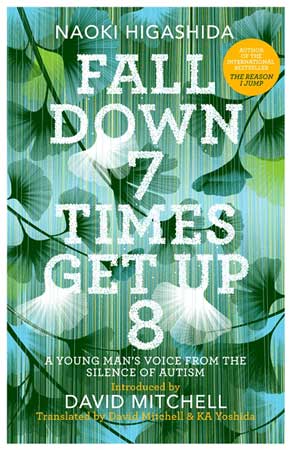
    Fall Down Seven Times, Get Up Eight – Review


    Book Review of
     
    “FALL DOWN SEVEN TIMES, GET UP EIGHT”
    By Naoki Higashida,
    Introduced by David Mitchell
    Translated by David Mitchel and K A Yoshida
    Publisher: Sceptre; Unabridged edition edition (11 July 2017)

    Some of you may have read “The Reason I Jump”, which was Naoki Higashida’s account of Autism from inside. The book is on our recommended book list.

    He wrote this when he was thirteen, back in 2007. Ten years on, he is now giving us further insight into Autism as a young adult.

    It is described as a young man’s voice from the silence of Autism and there are eight chapters which have been translated from Japanese by David Mitchell, who translated “The Reason I Jump”.

    He is described as having Autism that has been labelled as severe and non-verbal. You will note that at Axia, we don’t like to talk about severity and to echo what Dr Luke Beardon has said, that
    Autism + Environment = Outcome.

    The title is borrowed from a Japanese proverb about the merits of persistence and the book is described as offering experience and advice and hope.

    We shall be bringing the book to our Post-Diagnostic Support group and I would welcome, if anyone feels able to, read the book and review it for us.

    Dr. Linda Buchan
    Consultant Clinical Psychologist
    & Director of Axia ASD Ltd.

    Share This Post:

    Facebooktwitterlinkedinmail
  • July PDSG – A Note from Linda

    July PDSG – A Note from Linda


    Dear All
     
    For the first time ever I will not be at the Post-Diagnostic Support Group. This will be because I am on holiday.
    Calvin bought me the holiday as a surprise and had asked Carly previously which dates to avoid in July. Unfortunately he made a Dyspraxic/Dyslexic error and picked the dates that Carly told him to avoid because it was the post-diagnostic support group.
     
    I hope the group goes well and I will see you all again at the next one.
     
    Linda
    Dr. Linda Buchan
    Consultant Clinical Psychologist
    & Director of Axia ASD Ltd.

    Share This Post:
    Facebooktwitterlinkedinmail
  • CBT vs counselling: what’s next for the mental health of the UK?

    CBT vs counselling: what’s next for the mental health of the UK?


    Mental Health Today – News
    19th June 2017
    The BACP warned this month that counselling could be removed from the NICE Guidelines for Depression, leaving NHS patients only access to CBT. What could this mean for the mental health of the UK?

    Favouring cognitive behavioural therapy (CBT) over counselling is not a new thing.

    The NICE guidelines for Depression already recommends CBT as its frontline therapy. While they ask therapists offering counselling to discuss with their patients how uncertain the effectiveness of counselling can be.

    What’s the difference between CBT and counselling?

    Both CBT and counselling are used to support people with similar issues like anxiety and depression. And they’re both forms of talking therapy and can be used for short term work.

    But while CBT therapists and clients work together to change a client’s behaviour or thinking patterns, counselling is less directive and through listening, empathy, encouragement and challenge counselling hopes to help the client to better understand themselves and find their own solutions to cope with the issues that face them.

    Arguably someone could equally benefit from being supported by both interventions at different stages of their lives.

    CONTINUE READING…
    Share This Post:
    Facebooktwitterlinkedinmail
  • Autism And Asperger Syndrome In Adults – Review

    Autism And Asperger Syndrome In Adults – Review


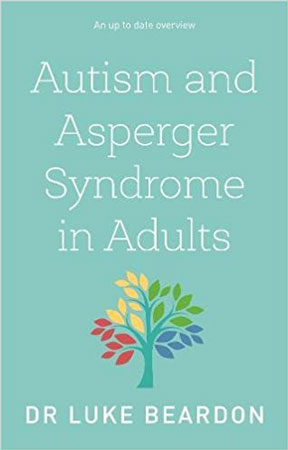
    Once again, our thanks to Dr Luke Beardon for his incredibly insightful, moving and at times funny presentation at our Post-Diagnostic Support Group. He was kind enough to give Axia some copies of his new book ‘Autism and Asperger Syndrome in Adults’ and I had the pleasure or reading it and here is my review:
     
    OVERCOMING COMMON PROBLEM SERIES:
     
    “AUTISM AND ASPERGER SYNDROME IN ADULTS”
    by Dr Luke Beardon
    Published by Sheldon Press

    As stated on the front cover this is clearly a very up to date overview of Autism and Asperger Syndrome. Although the title at the beginning says ‘in adults’, this book is pertinent to children, teenagers and their families.

    Real life situations are used throughout the book, with respect obviously to confidentiality. The chapters cover the following:

    • An introduction.
    • The second chapter explodes many of the myths of Autism
    • Social relationships and Echopraxic behaviour (copying others) Masking and being a good actor are the next two chapters.
    • The anxiety that people on the Spectrum often experience or are “made” to experience is Chapter 5.
    • The importance of consideration of sensory issues is covered by Chapter 6, Sensory Profile
    • Chapter 7 looks at diagnosis, or as the term Luke prefers, “identification”, bringing a greater understanding of self
    • Chapters 8 and 9 look at academic studying and employment
    • Relationships and parenthood are covered in Chapter 10
    • How people with Autism may come in contact with the criminal justice system is in Chapter 11 and people may be aware that his Phd was in this area
    • The final Chapter is a celebration of Autism

    Luke has decades of experience in the field in a number of settings, including working directly with individuals and in an academic setting.

    The back cover describes the book as both sensitive and insightful and that the book tackles myths and stereotypes about Autism, clearly explaining its implication in adulthood and I totally concur with this and this will be a book that we recommend to everyone we diagnose at Axia.

    Dr. Linda Buchan
    Consultant Clinical Psychologist
    & Director of Axia ASD Ltd.

    Share This Post:
    Facebooktwitterlinkedinmail
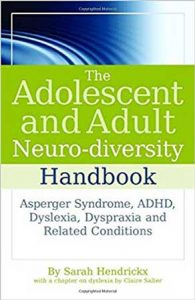
  • The Adolescent and Adult Neuro-diversity Handbook – Review

    The Adolescent and Adult Neuro-diversity Handbook – Review


    Book Review of
     
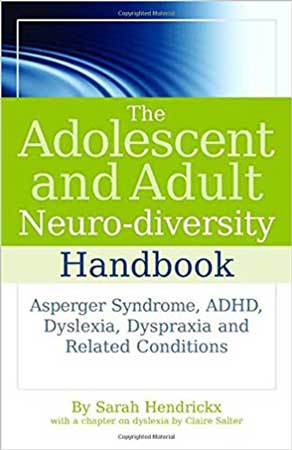
    “The Adolescent and Adult Neuro-diversity Handbook:”

    Asperger Syndrome, ADHD, Dyslexia, Dyspraxia and
    Related Conditions

    by Sarah Hendrickx
    Jessica Kingsley Publishers

    I have recently been reviewing the book lists that we send out with our diagnostic reports and some of you will be very familiar with those. Thus, we have booklists for adults, teenagers and children on the Autism Spectrum and book lists for other neurodiversity, including Dyspraxia, Dyslexia, Irlen Syndrome and so on.

    I realised that we had probably missed out by not including the Adolescent and Adult Neurodiversity handbook, Asperger Syndrome, Attention Deficit Hyperactivity Disorder, Dyslexia, Dyspraxia and related conditions by Sarah Hendrickx, with a chapter on Dyslexia by Claire Salter and have subsequently added it to all of our book lists.

    The design of the book, in my opinion is very neuro diverse friendly. The chapters begins with a definition of neurodiversity and then there are chapters on the following neuro diverse conditions:

    • Adult Attention Deficit Hyperactivity Disorder/Attention Deficit Disorder
    • Autistic Spectrum conditions: Asperger Syndrome
    • High functioning Autism
    • Pervasive Developmental Disorder/not otherwise specified PDD/NOS

    This book was written in 2010 and therefore was written prior to the changes to the DSM which was revised in 2013 and has got rid of all of the sub categories and simply talks about Autism Spectrum Disorder. It will probably be the case that the eleventh revision of the International Classification of Diseases will result in the same revision.

    Chapters are then written on:

    • Dyslexia
    • Dyspraxia/Developmental Coordination Disorder
    • Dyscalculia
    • Mathematic Disorder
    • Dysgraphia (disorder of written expression)
    • Tourrette’s Syndrome
    • Anxiety Disorders
    • Obsessive Compulsive Disorder (OCD)

    The final two chapters focus on the learning environment and the working environment looking at teaching approaches and workplace adjustments.

    The book clearly embraces diversity and also provides a number of helpful suggestions. The definition of neurodiversity is defined as a way of processing information and making sense of the world in a way that differs from the typical (neurotypical). I wholeheartedly recommend this book for anyone who experiences any neurodiversity or has family members with neurodiversity.

    Dr. Linda Buchan
    Consultant Clinical Psychologist
    & Director of Axia ASD Ltd.

    Share This Post:
    Facebooktwitterlinkedinmail
  • A Boy Made of Blocks

    A Boy Made of Blocks


    “A Boy Made of Blocks”
    by Keith Stuart
    Published by Sphere
    As part of Calvin’s role of self-proclaimed Nerd Consultant, he likes to keep up with any Television programmes that are important to Nerd Culture.

    He watches a particular programme, hosted by Dara O’Briain, called ‘Go 8 Bit’ and he has an off-shoot programmed DLC programme and various gamers compete against each other.

    More recently Keith Stuart, who writes the Guardian column around gaming appeared and spoke about one of his sons being Autistic. He then explained how both Keith and his two sons started playing video games together, especially Minecraft. Keith had always played games and since 1995 has been writing about them.

    The powerful creative sharing as a family and the blossoming communication that followed informed his debut novel ‘A Boy Made of Blocks’, a story about a dad who wants to communicate with his Autistic son, a dad who has forgotten how to play, is a story about letting go, about being a kid, which is how Keith learned about everything important in his life, starting with his son.

    His son is described as follows:
    “Meet eight year old Sam, beautiful, surprising and different. To him, the world is a frightening mystery, but as his imagination comes to life, his family will be changed for good”.
    It is described as a beautiful, funny and uplifting story of family and love inspired by the author’s own experiences with his son. I haven’t yet read it, but thought I would alert people as this may be a book that people would want to take away with them on holiday, which is probably what I would do.
     
    Thank you to Cal for bringing it to my attention.
    Dr. Linda Buchan
    Consultant Clinical Psychologist
    & Director of Axia ASD Ltd.

    Share This Post:
    Facebooktwitterlinkedinmail
  • Questions for Luke – May PDSG meeting

    Questions for Luke – May PDSG meeting


    In anticipation of our forthcoming Post-Diagnostic Support Group and given the fact there were 45 attendees at last month’s meeting, we are setting the room up slightly differently in order to accommodate larger numbers. The chairs will be set out in rows rather than a semi-circle.

    In addition, Dr Luke Beardon who is speaking at our group on 24 May has invited people to ask individual questions.

    Should you wish to ask a question please post it in the comments section for Luke to consider his response prior to the meeting.

    Dr. Linda Buchan
    Consultant Clinical Psychologist
    & Director of Axia ASD Ltd.

    Share This Post:
    Facebooktwitterlinkedinmail
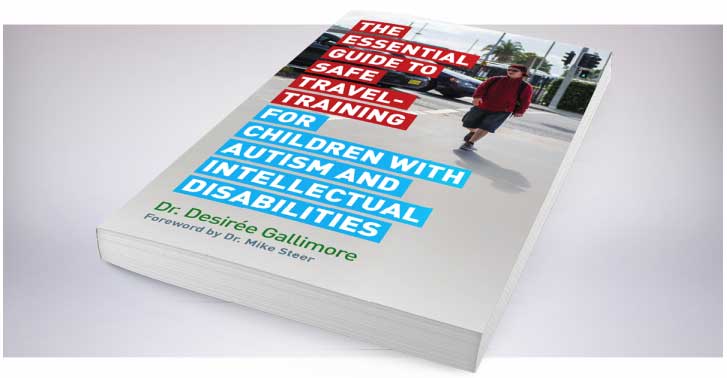
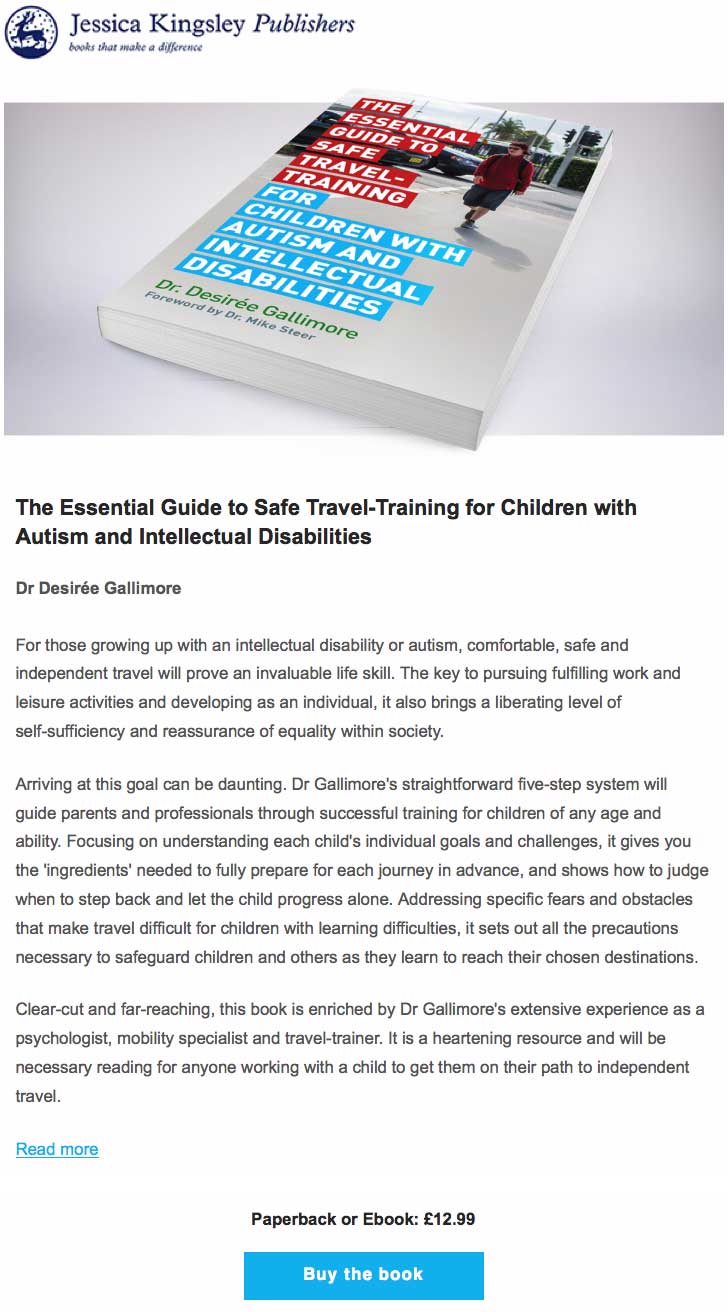
  • Jessica Kingsley Publishers – The Essential Guide to Safe Travel

    Jessica Kingsley Publishers – The Essential Guide to Safe Travel


    Jessica Kingsley Publishers Book News


    Share This Post:
    Facebooktwitterlinkedinmail