Author: Linda Buchan

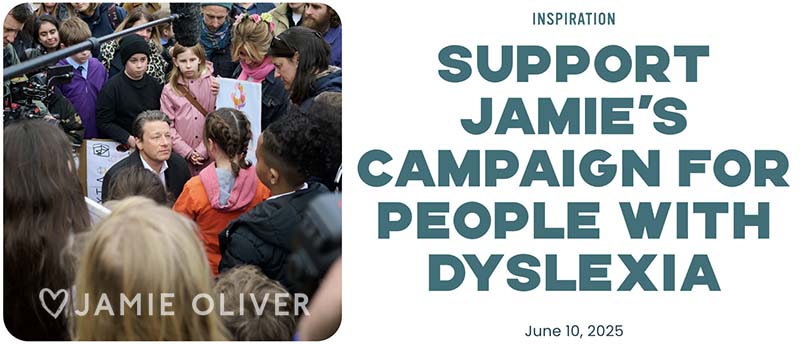
  • Support Jamie’s Campaign for People With Dyslexia

    Support Jamie’s Campaign for People With Dyslexia


    Get involved – #ComeOnBridget!

    We need the Secretary of State for Education, Bridget Phillipson, to make sure our education system works for all children – including those with dyslexia.

    If you’ve lived it, watched your child struggle, or tried to support kids in the classroom – now’s the time to speak up – LITERALLY!

    Voice Petition

    Jamie and the British Dyslexia Association have launched the UK’s first-ever voice petition — because not everyone communicates the same way, and your voice matters.

    As Bridget shapes the future of SEND, she needs to hear from those who live it: parents, teachers, young people, and allies who know what’s working — and what’s not.

    Record your voice note here. We’ll turn them into a growing, podcast-style petition — a living, breathing message to the government – live on Spotify here.

    Speaking up isn’t easy — but if we don’t, who will? Tell the world and bridgetphillipsonmp that you’ve added your voice, and ask others to do the same.


    Share This Post:
    Facebooktwitterlinkedinmail
  • NHS Learning Disability and Autism Update July 2025

    NHS Learning Disability and Autism Update July 2025


    We have included important information that was shared on social media during July, so you have this all in one place.

    We have tried to make it plain English. 

    If you are looking at this from a work email address and can’t see the pictures below, try sending this email to your personal email address.

    You should be able to see all the pictures.

    What we are covering:

    • Newsletter
    • Advisory group meeting
    • Co-production week
    • Love your lungs 
    • NCEPOD: Learning Disability study – patient and carer survey

    Read our latest NHS England Learning Disability and Autism Programme newsletter, number 19. Written in easy read and plain English.  

    The topics are:  

    • Mental Capacity Act guidance 

    • building better lives in the community 

    • annual health checks 

    The newsletter was coproduced with the wider programme, together with members from the learning disability and autism advisory group.  

    Please share this link widely with people who you think would like to read it and find it useful. https://www.england.nhs.uk/learning-disabilities/about/get-involved/newsletters/  

    Or if you would like any hard copies, please let us know. 

    The learning disability and autism advisory group met online on 9 July. 

    We had 24 of our advisory group attending, as well as staff joining us for part of the meeting from a hospital, a region and an integrated care board (ICB) and two GP practices, so that we could truly co-produce. 

    We heard from the groups about their views on problems with and ideas to improve accessing health care, which we will also share with the Department of Health and Social Care (DHSC). 

    We also shared new resources to support health and care staff use the Mental Capacity Act. The groups explored what else might be needed to help patients and staff in their Mental Capacity Act assessment. 

    Emma Clark, Lived Experience Policy Officer Co-worker, captured the day in the great picture below. 

    Some feedback we had:  

    • was really interesting and a great learning opportunity to go away and see how some of the issues raised are managed within own organisation or through the new plans 

    • the meetings make me feel like I’m having a real positive impact on the services for those in our community 

    It was co-production week at the start of July.  Read about how our lived experience staff contribute to our work and help us to co-produce. 

    https://www.england.nhs.uk/long-read/co-producing-policy-and-guidance-with-our-lived-experience-team/

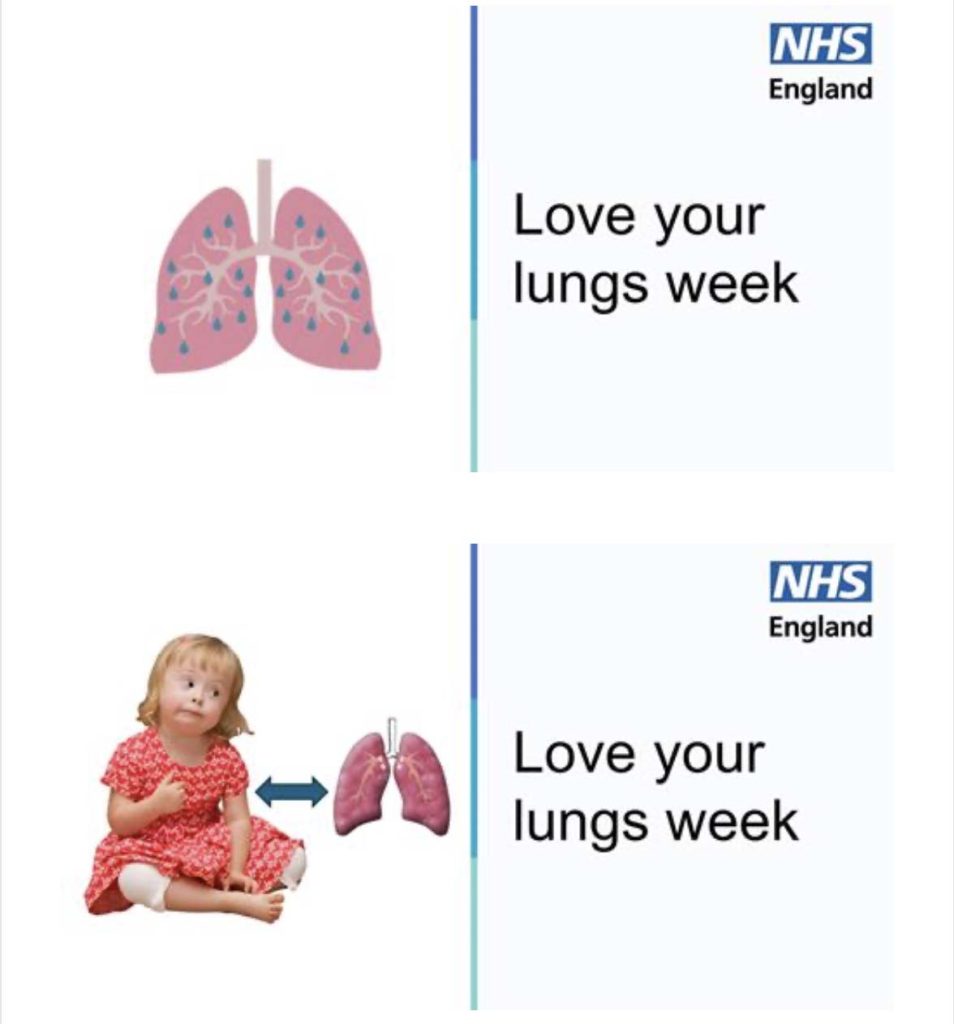
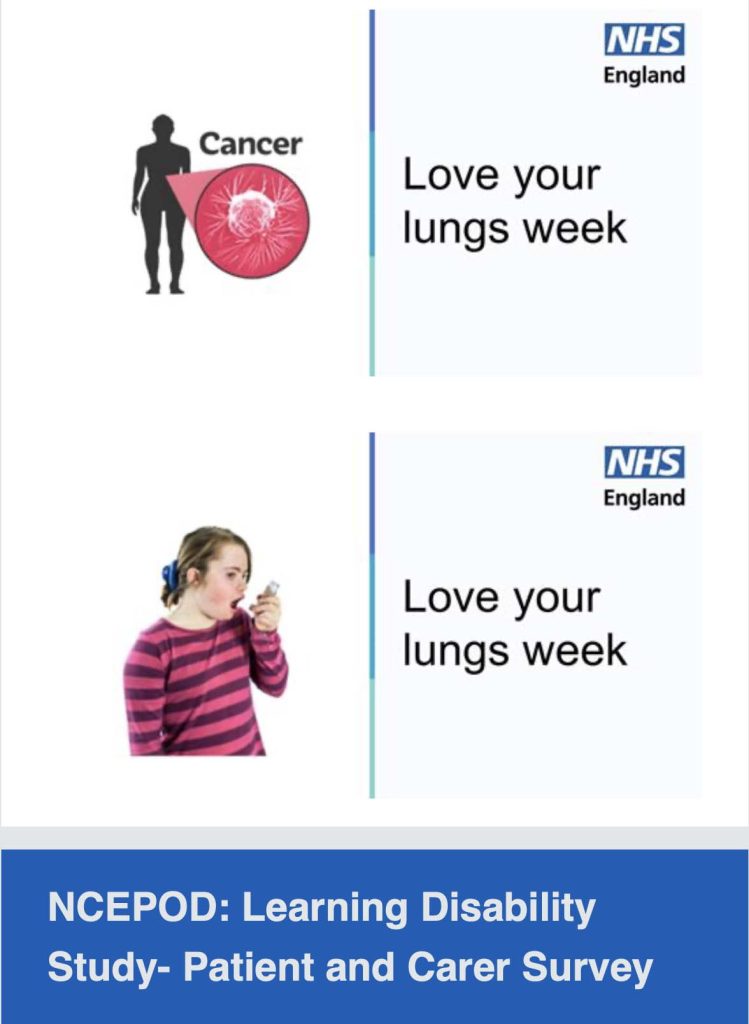
    It was love your lungs week from 21 to 27 July. We shared information on lung conditions that people with a learning disability are more likely to get. 

    Asthma is a common condition that affects your breathing. At the moment it   cannot be cured, but if it’s well treated you should not have problems. See this easy read guide on asthma.https://shop.asthmaandlung.org.uk/collections/easy-read/products/all-about-asthma-easy-read 

    Bronchiolitis is a common chest infection that affects babies and children under 2. It’s usually mild and can be treated at home. But sometimes it can be serious. See the Hampshire and Isle of Wight NHS webpage on bronchiolitishttps://www.healthiertogether.nhs.uk/child-under-5-years/bronchiolitis-and-rsv
    Pneumonia is inflammation of the lungs, usually caused by an infection. People can be at risk of getting seriously ill and may need treatment in hospital. Read this easy read guide on pneumoniahttps://mcusercontent.com/cc1d350f6ca35e29c3b45892e/files/5a47263f-2897-17a7-e8b4-fe9818b53cea/Pneumonia.pdf

    Lung cancer is one of the most common and serious types of cancer. Look at this easy read guide on lung cancerhttps://www.macmillan.org.uk/cancer-information-and-support/stories-and-media/booklets/lung-cancer-easy-read

    Obstructive pulmonary disease (COPD) is the name for a group of lung conditions that cause breathing difficulties. See this easy read guide on COPDhttps://www.easyhealth.org.uk/pages/21-lung-and-breathing-problems-copd

    We hope you have found the information useful to help keep your lungs healthy and know what to look for if you have any problems. 
    The National Confidential Enquiry into Patient Outcome and Death (NCEPOD) is a charity which works to make healthcare services better for the people who use them. Their work has led to lots of good changes in how healthcare is provided. They are trying to make hospital admissions for people with a learning disability better.

    They are collecting information to understand how hospitals can give better care to people with a learning disability. 
    If you have been in hospital when you were unwell, they want to hear about your experience. You may have taken an ambulance to hospital.

    The information they collect will help doctors, nurses, and other healthcare staff learn how to give better care in the future.

    They (NCEPOD) have made a survey for someone with a learning disability to complete to tell us what they think. There is also a survey for carers of people with a learning disability to complete.

    The survey is anonymous, NCEPOD removes all personal information from any surveys they receive, so you and your family cannot be identified.

    The closing date to complete the survey is 16 October.

    If you would like to complete a survey:

    Online – by clicking the link below or scanning the QR Code

    Patient survey – https://forms.cloud.microsoft/e/5yAVV0AWa2                             

    Carer survey –https://forms.cloud.microsoft/e/ibhGBWUkxe


    Give us your feedback!

    If you would like to feedback about anything in this update email, including the new look, please email us onengage@nhs.net


    Share This Post:

    Facebooktwitterlinkedinmail
  • They’ve only gone and done it! – NAS

    They’ve only gone and done it! – NAS


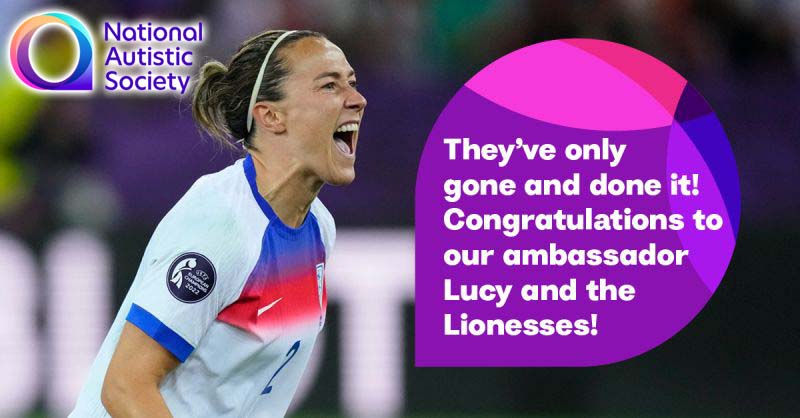
    They’ve only gone and done it! 🎉 ⚽

    The National Autistic Society is sending huge congratulations to the Lionesses for their spectacular win at the UEFA Women’s EURO final! Thank you for bringing it home!

    We are so proud of Lucy Bronze MBE who is not only a brilliant Ambassador for our charity, but an incredible role model for young autistic people. We hope the Lionesses enjoy every moment of their success and look forward to seeing many more wins in the future.


    Share This Post:
    Facebooktwitterlinkedinmail
  • Submit work to The Spectrum Magazine – NAS

    Submit work to The Spectrum Magazine – NAS


    Submit work to The Spectrum

    The Spectrum is a magazine written for and by autistic people and we are always looking for new contributors. Whether you have an article, piece of artwork or a poem you would like to be considered for inclusion, please send it in and it could appear in a subsequent issue.

    How do I submit work to The Spectrum?

    The steps for submitting your work are as follows:

    1. Read the submission information below.
    2. Read about the theme for the next issue below.
    3. Go to our Submit work page to read the permissions information and submit your work.

    Share This Post:
    Facebooktwitterlinkedinmail
  • Aviation Accessibility Task and Finish Group report

    Aviation Accessibility Task and Finish Group report


    Executive summary

    Background

    Since the pandemic there has been a significant increase in the number of passengers requesting assistance to enable them to travel by air. According to the most recent Civil Aviation Authority (CAA) data, in 2024, 5.5 million passengers requested assistance at a UK airport, which equates to approximately 1.9% of total passengers. This has increased from 0.94% in 2010, 1.35% in 2019 and 1.69% in 2023.

    The most recent CAA survey data shows that Disabled passengers remain less satisfied with air travel than non-disabled and younger passengers. See the CAA Aviation Consumer Survey October 2024 (Wave 13).

    Whilst there have been improvements in recent years, there remain unacceptable barriers to air travel for this group of travellers, with many examples of poor and inappropriate service, passengers being left onboard aircraft for long periods, damaged mobility aids, and discriminatory behaviour.


    Share This Post:
    Facebooktwitterlinkedinmail
  • NHS Learning Disability and Autism Engagement Team – Update Email June 2025

    NHS Learning Disability and Autism Engagement Team – Update Email June 2025


    We have included important information that was shared on social media during June, so you have this all in one place.

    We have tried to make it plain English.

    If you are looking at this from a work email address and can’t see the pictures below, try sending this email to your personal email address.

    You should be able to see all the pictures.

    What we are covering:

    • Carers Week
    • Mental Health Capacity Act guidance
    • Learning Disability Week
    decorative

    It was carers Week at the beginning of June. A big thank you to all the carers who help people with a learning disability and autistic people.

    Make sure you look after own mental health and wellbeing, as well as those you care for. See the Mind webpage on how to look after yourself as a carer. https://www.mind.org.uk/information-support/helping-someone-else/carers-friends-family-coping-support/looking-after-yourself/

    Here are some top tips to improve your mental wellbeing https://www.nhs.uk/every-mind-matters/mental-wellbeing-tips/top-tips-to-improve-your-mental-wellbeing/

    Young carers have a lot more responsibility than other people their age who are not carers. They need a break too. For help and support as a young carer, visit the Carers Trust website https://carers.org/getting-support-if-you-are-a-young-carer-or-young-adult-carer/getting-support-if-you-are-a-young-carer-or-young-adult-carer

    During carers week, we share an update from one of our programme team, Mary Busk, who is also a family carer, helping to coproduce the work we do. https://youtu.be/kXDiWxjigp0?si=aQ1SVlhjDCUyHUg-

    NHS England Mental Capacity Act guidance and toolkit is now out.

    If you go to hospital because you are unwell the staff should check that you have mental capacity before any tests, treatment or care are given to you. New guidance from NHS England will help hospital staff work out if people with a learning disability have mental capacity and get the right support if they do not .

    The new guidance and tools are for staff and NHS trusts but will affect anyone going into hospital.

    You can find the guidance and tools on the NHS England website https://www.england.nhs.uk/publication/guidance-to-support-implementation-of-the-mental-capacity-act-in-acute-trusts-for-adults-with-a-learning-disability/

    It contains advice (guidance) and tools for staff in hospitals about how to assess mental capacity.

    Capacity means being able to make decisions for yourself or to have support to do so.

    Staff in hospitals should use reasonable adjustments to help you understand information. They should carefully check if you are able to make decisions about treatment you may have for your health condition.

    See below a helpful resource pack for family carers of people with a learning disability
    https://www.mencap.org.uk/sites/default/files/2016-06/mental%20capacity%20act%20resource%20pack_1.pdf

    Look at this easy read document which talks about capacity and consent
    https://www.seeability.org/sites/default/files/2024-03/Consent%20and%20capacity.pdf

    It was also learning disability week in June. This year’s theme was about being seen, heard and being valued. See what Harshi, one of our independent Advisory Group members, says about herself https://www.youtube.com/watch?v=FnWIikVx3tU

    We reminded you that you have the right to ask for reasonable adjustments to make sure you get the right health care you need. https://youtu.be/6bdxREk9_2I

    We told people that anyone over the age of 14 with a learning disability should have a health check every year. https://youtu.be/ocU8XhD1kh8 Make sure you ask your GP for your health check https://youtu.be/TBZpaJbeg2g

    Our Website
    How to get involved
    Accessible Video Blogs


    Share This Post:
    Facebooktwitterlinkedinmail
  • Autism Act 2009 Committee – Linked In

    Autism Act 2009 Committee – Linked In


    On Monday 30 June, we’ll question Government ministers on what they plan to do to improve outcomes for autistic people when the current autism strategy ends in 2026.

    At 2:45, we’ll hear from:
    ⭐ Stephen Kinnock MP, Minister of State for Care, Department of Health and Social Care (DHSC)
    ⭐ Alison McGovern MP, Minister for Employment, Department for Work and Pensions (DWP)
    ⭐ Catherine McKinnell MP, Minister for School Standards, Department for Education (DfE)

    You can also read the Government’s response to our call for evidence, now published here:
    https://lnkd.in/ecYRBMEK


    Share This Post:
    Facebooktwitterlinkedinmail
  • Care for those with learning disabilities or autistic people – Government Press release

    Care for those with learning disabilities or autistic people – Government Press release


    Care for those with learning disabilities or autistic people

    New guidance published today will provide a boost in the quality of care for people with a learning disability or autistic people

    Published 19 June 2025

    • New guidance published today to ensure health and care staff have skills to provide care for people with a learning disability and autistic people
    • Oliver McGowan Mandatory Training on Learning Disability and Autism named after teenager who died in 2016 after having severe reaction to medication given to him against family’s wishes
    • Training will aim to tackle health inequalities faced by people with a learning disability and autistic people, who face poorer health outcomes than general population

    People with a learning disability and autistic people will get safer, more personalised care as the government publishes new guidelines for health and care providers to train staff.

    The Oliver McGowan code of practice on statutory learning disability and autism training aims to ensure staff have the right skills to provide care and boost understanding of the needs of these groups of people.


    Share This Post:
    Facebooktwitterlinkedinmail
  • Jamie Oliver: Why Dyslexic Thinking Is The Secret Ingredient You Need To Create Change – YouTube

    Jamie Oliver: Why Dyslexic Thinking Is The Secret Ingredient You Need To Create Change – YouTube


    Jamie Oliver: Why Dyslexic Thinking Is The Secret Ingredient You Need To Create Change

    Jamie Oliver is Britain’s best-selling non-fiction author – selling over 50 million books worldwide. He’s taught the world to cook and used his Dyslexic Thinking to make complex recipes simple and easy and create powerful change. First with school dinners. Next by training disadvantaged kids to become top chefs. Now, he’s tackling dyslexia and the education system.

    As his Channel 4 documentary airs, Jamie tells Kate how cooking saved him, why his cook books are covered in ‘dyslexic code’ and reveals that so many of his Dyslexic Thinking skills have played an instrumental role in his groundbreaking campaigning and ability to communicate, simplify and steer powerful teams.

    Whether it’s as a communicator, an imaginer or an entrepreneur… dyslexics like Jamie are brilliant at spotting what no one else is doing and using their creativity to imagine solutions that make everyone’s lives better.


    Share This Post:
    Facebooktwitterlinkedinmail
  • Take Action To Oppose The Disability Benefits Cuts! – Disability Rights UK

    Take Action To Oppose The Disability Benefits Cuts! – Disability Rights UK


    Take Action To Oppose The Disability Benefits Cuts! – Sign The Petition, Write To Your MP

    A new petition backed by Disabled People’s Organisations (DPOs) aims to unite opposition to the government’s “devastating” disability benefit cuts and reforms by calling for every one of the measures to be abandoned.

    The petition has been endorsed by DPO Forum England, whose 40-plus members include GMCDP, Disabled People Against Cuts (DPAC), Disability Rights UK, Inclusion London and the National Survivor User Network.

    Unlike previous petitions, this Greater Manchester Coalition of Disabled People (GMCDP) petition targets the whole Green Paper reform strategy.

    The petition calls on the government to work with Disabled people to draw up a national disability strategy in line with the UK’s international disability rights treaty obligations.

    It calls on the government to drop the green paper proposals “and instead begin a process of co-production with Disabled people’s representative organisations to create a whole government disability strategy”


    Share This Post:
    Facebooktwitterlinkedinmail
  • Linked In – Paid research consultation opportunity for autistic adults

    Linked In – Paid research consultation opportunity for autistic adults


    A team at City St George’s are looking to work with 5 autistic adults who have recently had diagnostic imaging (like x-rays, CT, MRI, ultrasound) or radiotherapy. We need your help to design a questionnaire, and we need to ensure we are informed by your priorities.

    🕒 Time commitment: 3 hours (with more available in the future if interested)
    💰 Payment: £75 voucher (£25 per hour)
    💻 Location: remote/online from home

    ➡️ What it involves:
    You will be asked to review a draft survey, provide feedback during one online meeting (scheduled for Wednesday 2nd July), and test the online survey platform.


    Share This Post:
    Facebooktwitterlinkedinmail
  • Exploring the Intersectional experience of being Black and Autistic

    Exploring the Intersectional experience of being Black and Autistic


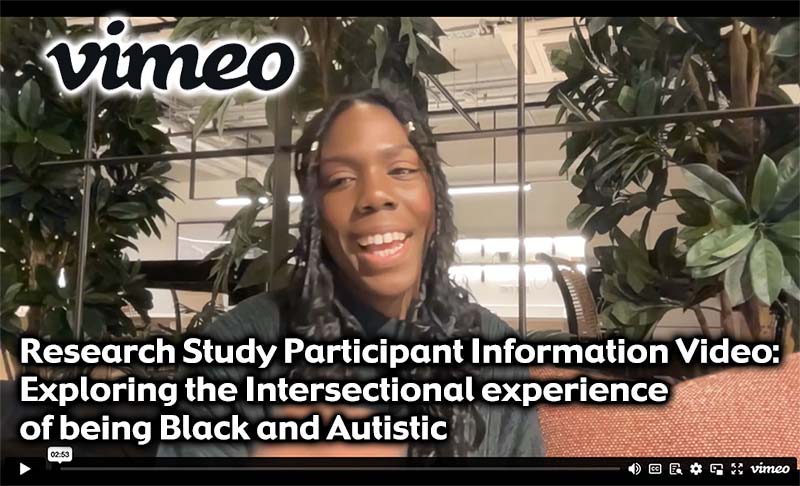
    Research Study Participant Information Video: Exploring the Intersectional experience of being Black and Autistic

    Informational Video about autism research taking place. If you are interested in participating, please contact the researcher Heather Chambers via email: h.chambers3@herts.ac.uk for more info.


    Share This Post:
    Facebooktwitterlinkedinmail
  • Katie Munday, MRes’ Post – LinkedIn

    Katie Munday, MRes’ Post – LinkedIn


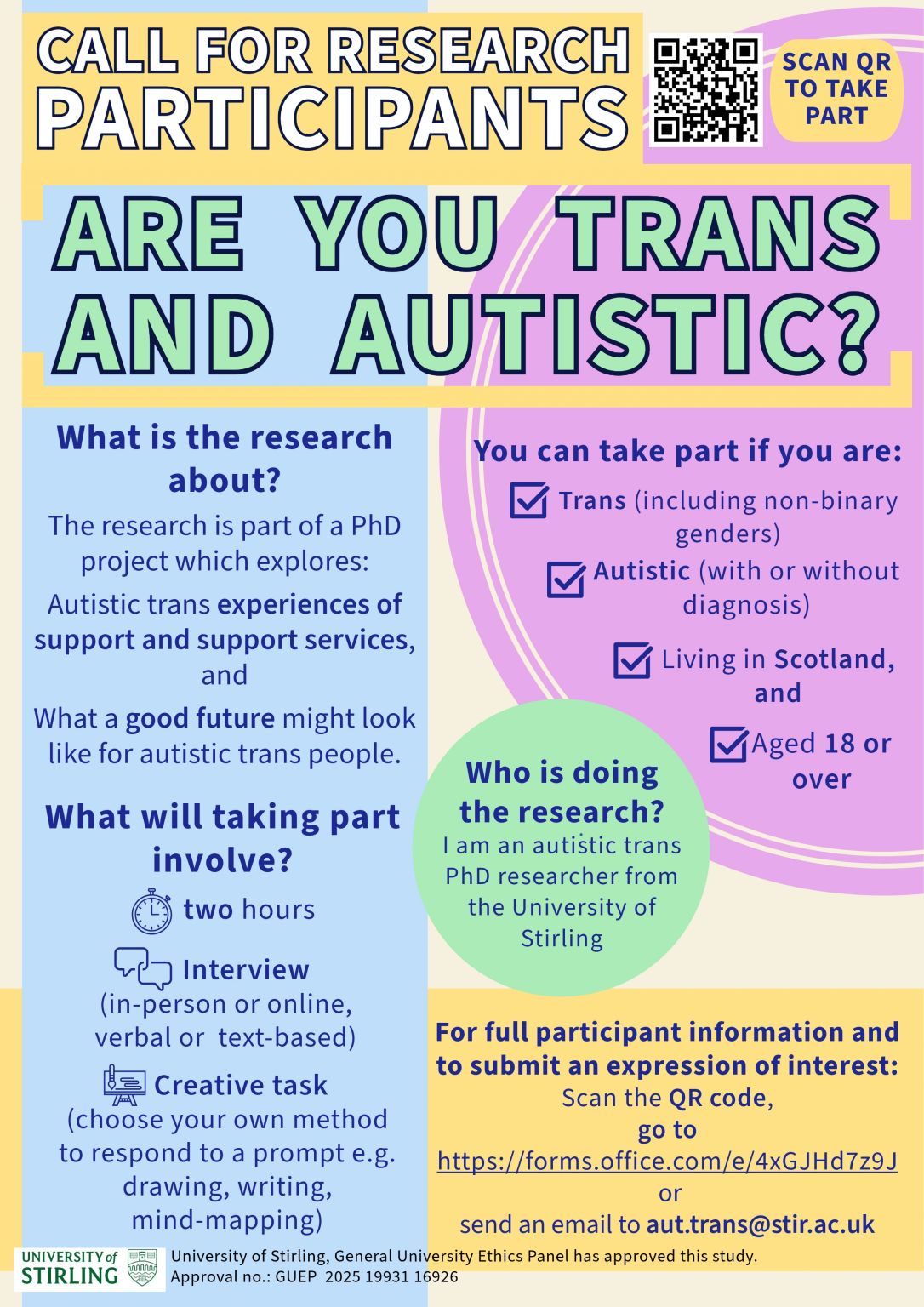
    A research recruitment poster from a dear trans Autistic friend of mine.

    ***

    A poster for a research project. The title reads “call for research participants: are you trans and autistic?” and there is a QR code which could be scanned to take part.

    The text continues: What is the research about? The research is part of a PhD project which explores: autistic trans experiences of support and support services, and what a good future might look like for autistic trans people. You can take part if you are: trans (including non-binary genders); autistic (with or without diagnosis); living in Scotland; and aged 18 or over.

    What will taking part involve? A time commitment of two hours; an interview (in-person or online, verbal or text-based); a creative task (choose your own method to respond to a prompt e.g. drawing, writing, mind-mapping).


    Poster

    Share This Post:
    Facebooktwitterlinkedinmail
  • Autism Act 2009 Committee’s Post – LinkedIn

    Autism Act 2009 Committee’s Post – LinkedIn


    On Thursday 24 April at 10:15, the Committee will hear from three witnesses who advocate for better health and care services for autistic people.

    ➡️ Paula McGowan OBE (Also on BlueSky), Founder of Oliver McGowan mandatory training on learning disability and autism
    ➡️ Virginia Bovell OBE, Founding parent of TreeHouse School, co-founder of Ambitious about Autism, and ex-Trustee at the National Autistic Society
    ➡️ Dr Rachel Moseley, Principal Academic in Psychology, University of Bournemouth

    We’ll be discussing issues including:


    Share This Post:
    Facebooktwitterlinkedinmail
  • It’s How You Show Up – NAS

    It’s How You Show Up – NAS


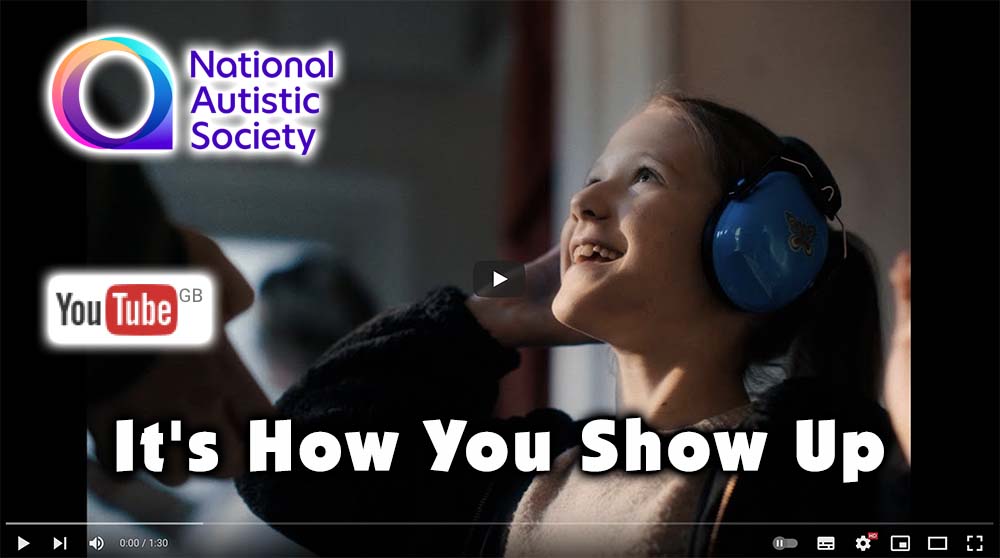
    The National Autistic Society – It’s How You Show Up

    Our surveys show there is a significant gap in understanding of autism and the ways in which people can support autistic people and their families.

    Showing up for autistic people can be easier than you might think. We have launched a public awareness campaign to educate people on simple changes they can make.


    Share This Post:
    Facebooktwitterlinkedinmail
  • UK Parliament – Call for Evidence Launched to Mark World Autism Acceptance Day

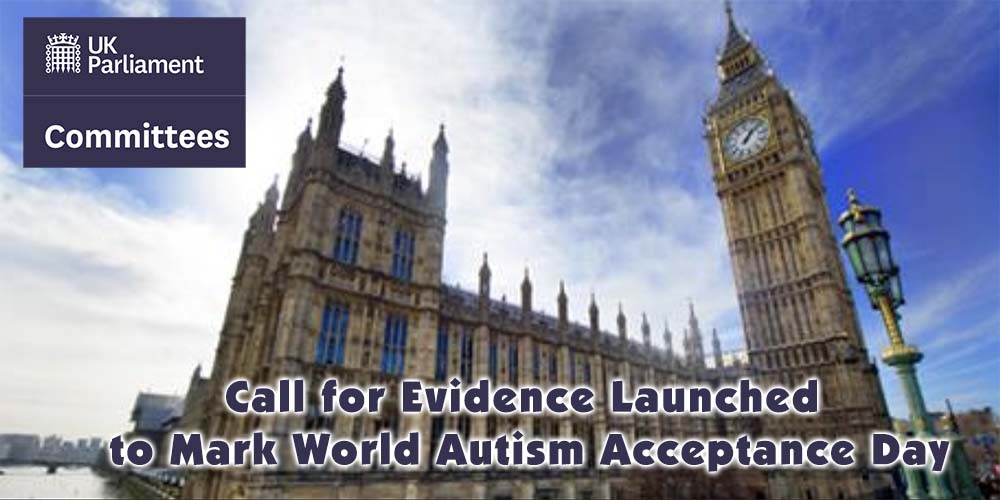
    UK Parliament – Call for Evidence Launched to Mark World Autism Acceptance Day


    To mark World Autism Acceptance Day, the House of Lords Committee on the Autism Act 2009 is today launching its Call for Evidence inviting written contributions to its inquiry.

    Background

    The Committee wants to understand how well the Autism Act, the Government’s autism strategy and the statutory guidance are working so that it can make specific, practical recommendations about what the Government should do next.

    The committee is seeking evidence on key questions about how to improve support for autistic people, including:

    • How can public understanding and acceptance of autistic people be improved?
    • How can the Government improve assessment, diagnosis and post-diagnostic support?
    • How can the Government improve the identification and support of autistic people when they need it (including if they do not have a diagnosis)?
    • How can access to healthcare be improved?
    • How can community support be improved?
    • How can access to education be improved?
    • How can support for autistic people to find and stay in work be improved?
    • How can support for autistic people who are in contact with the criminal and youth justice systems be improved?

    The Committee wants to hear from a wide range of people and organisations with different experiences and perspectives. We particularly welcome your views if any of the following apply to you:

    • you are an autistic person (including if you have a diagnosis or if you consider yourself autistic)
    • you have an autistic person in your family, or you care for/support an autistic person
    • you work with autistic people in your job
    • you work on research into how to support autistic people.

    To give everyone interested the opportunity to respond, the call for evidence is open for two months, which is longer than usual. The committee invites interested people to submit written evidence by Monday 2 June 2025.

    Share This Post:
    Facebooktwitterlinkedinmail
  • LinkedIn – Adam Wonders, Participants Needed

    LinkedIn – Adam Wonders, Participants Needed


    Hey folks,

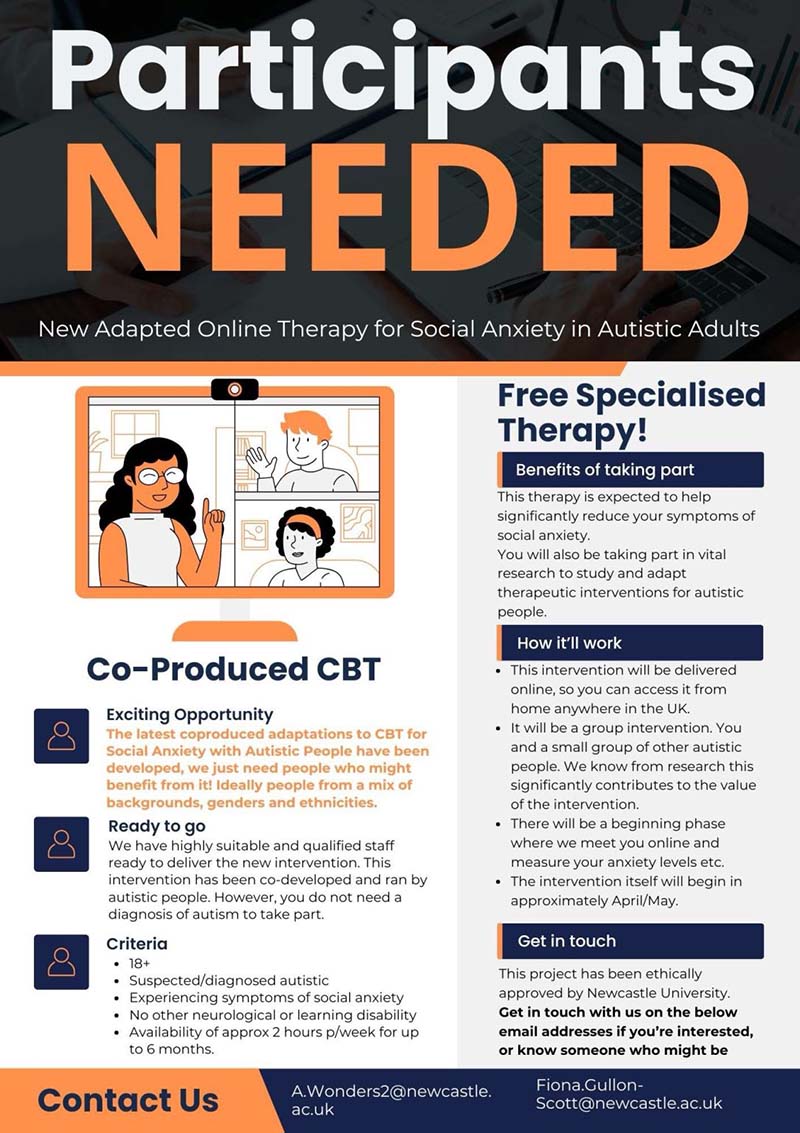
    If you or anyone you know or work with may benefit from free co-produced/specialised therapy for social anxiety disorder in autistic people, we’re looking for participants!

    *We’re particularly keen on recruiting a diverse sample if possible. So to any clinicians on my LinkedIn if you can think of any of your clients who may benefit from this, do let me know.*

    Inclusion criteria:

    • Age 18+
    • Access to computer/online
    • Either diagnosed or suspected autism (clinical diagnosis not required)
    • Currently experiencing anxiety in social situations
    • Availability of up to 2 hrs p/week for 6 months. (In reality it will be much less than this, but this is the maximum ball-park so people can plan ahead)
    • Not diagnosed with a learning disability or neurological condition, and no current acute suicidal ideation or self harm (this is for risk management purposes)

    Get in touch via the email provided in the poster if interested, and feel free to share 😊


    Share This Post:
    Facebooktwitterlinkedinmail
  • No one wins when autistic people face #AConstantFight for support – NAS

    No one wins when autistic people face #AConstantFight for support – NAS


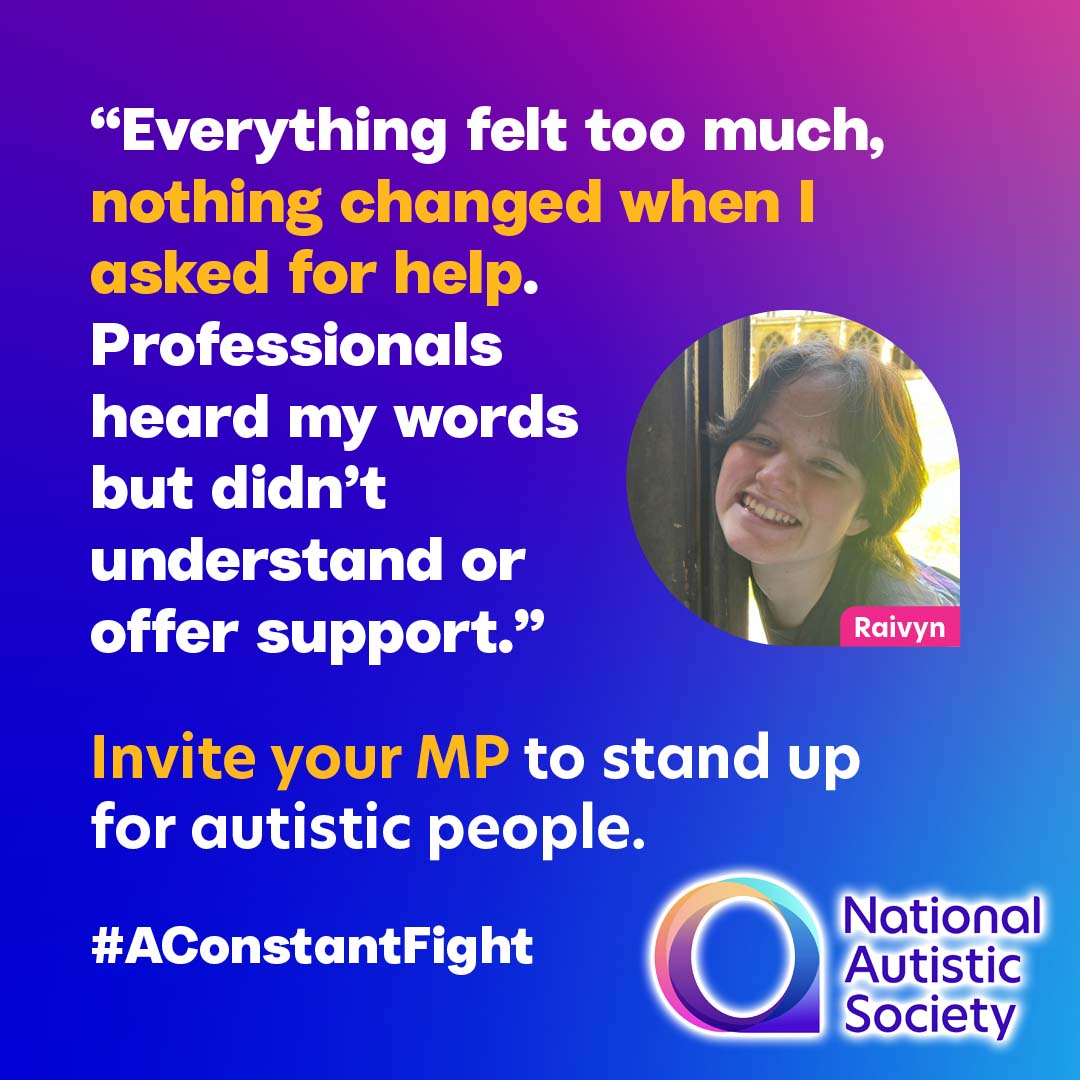
    Autistic people and their families are facing #AConstantFight for support. From diagnosis, to education, to healthcare, employment and beyond, as soon as one round ends, it feels like another starts.

    We are hosting an event in parliament to make sure every MP understands the reality, impact and what they can do. Will you make sure your MP is there?

    • Nearly nine in ten people wait longer than the recommended 3 months for an autism assessment
    • More than one in four parents wait over three years to receive support for their child at school
    • Only three in ten autistic people are in work
    • 77% of autistic adults waiting for community care reach crisis point before they get help
    • 80% of autistic adults report difficulty visiting a GP.

    Nothing is working as it should, and autistic people are bearing the brunt of a broken system. This can’t go on. We need your help to show all MPs how much this means to their constituents. Can you help us by sending an invitation to your MP?

    Thanks for taking action,

    Ella
    Campaigns Manager


    Share This Post:
    Facebooktwitterlinkedinmail